Friday, September 04, 2020

Music Friday: Mama Rose Calls Mr. Goldstone 'a Gem' in Broadway Revival of 'Gypsy'

Welcome to Music Friday when we bring you fun songs with jewelry, gemstones or precious metals in the lyrics or title. Today, Tony Award winner Patti LuPone calls Mr. Goldstone "a gem" in a witty tune from the 2008 revival of the 1959 Broadway musical, Gypsy. In the song "Have an Eggroll, Mr. Goldstone," LuPone as Mama Rose tries secure a contract with the Orpheum Circuit executive by showering him with flattery and offering all kinds of leftovers from a take-out dinner.

With music by Jule Styne and lyrics by Stephen Sondheim, Gypsy follows the lives of Rose, the ultimate show business mother, and her two daughters, June and Louise, as they navigate the vaudeville circuit during the early 1920s. Jammed into a small apartment, Rose and her girls are caught off guard when Rose's boyfriend, Herbie, and Goldstone come by unannounced. Playwright Arthur Laurents cleverly uses the name Goldstone to convey the character's wealth and power.

LuPone and the cast of Gypsy sing, "There are good stones and bad stones / and curbstones and gladstones / and touchstones and such stones as them / There are big stones and small stones / and grindstones and gallstones / but Goldstone is a gem!"

Gypsy opened to rave reviews on Broadway in 1959 with Ethel Merman in the lead role. Rosalind Russell and Natalie Wood starred in the big screen version of Gypsy in 1963 and the stage show returned to Broadway in 1974, 1989, 2003 and 2008. LuPone's portrayal of Rose won her a Tony Award for Best Actress in a Musical. Critics have called Gypsy the greatest American musical.

Trivia: The Northport, NY-born LuPone played the part of Louise in a high school production of Gypsy when she was 13 years old.

More trivia: "Have an Eggroll, Mr. Goldstone" is the fifth song of Act I in the 2008 revival of Gypsy. The original name of the song was "Mr. Goldstone, I Love You."

Please check out the audio clip of LuPone and the 2008 Broadway cast of Gypsy singing "Have an Eggroll, Mr. Goldstone." The lyrics are below if you'd like to sing along...

"Have an Eggroll, Mr. Goldstone"
Written by Jule Styne and Stephen Sondheim. Performed by Patti LuPone and the Broadway cast of Gypsy.

Have an eggroll, Mr. Goldstone.
Have a napkin, have a chopstick, have a chair.
Have a spare rib, Mr. Goldstone.
Any spare that I can spare I'll be glad to share!

Have a dish, have a fork, have a fish, have a pork.
Put your feet up. Feel at home.
Have a smoke, have a Coke.
Would you like to hear a joke?
I'll have June recite a poem!

Have a lychee, Mr. Goldstone.
Tell me any little thing that I can do.
Ginger peachy, Mr. Goldstone.
Have a kumquat, have two!
Everybody give a cheer.
Santa Claus is sitting here.
Mr. Goldstone I love you!

Have a Goldstone, Mr. Eggroll.
Tell me any little thing that I can do.
Have some fried rice, Mr. Soy Sauce.
Have a cookie, have a few!
What's the matter, Mr. G?
Have another pot of tea.
Mr. Goldstone I love you!

There are good stones and bad stones
and curbstones and gladstones
and touchstones and such stones as them.
There are big stones and small stones
and grindstones and gallstones,
but Goldstone is a gem!

There are milestones, there are mill stones.
There's a cherry, there's a yellow, there's a blue.
But we don't want any old stone,
only Goldstone will do!
Moonstones, sunstones.
We all scream for one stone.
Mr. Goldstone we love you!
Goldstone!

Credit: Screen capture via YouTube.com.

Wednesday, September 02, 2020

Birthstone Feature: 'Blue Belle of Asia' Crushed the Sapphire World Record in 2014

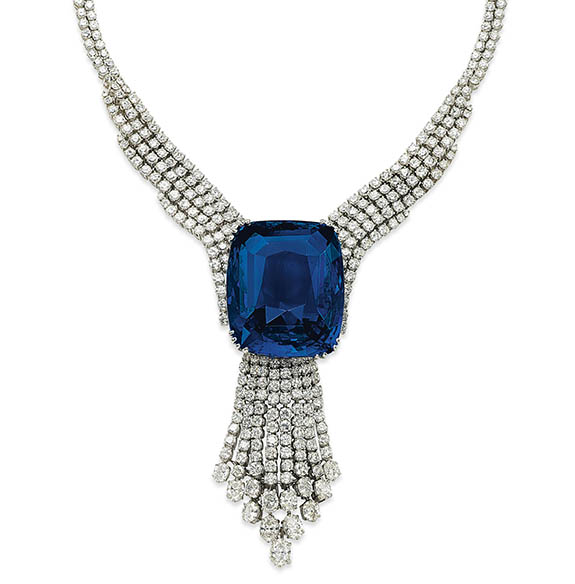
In honor of September's official birthstone, we're revisiting a magnificent 392-carat blue sapphire that smashed an auction record when it sold for $17.3 million at Christie's Geneva in 2014. It remains the highest price paid at auction for a sapphire.

Named the "Blue Belle of Asia," the cushion-cut, cornflower blue Ceylon sapphire fetched nearly twice its pre-sale high estimate of $9.9 million.

When the tense bidding session was completed on November 11, 2014, Rahul Kadakia, International Head of Christie’s Jewelry Department, slammed down his gavel and proclaimed, "The private collector, seated in the room, is now the new owner of the most valuable sapphire in the world."

The stone has a provenance dating back 94 years. Blue Belle of Asia was discovered in 1926 at Pelmadula, Ratnapura (The City of Gems) in Ceylon (now known as Sri Lanka). It was originally owned by famous gem and jewelry dealers O.L.M. Macan Markar & Co., based in Colombo, Sri Lanka. According to Christie's, the Blue Belle of Asia was cut and polished to its current size and shape between 1926 and 1928.

British automobile magnate Lord Nuffield purchased the gem in 1937 with the rumored intentions of presenting it to Queen Elizabeth on her coronation day in May of that same year. The Queen never took possession of the stone and it subsequently “disappeared” into private hands. Its location remained a mystery for the next 35 years. In the 1970s, the stone curiously turned up in the notes and drawings of Swiss gem dealer Theodore Horovitz, although the owner remained anonymous.

After 40 more years in the shadows, the formidable gem finally returned to the limelight in 2014 as the headliner of the Christie's high-profile Geneva event.

The Blue Belle of Asia is the centerpiece of a majestic diamond necklace featuring nine tassels adorned with brilliant-cut diamonds. Each tassel terminates in a larger oval-cut diamond.

All sapphires are made of the mineral corundum (crystalline aluminum oxide). In its pure state, the corundum is colorless, but when trace elements are naturally introduced to the chemical composition, the results are magical and colorful. Trace elements like iron, titanium, chromium, copper and magnesium give naturally colorless corundum a tint of blue, yellow, purple, orange or green, respectively, according to the American Gem Society. Ruby is the red variety of corundum.

Corundum has a hardness of 9 on the Mohs scale, compared to a diamond, which has a hardness of 10.

In additional to being the official September birthstone, sapphire is also the preferred gem for couples celebrating their 5th or 45th wedding anniversaries.

Credits: Images courtesy of Christie's.

Monday, August 31, 2020

Next Stop on the National Gem Gallery Virtual Tour Is the 'Hall Sapphire Necklace'

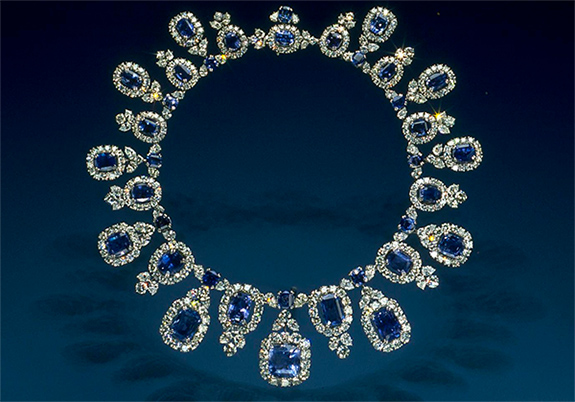
Featuring 36 cushion-cut Sri Lankan sapphires totaling 195 carats, the spectacular "Hall Sapphire Necklace" is the next stop on our virtual tour of the Smithsonian’s National Gem Collection, which resides in the Janet Annenberg Hooker Hall of Geology, Gems, and Minerals in Washington, DC.

The platinum necklace — a gift to the Smithsonian in 1979 by philanthropist Evelyn Annenberg Hall — is accented with 435 pear-shaped and round brilliant-cut diamonds boasting a total weight of 83.75 carats.

(Evelyn Annenberg Hall is the younger sister of Janet Annenberg Hooker and, interestingly, both women have "Hall" connections. Evelyn's last name is Hall, while Janet has a "Hall" named in her honor. The sisters share a famous brother, Walter Annenberg, who owned and operated Triangle Publications, which included TV Guide, The Saturday Evening Post, The Atlantic Monthly, Essence and Seventeen magazine.)

Designed by luxury jeweler Harry Winston, the Hall Sapphire Necklace is arguably the most lavish of the three eye-popping sapphire pieces featured in a display called "Rubies and Sapphires." The other two are the 423-carat "Logan Sapphire" and the 98.57-carat "Bismarck Sapphire Necklace."

While the Smithsonian museums in Washington, DC, remain temporarily closed in an effort to contain the spread of COVID-19, we continue to present these virtual tours of the finest items in the National Gem Collection. Previous stops have included the “Victoria-Transvaal Diamond,” “Carmen Lúcia Ruby,“ “Chalk Emerald,“ “Gifts from Napoleon,“ “Stars and Cat’s Eyes,“ “Logan Sapphire,“ “Dom Pedro“ aquamarine, “Steamboat“ tourmaline and a grouping of enormous topaz.

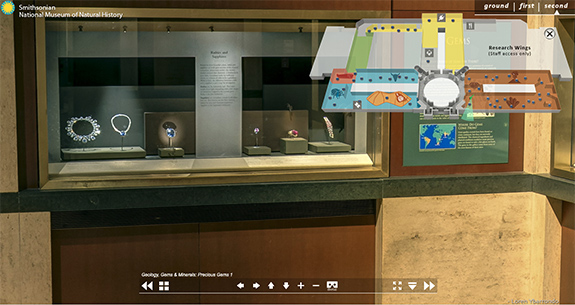
Here’s how to navigate to the exhibit called “Rubies and Sapphires.” The first item in the case is the Hall Sapphire Necklace.

— First, click on this link…

The resulting page will be a gallery called “Geology, Gems & Minerals: Precious Gems 1.”

When you arrive, the foreground in the center of the screen will show a four-sided glass case housing a topaz exhibit. Visible to the right of the topaz display, on the back wall, is a partitioned showcase called “Rubies and Sapphires.” The sapphire items are on the left and the ruby items are on the right.

– Click and drag the screen slightly from right to left and then touch the Plus Sign to zoom in. There you will see the Hall Sapphire Necklace.

(You may touch the “X” to remove the map. This will give you a better view of the jewelry. You may restore the map by clicking the “Second” floor navigation on the top-right of the screen.)

The Hall Sapphire Necklace displays three dozen well-matched sapphires of impressive size and quality. As the Smithsonian notes on its website, Sri Lanka has been an important source of sapphires, rubies and other gemstones for more than 2,000 years. The sapphires from this area are famous for their soft, sky-blue color.

The Smithsonian also explained that the precious stones from Sri Lanka have eroded from the country's central mountains and are picked by hand from alluvial ground deposits.

Evelyn Annenberg Hall passed away in 2005 at the age of 93.

Credits: Jewelry photos by Chip Clark / Smithsonian; Screen capture via naturalhistory2.si.edu.

Friday, August 28, 2020

Music Friday: The Kingston Trio Sings About a 'Priceless Gem of Perfection'

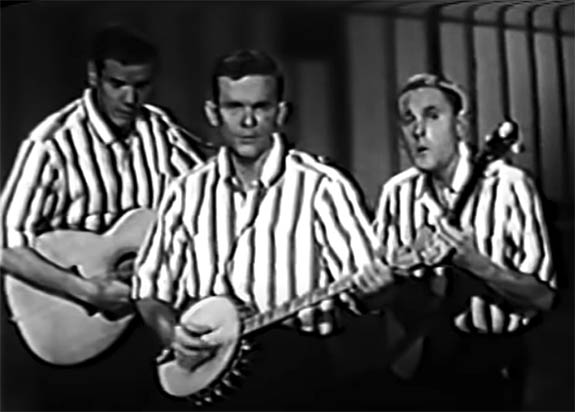
Welcome to Music Friday when we bring you throwback songs with jewelry, gemstones or precious metals in the title or lyrics. Today, we flip the 45 of The Kingston Trio's 1958 chart-topping hit, "Tom Dooley," to find a surprising gem of a song on the B-side, "Ruby Red."

Writers Lee Pockriss and Paul Vance employ rubies, diamonds, emeralds and sapphires in the lyrics to describe the one that got away.

Dave Guard, Bob Shane and Nick Reynolds of The Kingston Trio sing, "Ruby red were her lips. Diamond pure was her heart / Emerald green (emerald green) was the color of her eyes / A priceless gem of perfection, but I lost her 'neath the sapphire sky."

"Ruby Red" earned tremendous exposure on the B-side of a record that would sell more than three million copies and top the charts in five countries, including the U.S., Canada, Australia, Norway and Italy.

As the following songs attest, there is no shame in being on the B-side of a hit record...

• "Hound Dog," Elvis Presley (1953) / B-side of "Don't Be Cruel"

• "I Saw Her Standing There," The Beatles (1963) / B-side of "I Want To Hold Your Hand"

• "We Will Rock You," Queen (1977) / B-Side of "We Are the Champions"

• "You Can't Always Get What You Want," Rolling Stones (1969) / B-side of "Honky Tonk Women"

"Ruby Red" made its album debut as the 10th track of The Kingston Trio's second live album called Stereo Concert, which was released in 1959.

Only one year later, Pockriss and Vance would score their own #1 hit with "Itsy Bitsy Teenie Weenie Yellow Polka Dot Bikini." Recorded by Brian Hyland, the song became a worldwide smash and sparked the sales of two-piece bathing suits.

The Kingston Trio is credited with launching the folk revival of the late 1950s. The group started as a San Francisco lounge act, but quickly gained international fame. The Kingston Trio received an honorary Grammy in 2011.

Although Shane, the last surviving original member of The Kingston Trio, passed away in January at the age of 85, the band continues to tour with a new cast of musicians.

Please check out the audio track of "Ruby Red." The lyrics are below if you'd like to sing along...

"Ruby Red"
Written by Lee Pockriss and Paul Vance. Performed by The Kingston Trio.

Ruby red, Ruby red

Ruby red were her lips. Diamond pure was her heart
Emerald green (emerald green) was the color of her eyes
A priceless gem of perfection, but I lost her 'neath the sapphire sky
Ruby red, Ruby red, Ruby red

I'd cross the wide Pacific and swim the China Sea
To have those lips of ruby red back here again with me
Ruby red, Ruby red
To have those lips of Ruby red back here, again, with me

Ruby red were her lips. Diamond pure was her heart
Emerald green (emerald green) was the color of her eyes
A priceless gem of perfection, but I lost her 'neath the sapphire sky
Ruby red, Ruby red, Ruby red

I thought I could forget, and so I sailed away, but I lived to regret until this very day
Ruby red, Ruby red
To have those lips of Ruby red back here, again, with me

Ruby red were her lips. Diamond pure was her heart
Emerald green (emerald green) was the color of her eyes
A priceless gem of perfection, but I lost her 'neath the sapphire sky
Ruby red, Ruby red, Ruby red

Ruby red. Ruby red

Credit: Screen capture via YouTube.com.

Wednesday, August 26, 2020

Gal Gadot Becomes the 4th Woman to Ever Wear the 128-Carat 'Tiffany Diamond'

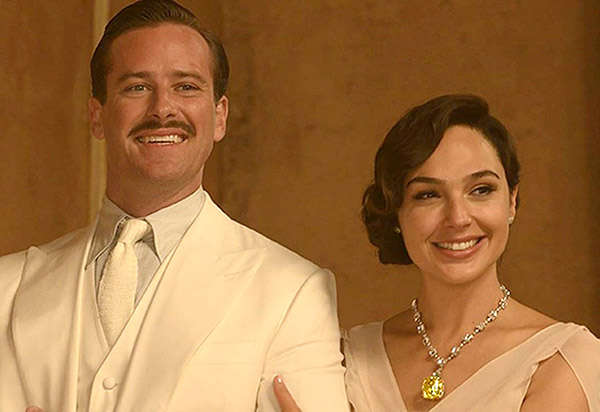
Actress Gal Gadot gets to wear the 128.54-carat "Tiffany Diamond" in the soon-to-be-released big screen adaptation of Agatha Christie's Death on the Nile. The famous — but rarely worn — gem dangles from a platinum necklace featuring an openwork motif of sun rays glistening with 481 diamonds totaling more than 100 carats.

A Tiffany representative told the Hollywood Reporter that the necklace is showcased prominently in the murder mystery, starring Tom Bateman, Kenneth Branagh, Russell Brand, Dawn French, Armie Hammer, Annette Bening, Emma Mackey and Letitia Wright. Gadot plays a glamorous heiress who meets with foul play during her honeymoon aboard a cruise ship on the Nile River.

During its storied 143-year history, the cushion-cut yellow diamond has been worn by only four women. The gem made its first public appearance on the neck of Mrs. E. Sheldon Whitehouse at the 1957 Tiffany Ball. Actress Audrey Hepburn famously wore it in 1961 publicity posters for the motion picture Breakfast at Tiffany’s. And, in February of 2019, Lady Gaga turned heads when she wore it at the 91st Academy Awards.

Gaga revealed in June of this year how The Tiffany Diamond remained on her neck during a Madonna-hosted afterparty — and a late-night excursion to Taco Bell.

“When we were heading to Taco Bell, my car was pulled over, and Tiffany’s security politely removed [the necklace] from my neck,” Gaga said during a virtual appearance on The Graham Norton Show.

Promoted by Tiffany as one of the largest and finest fancy yellow diamonds in the world, the 128.54-carat gem was cut from a 287.42-carat rough stone discovered in the Kimberley diamond mines of South Africa in 1877. It was acquired the following year for $18,000 by Tiffany’s founder, Charles Lewis Tiffany. Today, it's estimated to be worth $30 million.

The rough stone was brought to Paris, where Tiffany’s chief gemologist, Dr. George Frederick Kunz, supervised the cutting of the diamond into a cushion-shape brilliant with an unprecedented 82 facets — 24 more facets than the traditional 58-facet brilliant cut. The stone is just over an inch wide and seven-eighths of an inch from top to bottom.

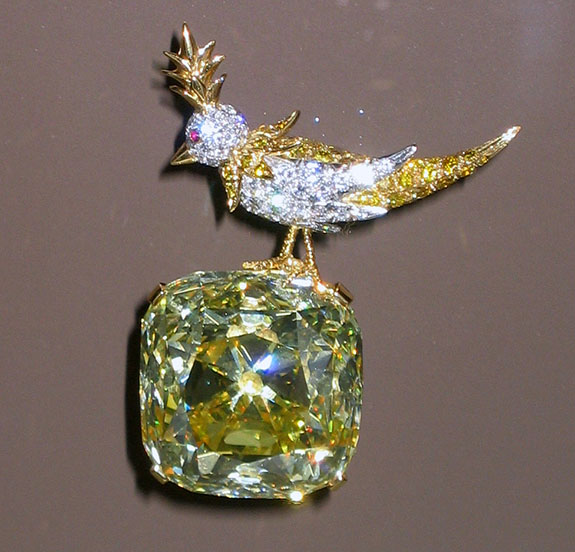
In 1961, the diamond was set in a ribbon rosette necklace to promote Breakfast at Tiffany’s. In 1995, it became part of a brooch called "Bird on a Rock," which was exhibited at the Musée des Arts Décoratifs in Paris.

The Tiffany Diamond necklace worn by Gadot was designed in 2012 to mark Tiffany’s 175th anniversary celebration. When the necklace is not attending the Academy Awards or on a movie set, it can be seen on the main floor of Tiffany's flagship store in New York City.

Death on the Nile is scheduled to hit theaters in October.

Credits: Promotional photo courtesy of 20th Century Studios. Tiffany Diamond image by Shipguy / CC BY-SA.