Friday, April 02, 2021

Music Friday: Duo Promises Gifts of Jewelry in Sam Cooke's ‘Bring It on Home to Me’

Welcome to Music Friday when we feature classic songs with jewelry, gemstones or precious metals in the lyrics or title. Today we shine the spotlight on Marc Broussard and Jamie McLean singing Sam Cooke’s 1962 R&B hit “Bring It on Home to Me.”

Honored as one of The Rock and Roll Hall of Fame's 500 Songs that Shaped Rock and Roll, “Bring It on Home to Me” is a song about a young man who lets the love of his life slip through his fingers. At first, he doesn't take the break-up seriously, but now he'll do anything to get her back.

Broussard and McLean sing, "I’ll give you jewelry, and money too / And that’s not all, all I’ll do for you / Oh, oh, bring it to me / Bring your sweet loving / Bring it on home to me."

The duo delivers a powerful, soulful rendition of the song that employs a call-and-response format. In the original, Cooke teamed up with none other than Lou Rawls.

The original version of the tune topped out at #2 on the Billboard Hot R&B Sides chart and #13 on the Billboard Hot 100. The 2019 rendition appeared as the first track on the Jamie McLean Band's 2019 album, "New Orleans Session." The band is described as a musical gumbo that incorporates New Orleans soul, middle Americana roots, Delta blues and New York City swagger.

Broussard's style has been described as "Bayou Soul" — a Southern-influenced blend of funk, blues, R&B, rock and pop.

While Broussard and McLean injected their own brand of soul into the song, over the past 55+ years the biggest names from every corner of the music world have gravitated to the song. They include The Animals (1965), Sonny & Cher (1966), Otis Redding and Carla Thomas (1967), Aretha Franklin (1969), Lou Rawls (1970), Rod Stewart (1974), Van Morrison (1974), Mickey Gilley (1976), Paul McCartney (1988) and Mandy Moore with Sam Trammell (2017).

Trivia: "Bring It on Home to Me" was actually the "B" side of Cooke's "Having A Party." Both songs became hits.

Please check out Broussard and McLean's studio performance of “Bring It on Home to Me.” The lyrics are below if you'd like to sing along…

“Bring It on Home to Me”
Written by Sam Cooke. Performed by Marc Broussard & Jamie McLean.

If you ever change your mind
About leaving, leaving me behind
Oh, oh, bring it to me
Bring your sweet loving
Bring it on home to me

You know I laughed when you left
But now I know I’ve only hurt myself
Oh, oh, bring it to me
Bring your sweet loving
Bring it on home to me

I’ll give you jewelry, and money too
And that’s not all, all I’ll do for you
Oh, oh, bring it to me
Bring your sweet loving
Bring it on home to me

You know I’ll always be your slave
Till I’m buried, buried in my grave
Oh, oh, bring it to me
Bring your sweet loving
Bring it on home to me

I tried to treat you right
But you stayed out, stayed day and night
I forgive you, bring it to me
Bring your sweet loving
Bring it on home to me

Yeah (yeah), yeah (yeah)
Yeah (yeah), yeah (yeah)…

Credit: Screen capture via YouTube / Marc Broussard.

Wednesday, March 31, 2021

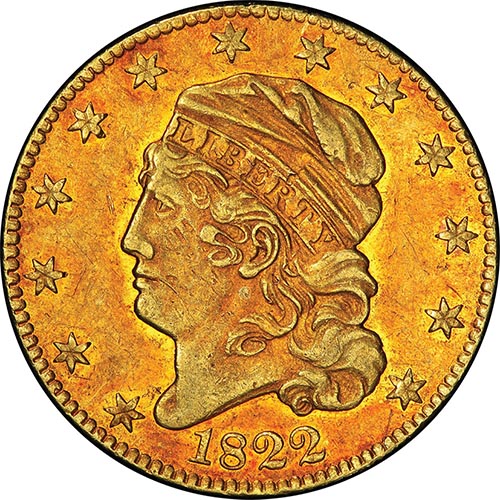
Historic 1822 Half Eagle Gold Coin Sells for Record-Breaking $8.4 Million

The finest known 1822 Half Eagle gold coin set a new world record when an anonymous bidder snatched it up at a Las Vegas auction last Thursday for $8.4 million.

“The 1822 Half Eagle is now the most valuable gold coin minted by the United States ever sold at auction. It’s also now the third-most valuable coin ever sold at auction,” said Brian Kendrella, the president of Stack's Bowers Galleries.

Exactly 17,796 of these $5 coins were minted, but only three specimens are known to have survived. The record holder is the only one owned by a private individual. The other two are permanent residents of the National Numismatic Collection in the Smithsonian Institution.

The privately owned specimen was first acquired by Virgil Brand in 1899 and remained in his vast collection until it was sold by his heirs in 1945.

At that time, it entered the unparalleled collection of Louis E. Eliasberg, Sr., who had the distinction of successfully assembling a complete set of every U.S. coin ever minted.

When the gold coins from the Eliasberg Collection were auctioned in 1982, the successful buyer was the young D. Brent Pogue in the early stages of building what would become the most valuable numismatic collection in history, according to Stack's Bowers Galleries.

Pogue's collection would eventually fetch more than $140 million in a series of sales by Stack's Bowers Galleries from 2015 through 2021.

The newest owner of the 1822 Half Eagle has chosen to remain anonymous.

While the 1822 Half Eagle earned the distinction of being the most expensive GOLD coin ever minted by the U.S, two other coins have sold for more. The 1794 Flowing Hair Silver Dollar — the first dollar coin issued by the United States federal government — realized more than $10 million at an auction at Stack’s Bowers Galleries in January 2013.

The 1787 Brasher Doubloon — a gold coin minted privately by goldsmith and silversmith Ephraim Brasher — earned $9.36 million at Heritage Auctions this past January.

Interestingly, barrons.com reader Stephen Donnelly did the math to determine the compound return for a $5 coin that would eventually sell for $8.4 million. He concluded that the $5 coin returned 7.5% annually over 199 years.

Credits: Images courtesy of Stack's Bowers Galleries.

Tuesday, March 30, 2021

‘The Perfect Palette’ of Colored Diamonds to Be Featured at Christie’s NY

On April 13, Christie’s Magnificent Jewels sale in New York will showcase “The Perfect Palette,” a vibrant trio of colored diamonds that will be sold separately at the auction house's Rockefeller Plaza headquarters.

The most anticipated lot among the three is a 2.13-carat fancy vivid blue diamond that's expected to sell for $2 million to $3 million. The cut-cornered rectangular modified brilliant-cut diamond boasts a clarity rating of VS1.

The second headliner is a cut-cornered rectangular modified brilliant-cut fancy vivid orange diamond that weighs in at 2.34 carats and has a clarity grade of VS1. This gem is expected to fetch between $1.5 million and $2.5 million.

The third featured colored diamond boasts a fancy vivid purplish-pink hue. The cut-cornered square modified brilliant-cut diamond weighs 2.17 carats, carries a SI1 clarity grade and a pre-sale estimate of $1.5 million to $2.5 million.

While fancy colored diamonds will be taking center stage on April 13, white diamonds will surely draw a lot of attention, as well.

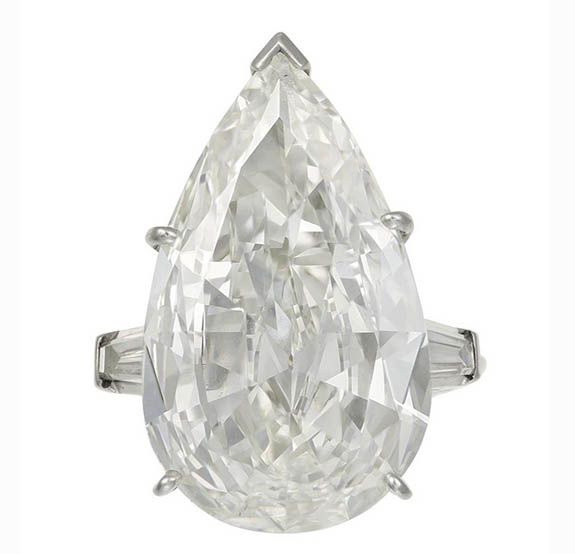
First up is a 38.04-carat pear-shaped, brilliant-cut, D-color, flawless, Type IIa colorless diamond with an estimate of $2.5 million to $3.5 million.

The “Buhl-Mann” diamond ring, featuring a 19.47-carat square emerald-cut center stone, is expected to fetch between $200,000 and $300,000.

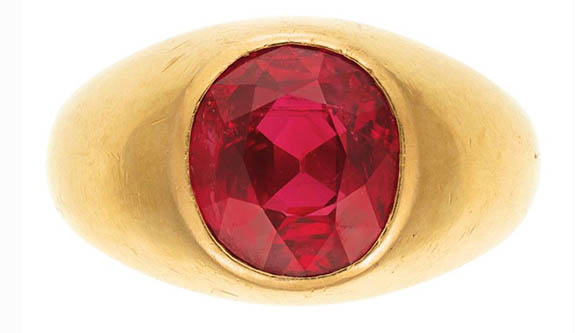
Other important colored gemstones in the sale include an oval mixed-cut Burmese ruby ring by F.J. Cooper. The piece is expected to sell for $1.2 million to $2.2 million.

Credits: Images courtesy of Christie's.

Thursday, March 25, 2021

Spanish Conquistadors Tossed Platinum Aside When Searching for Silver in Colombia

Since the late 1800s, platinum has maintained its stature as the ultimate precious metal due to its rarity, beauty, strength and durability. But it's amazing to imagine that a precious metal that is prominently featured in the world's finest jewelry was once belittled and cast aside by the Spanish conquistadors who encountered the material while mining for silver in Rio Pinto, Colombia. In the 1500s, they named the curious metal "platina" or "little silver." In one version of the story, the conquistadors threw the platinum nuggets back into the river hoping they would ripen into silver.

platinum1

Today, silver is priced at about $25 per ounce, or 2% of the value of platinum.

Throughout history, platinum has been a curiosity. Julius Caesar Scaliger wrote in 1557 that it was a metal which “no fire nor any Spanish artifice has yet been able to liquefy.” In 1748, Spanish scientist Antonio de Ulloa published a scholarly paper that concluded that platinum was unworkable and unmeltable.

It wasn't until the invention of the oxyhydrogen torch in the mid 1800s that jewelers could finally achieve a temperature of 3190 F or 1755 C to melt and work with the noble metal.

By the late 19th century, French jeweler Louis Cartier had catapulted platinum into worldwide prominence by incorporating the precious metal into the designs of his finely crafted, regal creations.

Platinum was loved by a cavalcade of kings and queens. Before long, the most valuable and famous gemstones in the world — including the 45.52-carat Hope Diamond (seen above)— would be set in platinum.

Here are bunch of other fun facts about platinum...

• Platinum is 30 times more rare than gold. If all the platinum ever mined were melted and poured into an Olympic-sized pool, the platinum would barely reach your ankles. Gold, however, would fill three Olympic-sized pools.

• About 80% of the world's platinum is mined in South Africa. The rest is sourced in Russia, as well as North and South America. Platinum is typically the byproduct of mining for other metals, such as copper or nickel.

platinum2

• Platinum typically occurs as small grains and crystals in certain layered igneous rocks. The extraordinarily rare platinum nugget, above, weighs 444.4 grams (just under 1 pound) and is so special that it's on permanent exhibit at the Smithsonian's National Museum of Natural History in Washington, DC.

• 30% of the world's platinum is used for fine jewelry. Half is used for industrial applications, such as catalytic converters, which are the devices on automobiles that filter harmful engine emissions.

• About half of all cancer patients receive treatments that include platinum, according to an article published in the technical journal, Chemical Reviews.

• Platinum is stronger and denser than gold. When platinum is scratched, the material moves aside and no platinum is lost. When gold is scratched, tiny bits flake away. This is why gold rings that are worn for a long period of time often need to be re-shanked.

• Platinum jewelry is typically 90% to 95% pure and includes markings in the band that say "PLATINUM, PLAT, PT, PT950, 950PT or 900PT." Canadian quality marks can say ""platinum," "plat." or "platine." In the UK, the platinum marks will say "850," "900," "950" or "999." Gold purity, on the other hand, is measured in karats. Most commonly, 14-karat gold is 14/24th (58.3%) gold and alloyed with other metals. Eighteen-karat gold contains 75% precious metal.

• Platinum is a true white metal. White gold, by comparison, is actually yellow gold that has been mixed with other white metals and then plated with rhodium to give a bright white appearance. That plating does wear off over time and requires re-plating.

• Platinum is hypoallergenic and an excellent choice for people with sensitive skin or allergies to other metals.

• Platinum is 60% heavier than 14-karat gold. It's a difference you can actually feel.

• Platinum is strong and durable, a great choice for jewelry that will be worn every day. Platinum does an excellent job holding gemstones firmly and securely.

Credits: Photos by Chip Clark / Smithsonian.

Wednesday, March 24, 2021

Archeologists Unearth Cache of 1,300-Year-Old Gold Foil Figures in Sweden

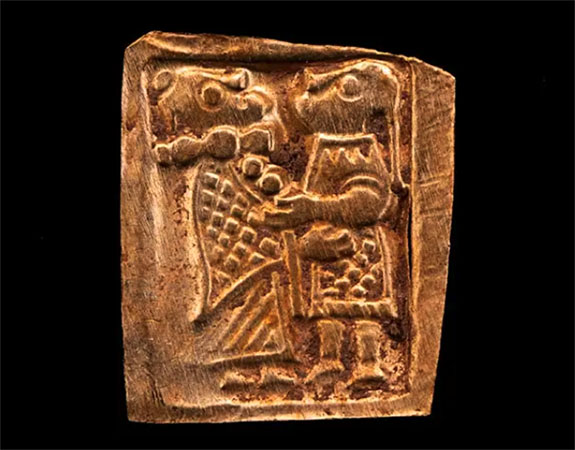
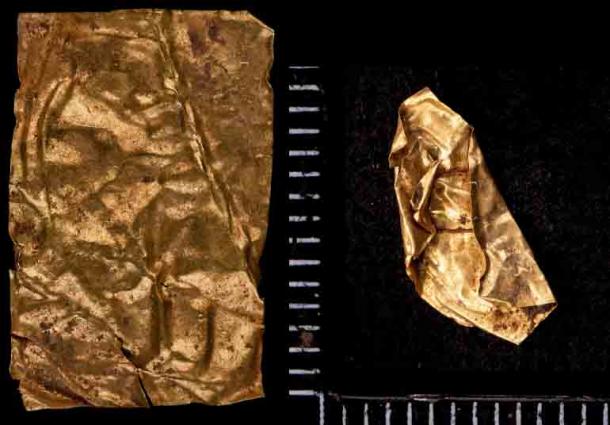
Archeologists in Sweden recently unearthed a cache of wisp-thin gold foil figures at the Aska archeological site in Hagebyhöga. The delicate specimens, which depict embracing couples and date back about 1,300 years, were found at the bottom of post holes in the remains of a great hall at this historic site.

The foil shown, above, was completely unharmed after being buried for more than a millennium. Some foils were badly fragmented. Others were folded with their edges pointed toward the center. Archeologist from the University of Lodz in Poland sought the assistance of a goldsmith to unfold the delicate parcels.

"Our best estimate is that we have 22 foil figures. The exact number is not quite clear because most are fragmented, and there is some uncertainty as to which fragments go together," Martin Rundkvist, an archaeology professor at the University of Lodz, wrote in a report recently uploaded to academia.edu.

Amazingly the combined weight of all the recovered foils was 0.76 grams (about 0.026 ounces).

According to Rundkvist, 15 of the foils have been returned to the full original dimensions. Every one of them depicts an embracing couple. The team believes that the foils were once affixed to the upright posts that supported the great hall. Many of the foils were found at the bottom of seven post holes.

There are a number of theories regarding the identities of the couples stamped into the foil. Some believe the couples are gods or goddesses.

"We do know that kings at the time claimed divine descent," Rundkvist noted. He also speculated that they may depict princes and princesses who were about to get married.

Other scholars believe that the embracing couples may represent the mythological union of the god Freyr and the giantess Gerdr from Norse mythology.

In addition to the gold foils, the archaeologists recovered from the Aska site three spiral “omega” pendants made of iron and two game pieces made of whale bone.

Credits: Complete foil image by Björn Falkevik via Academia.edu. Folded foil images by Björn Falkevik - Cheyenne Olander via Academia.edu.