Wednesday, March 17, 2021

Apple Files Patent for Smart Ring That Can Interpret Hand Gestures

Apple, the tech giant that changed your world with the introduction of the iPhone, iPad, iPod, iMac, AirPods and Apple Watch, just filed a patent for a unique ring that has the ability to interpret hand gestures and interact with other devices.

Technically, Apple describes the ring as "a self-mixing interferometry (SMI) sensor-based gesture input system."

According to pymnts.com, SMI technology sends laser beam pulses out into the world and then, by measuring how long it takes for those beams to return, measures its own orientation in space.

In its patent application, Apple noted that the ring might be used alone or in pairs for AR (augmented reality), VR (virtual reality) and MR (mixed reality) applications.

By wearing two Apple rings — one on the index finger and another on the thumb, the user might move her fingers in the air to imitate the pinching, zooming or swiping action used on actual devices. The ring might also detect an Apple Pencil in the user's hand and be able alter the writing tool's functionality with a flick of the wrist.

Another unique feature of the Apple ring is its ability to sense its position in relation to other devices.

The website ubergizmo.com speculated that the ring could also be used to help tell another device — like a pair of smart glasses — exactly "where" the Apple Pencil is in relation to the glasses so that users could draw virtually in the air.

This is not Apple's first patent for a smart ring, according to pymnts.com. The company filed a patent for a ring with an embedded touchscreen in 2019 and, four years earlier, filed a patent for a ring with a touch display that would be worn on the index finger and controlled with the thumb.

Clearly, Apple has ring-based technology on its radar and its only a matter of time before something very cool is released to the public. We're guessing that a future line of Apple rings will be offered in white, yellow and rose gold. Stay tuned.

Credit: Illustration via United States Patent and Trademark Office.

Monday, March 15, 2021

55.55-Carat Flawless Diamond Is a Fitting Tribute to 100 Years of Chanel No. 5

To mark the 100th anniversary of its Chanel No. 5 perfume, the French luxury house unveiled last week a 55.55-carat, octagonal, D-flawless diamond at the center of a commemorative necklace. The center diamond is framed by 104 round diamonds and 42 baguette diamonds, and when viewed from the side resembles the profile of the perfume bottle's stopper.

Exactly 100 years ago, a 37-year-old Coco Chanel commissioned renowned Russian perfumer Ernest Beaux to create a special scent that she would gift to the regular clientele of her Paris-based fashion boutique. The perfume proved to be so popular with The House of Chanel's customers that Coco decided to offer it for sale in 1922. Since then, Chanel No. 5 in its distinctive rectangular bottle has become the world's bestselling perfume.

The center diamond in the commemorative piece was meticulously cut to weigh exactly 55.55-carats because the number 5 was very special to Coco Chanel.

When Beaux presented her with choices for a signature fragrance, they were numbered 1 through 5 and 20 through 24.

"Number five. Yes," Chanel reportedly said. "That is what I was waiting for. A perfume like nothing else. A woman's perfume, with the scent of a woman."

She added, "I present my dress collections on the fifth of May, the fifth month of the year and so we will let this sample number five keep the name it has already, it will bring good luck."

Some believe that Beaux's winning formula was actually the result of a laboratory mishap. Apparently, Beaux's assistant mistakenly added to the concoction an unusually high dose of aldehyde (a chemical that mimics a soapy-lemony-floral scent).

Gabrielle "Coco" Chanel became the face of the fragrance and was featured in magazine advertisements. The fashion icon passed away in 1971 at the age of 87. In 2020, the brand she created carried a valuation of $13.7 billion.

Credits: Diamond jewelry images by Chanel. Chanel No. 5 bottle image by arz, Public domain, via Wikimedia Commons.

Friday, March 12, 2021

Music Friday: Tom Misch Wants to Stay 'South of the River' Where the 'Loving Is Gold'

Welcome to Music Friday when we bring you groovy songs with jewelry, gemstones or precious metals in the title or lyrics. Today, 25-year-old Tom Misch and hundreds of his fans perform "South of the River," his tribute to South London where the "loving is gold."

For those of you unfamiliar with the geography of London, the city is split horizontally by the Thames River. Historically, South London conjured images of heavy industry and hardscrabble existences, while North London carried an air of posh lifestyles and sophistication. Well, times have changed and South London has undergone a renaissance. It is now widely acknowledged as an artistic and cultural hub.

In his 2017 release, "South of the River," Misch presents his case for why his part of London is the place to be.

He sings, "Watching the sunshine blaze the gray / I don't know why you wouldn't stay / You should come south of the river / Where the loving is gold."

"South of the River" appeared as the third track of Misch's debut studio album, Geography. The album charted in eight countries, including a #2 position on the US Billboard Top Jazz Albums chart and a #8 slot on the UK Albums chart. Interestingly, the young artist released the album through his own label, Beyond the Groove.

The official video is a compilation of clips contributed by Misch's fanbase.

He told The FADER, "When it came to the video, I thought it would be cool to include my fans, so we asked everyone to send in their submissions of their own videos. Nothing too serious, just messing around, miming, dancing etc. I didn't expect such a crazy response! It was a lot of fun piecing them all together, big up to everyone that submitted!"

Thomas Abraham Misch was born in London in 1995. He began learning to play the violin at age 4 and studied music technology at Langley Park School for Boys. In 2014, at the age of 21, he dropped out of a jazz guitar course at the Trinity Laban Conservatoire of Music and Dance to pursue his music career.

The video of Misch and his fans performing "South of the River" has been viewed on YouTube 1.1 million times. Both the video and the lyrics are below…

"South of the River"
Written by Tom Misch, Ed Thomas, Carmody Nathan and Tobie Tripp. Performed by Tom Misch.

I want to stay south of the river
With the chains and the gold
We could be out here together
But, you have places to go

Watching the sunshine blaze the gray
I don't know why you wouldn't stay
You should come south of the river
Where the loving is gold

You should come south of the river
This is where it all starts
I think that we could stay here forever
Lie on the roof 'til it's dark

And when the last bus pulls away
I swear that I almost heard you say
"I should move south of the river."
I want to get to know
I want to get to know, oh

I want to stay South of the River…

Credit: Screen capture via YouTube.com.

Wednesday, March 10, 2021

'Dragon Stone' Plays Central Role in Disney's 'Raya and the Last Dragon'

A radiant, powerful "dragon stone" plays a central role in the newly released — and critically acclaimed — Disney fantasy film, Raya and the Last Dragon.

The stone is a symbol of power and peace in the mythical land of Kumandra. When the stone is fractured, its powers dissipate and the peaceful land becomes vulnerable to the nasty Druun (amorphous, dark purple and black clouds) that have the power to turn their enemies into statues.

In the mythical land of Kumandra, 500 years ago, humans and dragons lived peacefully, but when their land is invaded by the Druun, the dragons sacrifice themselves to save the land and their two-legged friends. The dragons leave behind a glowing, orb-like stone that has the power to keep the Druun at bay. They also leave behind a single dragon named Sisu, who hides away.

Five centuries later, we find the land of Kumandra in turmoil. The divided territory is now run by rival factions. Benja guards the precious dragon stone, but his rivals believe incorrectly that his control of the stone has delivered great wealth. Benja teaches his young daughter, Raya, how to protect the stone. But the youngster is tricked by Namaari, the daughter of the powerful rival, Virana.

The orb is compromised and fractures into several pieces, ruining its ability to hold back the lurking Druun.

The beautifully animated and skillfully voiced movie follows a grown-up Raya and the last dragon (Sisu) as they try to reunite the pieces of the dragon stone while being chased by Virana and Namaari.

As each fragment is collected, Sisu gains the power of one of her fellow dragons and becomes more confident in her abilities. The overall messaging is that of trust, cooperation and compromise for the greater good.

The PG film earned a 96% rating on Rotten Tomatoes. It runs 1 hour 54 minutes and can be seen in theaters and on Disney+.

Credit: Image courtesy of Disney Animation Studios.

Tuesday, March 09, 2021

Gem and Mineral Museum in Tucson Is One Step Closer to Opening

The University of Arizona's Alfie Norville Gem & Mineral Museum, a brand new 12,000-square-foot facility at the historic Pima County Courthouse in downtown Tucson, is one step closer to opening.

With the buildout and renovation complete, the museum staff is now working on completing exhibits and displays. While an opening date for the museum has not yet been determined, UArizona is working closely with Pima County to be able to safely open to the public this year.

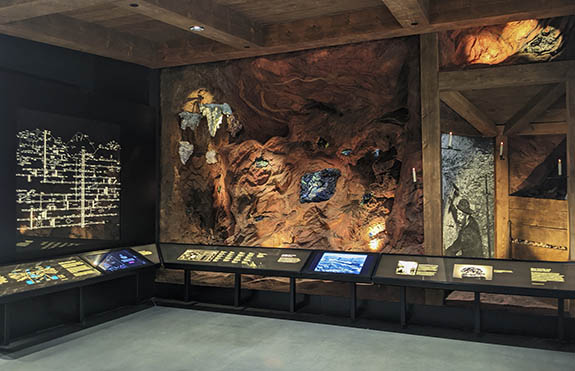
The facility will display more than 2,200 gems and minerals from collections held by the University of Arizona and loan partners. The museum's three main galleries and new showcases will focus on the evolution of minerals, minerals native to Arizona and Mexico, gemstones, jewelry and gem science. Visitors of all ages will be able to take part in hands-on, interactive activities.

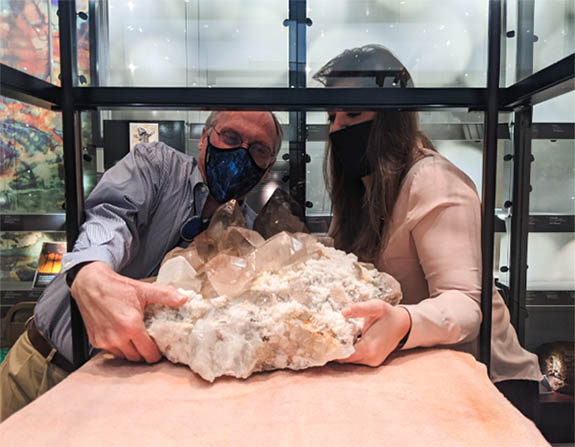
"The vision of creating a world-class gem and mineral museum in the heart of Tucson has reached a significant milestone," said Eric Fritz, manager of the museum. Fritz is shown in the photo, above, adding a large specimen to a display case with the assistance of exhibit specialist Elizabeth Gass. Construction on the museum began in 2018.

Tucson is an ideal location for the museum because each year in February the city transforms into the dynamic center of the gem and jewelry world as 65,000 visitors stream in to participate in dozens of trade shows and exhibitions.

In fact, the Alfie Norville Gem & Mineral Museum is named for the late Alfie Norville, a co-founder of the Gem and Jewelry Exchange show that runs during the annual Tucson Gem, Mineral & Fossil Showcase. An initial gift by the Norville family made it possible for the renovation and the move of the mineral museum from the UArizona campus to downtown Tucson.

Credits: Images courtesy of the Alfie Norville Gem & Mineral Museum.