Monday, December 21, 2020

Amid Pandemic-Spawned Disruptions, Couples Rely on Technology to Find the Perfect Ring

Faced with the pandemic-spawned life disruptions of 2020, tech-savvy millennials and Gen Zers were quick to adapt to the changing retail landscape by utilizing digital resources in their quest for the perfect engagement ring.

According to The Knot's 2020 Jewelry & Engagement Study, the limited ability to shop in person for engagement jewelry led many proposers to use more online features throughout the research process, such as increasing the amount of time spent researching engagement rings online (33%), connecting with jewelers via social media (11%), or even using virtual tools for online consultations with jewelers (10%).

The study of more than 5,000 newly engaged individuals (who got engaged between April and November 2020) analyzed how couples and their proposals were impacted by the COVID-19 pandemic this year. One silver lining of the pandemic is that it offered many couples an additional chance to connect, as quarantine restrictions resulted in the majority of newly engaged couples (68%) spending more time together.

Due to social distancing guidelines and limited in-store appointments, proposers visited fewer retailers in 2020 (on average 2, down from 3 in 2019) and viewed significantly fewer rings (8, down from 15 in 2019) before selecting the one. Overall, the majority (63%) of engagement rings continue to be purchased in person at either a local jeweler (51%) or national retailer (33%). Nearly a third were purchased online.

Uncertainty surrounding the pandemic and the state of the economy only slightly impacted how much couples budgeted for their rings. Respondents said they spent an average of $5,500 on an engagement ring in 2020, compared to $5,900 in 2019. Engagement ring shopping in 2020 continued to be a collaborative effort for most couples, as 72% of proposees reported being involved in the selection of their engagement ring.

Here are some other quick takeaways...

• The most popular center stone cuts were round (43%), oval (15%) and princess/square (13%).
• The most popular setting materials were white gold (48%), yellow gold (16%), rose gold (13%) and platinum (13%).
• The average ring's diamond total weight was 1.5 carats and the average center stone weighed 1.3 carats.

Regarding the actual proposals, 83% of proposers said they felt pressure to curate a highly unique proposal in 2020 (up from 75% in 2019), and nearly half of proposers had to pivot original plans as a result of the pandemic, from changing the location (67%) or date (63%) to involving their loved ones (52%).

Many proposers (48%) had to rethink their proposal plans, as the pandemic altered their original proposal location (67%), date (63%) and how the proposal took place (56%). Despite many proposers needing to alter their original proposal plans, the most popular proposal locations in 2020 remained the same as previous years: scenic viewpoints (31%), at their home (23%), at a place with significance to the couple (16%) and during outdoor activities like hiking (15%, up from 12% in 2019).

The study also revealed that newly engaged couples have an increased sense of urgency to kick-start wedding planning: 8 in 10 newly engaged couples have secured an upcoming wedding date, the majority of which will occur in 2021 (73%), and most (66%, up from 57% in 2019) started to plan their future wedding festivities within one month of getting engaged.

Credit: Image via Bigstockphoto.com.

Friday, December 18, 2020

Music Friday: In Olivia Holt’s 2013 Holiday Release, People ‘Shine Like Diamonds in the Sun’

Welcome to another Christmas season edition of Music Friday, when we bring you festive songs with jewelry, gemstones or precious metals in the lyrics or title. Today, we present former Disney star Olivia Holt performing her holiday release, “Snowflakes,” an inspirational song about how we’re all unique and beautiful in our own ways.

In the first verse, she sings, “Some people spend their whole life in the clouds / Some ride the wind and never hit the ground / Some will shine like diamonds in the sun / Heaven sent down each and every one.”

Songwriters George G. Teren III and Jessi Alexander use diamond and snowflake imagery to deliver a powerful message about how we should embrace the qualities — and flaws — that make us different from the rest.

“Snowflakes” was first heard in 2013 on Disney’s Holidays Unwrapped Christmas Album, which featured performances by a number of popular Disney Channel favorites, such as Debby Ryan, Ross Lynch, Sabrina Carpenter and Zendaya. In 2014, at age 17, Holt released an acoustic version of “Snowflakes” for Disney’s Playlist Sessions. The official video of that performance has accumulated more than 1 million views on YouTube.

The Tennessee-born and Mississippi-raised Holt got her start in show business as a 10-year-old doing commercials for popular toys, such as Bratz dolls and Littlest Pet Shop.

She is best known for her starring roles in the Disney series Kickin’ It and the Disney Channel Original Series, I Didn’t Do It. In 2016, she released her first EP, Olivia, and more recently, she portrayed the titular role Tandy Bowen/Dagger in the Freeform series Cloak & Dagger.

Please check out the video of Holt’s acoustic version of “Snowflakes.” The lyrics are below if you’d like to sing along…

“Snowflakes”
Written by George G. Teren III and Jessi Alexander. Performed by Olivia Holt.

Some people spend their whole life in the clouds
Some ride the wind and never hit the ground
Some will shine like diamonds in the sun
Heaven sent down each and every one

We are snowflakes
Floating till we find our place
From a distance we may look the same,
but we’re beautiful in our own way
We are snowflakes

Will I sparkle, will I drift or will I dance
Will I melt when I touch another’s hand
Will I learn for my mistakes when I fall
And remember when I get to feeling small

We are snowflakes
Floating till we find our place
From a distance we may look the same,
but we’re beautiful in our own way
We are snowflakes

And all I can do is do my best
What it is that makes me different from the rest
And nothing more,
and nothing less

Then snowflakes,
Floating till we find our place
From a distance we may look the same,
but we’re beautiful in our own way
We are snowflakes
Mmm, yeah, snowflakes
Mmm, yeah…

Credit: Screen capture via YouTube.com.

Wednesday, December 16, 2020

It Takes 20,000 Hammer Blows to Make Gold Leaf at This Mandalay Workshop

Wielding seven-pound hammers, rows of young men in a Mandalay workshop rhythmically take aim at their precious targets with the goal of creating the thinnest of gold leaf.

The process starts with tiny squares of 22-karat gold separated from the next by a layer of protective bamboo paper. Hundreds of these gold-and-paper pairs are neatly stacked like pages in a book and then tightly wrapped in a bundle made from deer hide. After 20,000 hammer blows over five grueling hours, the gold is reduced to a thickness of just .0001 inches — about 30 times thinner than a human hair.

Writer and National Geographic fellow Paul Solopek shared his experiences at Myanmar's King Galon Gold Leaf Workshop on the magazine's website.

Solopek reported that the young tradesmen aim for the center of their deer-hide targets to achieve the ideal thinness, as the gold grows hot from the thousands of blows. An antique clock called a clepsydra guides the workday. It is constructed of a coconut shell floating in a bucket of water. The coconut shell has a small hole, which causes it to take on water and sink every hour, signaling a 15-minute break for the workers.

The writer noted that gold leaf manufacturing in Myanmar is many centuries old and is closely associated with Buddhist rituals.

Gold is nature’s most malleable metal. That means that it can be pounded so thin that one ounce of gold could cover about 100 square feet of a surface. The American Museum of Natural History (AMNH) calculated that it would take 576 ounces (or just 36 pounds) of gold to completely cover a football field. The element is also ductile, which means that gold can be made into the thinnest wire. The AMNH notes that one ounce of gold can be drawn into 50 miles of wire, five microns thick.

Edible 24-karat gold leaf has become a culinary treat for over-the-top eateries looking to add a touch of decadence to a main dish, dessert or drink. Gold is tasteless and is not harmful to the digestive system because it is inert.

Please check out this short video of the King Galon Gold Leaf Workshop…

Credits: Screen captures via YouTube.com. Gold leaf photo by Metropolitan Museum of Art, CC0, via Wikimedia Commons.

Monday, December 14, 2020

Diamond Ring Taped to Dollar Bill Makes Season Brighter for Salvation Army

An anonymous donor who taped a diamond engagement ring to a crisp dollar bill and deposited it into a Red Kettle is making the season much brighter for The Salvation Army of Jacksonville and the people it serves.

The Salvation Army’s bell ringing season starts each November and runs through Christmas Eve. While the bulk of donations come in the form of coins and paper money, the most newsworthy ones always contain a bit of bling.

The yellow gold ring, which features a 1.75-carat round solitaire diamond, is valued between $8,000 and $9,000, according to a local jeweler's appraisal. The diamond carries a clarity grade of VVS2 and a color grade of M/N. It was deposited into a Red Kettle at a Publix supermarket in Jacksonville, FL, and the story behind the ring and its anonymous owner remains a mystery, for now.

Kettle counter Kirk Lewis said he was stunned to find a diamond ring taped to a folded dollar bill.

The Salvation Army of Jacksonville plans to auction the ring, with the proceeds going to provide year-round services for thousands of children, families and seniors in the local area. This includes meals, toys and other holiday support for those in need, along with funding for food pantries, soup kitchens, social services and education programs.

“We are encouraged by every donation because it means someone gave of their hard-earned money to help others. We are hoping this diamond ring donation will inspire others to give,” noted Salvation Army Area Commander, Major Keath Biggers.

Biggers added that this year's Red Kettle Campaign has been challenging due to less foot traffic in retail locations due to COVID-19. He also noted that consumers are generally carrying less cash, fewer coins and are doing more electronic transactions.

“In spite of this jeweled donation, the funds raised through The Salvation Army’s iconic Red Kettles are at risk this year due to COVID-19, while requests for services are at an all-time high,” Biggers said.

Credits: Images courtesy of Salvation Army.

Friday, December 11, 2020

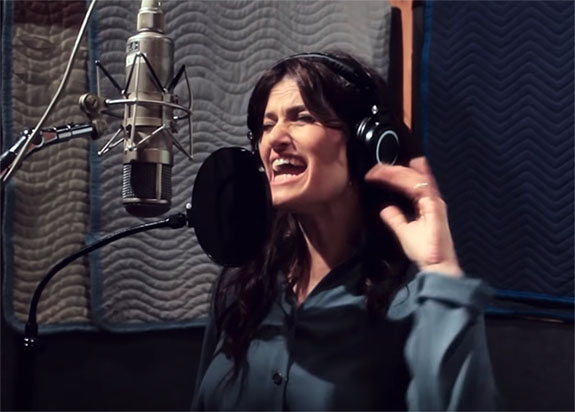
Music Friday: In This Holiday Classic, Idina Menzel Sings, ‘Let Us Bring Him Silver and Gold’

Welcome to a special holiday edition of Music Friday, when we bring you sensational songs with jewelry, gemstones or precious metals is the title or lyrics. Today, we present one of our all-time-favorite Christmas classics, “Do You Hear What I Hear.”

In this song about the birth of Jesus, a shepherd boy tells the mighty king, “Do you know what I know? / A child, a child shivers in the cold / Let us bring him silver and gold / Let us bring him silver and gold.”

The lyrics are based on the Gospel of Matthew (2:11), which recounts the story of the magi — three wise men — who traveled to Bethlehem to deliver gifts of gold, frankincense and myrrh to the Babe in the manger.

Penned by the married couple Noel Regney and Gloria Shayne Baker in 1962, “Do You Hear What I Hear” was intended as a plea for peace during the Cuban Missile Crisis — a time when the US and the USSR were in a tense standoff regarding the Soviet Union’s provocative move to construct ballistic nuclear missile bases in Cuba, just 100 miles from the US mainland.

Baker told the Los Angeles Times years later that neither she nor Regney could perform the song at the time they wrote it. “Our little song broke us up,” she said. “You must realize there was a threat of nuclear war at the time.”

Baker and Regney’s “Do You Hear What I Hear” became one of the most popular Christmas songs of all time. It has sold tens of millions of copies and has been covered by hundreds of artists over the past 58 years.

Crooner Bing Crosby made the song a worldwide sensation in late 1963, when he featured it on his holiday Christmas album and performed it during Bob Hope’s televised Christmas special.

As a holiday treat, we’re presenting two renditions of “Do You Hear What I Hear.” The first, from 2014, is an off-the-charts, full orchestral version by Tony Award-winning Idina Menzel, who is most famous for her Broadway stage roles in Rent and Wicked, as well being the voice of Elsa in Disney's animated musical, Frozen. The second is Bing Crosby’s iconic version from 51 years earlier.

The lyrics are below if you’d like to sing along. Enjoy!

“Do You Hear What I Hear”
Lyrics by Noel Regney. Music by Gloria Shayne Baker. First performance by Idina Menzel. Second performance by Bing Crosby.

Said the night wind to the little lamb,
“Do you see what I see?
Way up in the sky, little lamb,
Do you see what I see?
A star, a star, dancing in the night
With a tail as big as a kite,
With a tail as big as a kite.”

Said the little lamb to the shepherd boy,
“Do you hear what I hear?
Ringing through the sky, shepherd boy,
Do you hear what I hear?
A song, a song high above the trees
With a voice as big as the sea,
With a voice as big as the sea.”

Said the shepherd boy to the mighty king,
“Do you know what I know?
In your palace walls, mighty king,
Do you know what I know?
A child, a child shivers in the cold
Let us bring him silver and gold,
Let us bring him silver and gold.”

Said the king to the people everywhere,
“Listen to what I say!
Pray for peace, people, everywhere,
Listen to what I say!
The child, the child sleeping in the night
He will bring us goodness and light,
He will bring us goodness and light

Idina Menzel (2014)

Bing Crosby (1963)

Credits: Screen capture via YouTube.com/Idina Menzel.