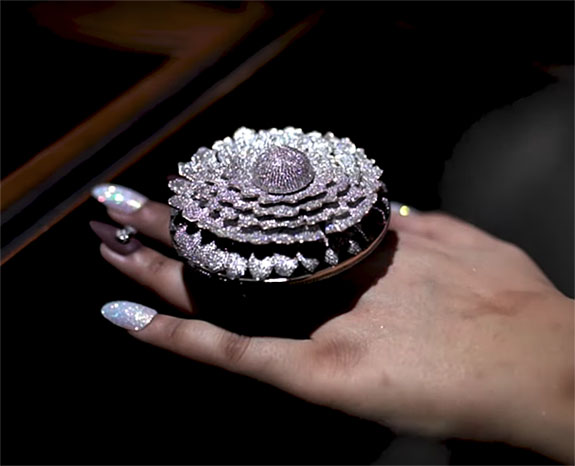
A 25-year-old Indian jeweler just earned a Guinness World Record for his eight-layer floral ring set with 12,638 natural diamonds. Three years in the making, Harshit Bansal's “The Marigold - The Ring of Prosperity” now holds the record for the "Most Diamonds in a Single Ring."
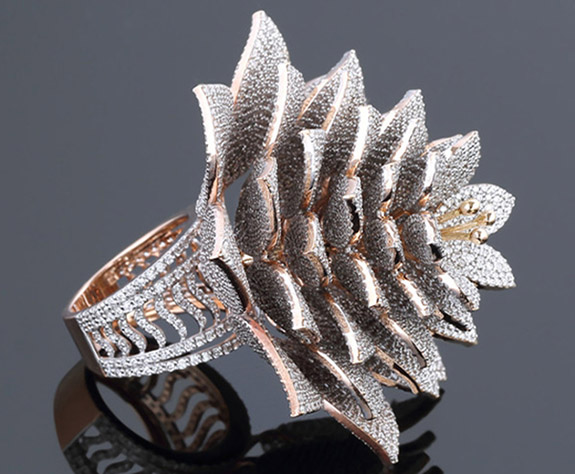
The new titleholder smashed the former record of 7,801 diamonds, which was held for a little more than a month by Indian jeweler Kotti Srikanth. Bansal's "Marigold" boasts 62% more diamonds than Srikanth's “Divine.”
In third place is Lakshikaa Jewels' "Lotus Temple Ring" with 7,777 diamonds.
Bansal, who works for Meerut-based Renani Jewels, told AFP that his dream was always to create a ring with more than 10,000 diamonds. He started formulating his plan while studying jewelry design in Surat.
"I trashed many designs and concepts over the years to finally zero in on this,” he told the news agency.
Bansal noted that the ring weighs 165.45 grams (5.83 ounces) and sparkles with 38.08 carats of diamonds. All the diamonds boast E-F color and VVS clarity.
“It was Renani Jewel’s and Harshit Bansal’s dream to achieve a Guinness World Records title and hope to receive international recognition for the diamond ring which they have created,” according to the Guinness World Record site.
In Indian culture, it is believed that marigolds bring prosperity and luck to everyone's life. According to the designer, each individual petal is uniquely shaped, giving the ring a perfect blend of organic symmetry, design and alignment. Despite its enormous size, Bansal claims that the ring is wearable and very comfortable.
The battle for diamond ring supremacy has seen three new title holders in the past 16 months. They're all India-based and each one used a multi-petal, floral motif to pull off the award-winning designs. In the video, below, you can see that Bansal set diamonds on both the front and back of each petal.
Credits: Screen captures of The Marigold via Youtube.com/Renani Jewels. Divine Ring and Lotus Temple Ring images courtesy of Guinness World Records.
For generations, grooms-to-be have been faced with the daunting task of picking out the perfect engagement ring. Sometimes they got it right and sometimes they got it wrong. With the engagement ring being the second-highest-priced item of all the couple's wedding expenses (the venue is #1), grooms are now acknowledging that they could use a lot of help.
According to a brand new survey commissioned by the Natural Diamond Council and carried out by One Poll, 63% of couples reported that they picked out their precious ring together, rather than having the ring chosen by the partner who would be popping the question.
These results seem to mesh with recent reports from The Knot, which revealed that 7 of 10 “proposees” were “somewhat involved” in selecting or purchasing their engagement ring, and nearly a quarter of that group (23%) said they looked at rings with their partner.
The recent One Poll survey also confirmed that white, colorless diamonds are still overwhelmingly favored by newly engaged couples. Two-thirds of the 2,000 respondents made this more traditional choice.
"Despite all the ways in which our society has evolved over the centuries, the diamond endures as the ultimate expression of love and commitment and the most beautiful way to mark life’s most precious moments," Lisa Levinson of the Natural Diamond Council told harpersbazaar.com.
Survey respondents also noted that clarity was the most important consideration when buying a diamond, followed by the setting type and the uniqueness of the design. Surprisingly, they reported their ideal center stone to be 2.2 carats. This number seems to be high and might reflect a very affluent group of respondents.
The survey also encouraged respondents to reveal their favorite celebrity engagement ring of all time. The Top 10 answers are below…
1. Catherine, Duchess of Cambridge's oval blue sapphire engagement ring
2. Meghan, Duchess of Sussex's trilogy ring with a cushion-cut center diamond flanked by two smaller diamonds
3. Singer Miley Cyrus' 19th century vintage old mine cut diamond in a solitaire setting
4. Model Hailey Bieber's oval-shaped diamond engagement ring
5. Singer Beyonce's 18-carat emerald-cut diamond ring
6. Actress Elizabeth Taylor's Krupp diamond ring
7. Rapper Cardi B's pear-shaped diamond ring with two diamond halos
8. Singer Demi Lovato's multi-carat emerald-cut ring with two smaller diamonds
9. Reality star Kim Kardashian's 15-carat cushion-cut diamond ring
10. Socialite Paris Hilton's 20-carat pear-shaped diamond accented with smaller diamonds
Welcome to Music Friday when we bring you great, new songs with jewelry, gemstones or precious metals in the lyrics or title. Today, country star Russell Dickerson compares his love to a "band of solid gold" in 2020's "Love You Like I Used To," the lead single from his forthcoming album.
When Dickerson delivers the first verse — "Girl, I have always loved you / Oh but something’s changed / Blame it on time, the road or the ride / But it ain’t the same" — the listener is certain that this is going to be another sad break-up song.
But, as he rolls into the chorus, we realized that we've been fooled. "Love You Like I Used To" is really a romantic testament to how love gets better and stronger over time.
He sings, "What we got ain’t got no ending, like a band of solid gold / It’s sweeter with time like strawberry wine / It gets as good as it gets old."
The surprising plot twist wasn't part of Dickerson's original version of the song. He wrote it in January of 2018 and then re-worked the lyrics in September to make the song more reflective of his own relationship with his wife, Kailey.
Dickerson told Billboard magazine that his wife really didn't care for the original version of the song. He recalled her saying, "Oh, I don't think you nailed it on this one."
She loved the revised version, a collaboration with songwriters Casey Brown and Parker Welling.
Dickerson recalled, "When we came back with the song sounding like a breakup song in the first verse and then it hit that twist in the first chorus, it was like boom!"
The song was released in February of 2020 and zoomed to #5 on the Billboard US Hot Country Songs chart and #2 on the Billboard Canada Country chart. "Love You Like I Used To" will be featured on Dickerson's yet-to-be-released second studio album, Southern Symphony.
Russell Edward Dickerson was born in Union City, TN, in 1987. He earned a Bachelor's degree in music from Belmont University and signed a record deal with Creative Artists Agency in 2010. In May of 2013, he married his wife, Kailey.
“Like all of my songs, I’ve lived it," Dickerson said. "I started dating my wife 10 years ago and it is true — I don’t love her like I used to and I think a lot of people will be able to relate to this song.”
Please check out the video of Dickerson performing "Love You Like I Used To." The lyrics are below if you'd like to sing along…
"Love You Like I Used To"
Written by Russell Dickerson, Casey Brown and Parker Welling. Performed by Russell Dickerson.
Girl, I have always loved you
Oh but something’s changed
Blame it on time, the road or the ride
But it ain’t the same
It’s a different kind of feeling
Not the one I knew
From the sweet on your lips
To how your hand in mine fits
Girl, I have always loved you
But I don’t love you like I used to
This gets better every time you kiss me like this
It’s stronger the longer I’m with you, yeah
More than every single day before
Didn’t know I could ever love you more than I did
But baby I do, I don’t love you like I used to, no
What we got ain’t got no ending, like a band of solid gold
It’s sweeter with time like strawberry wine
It gets as good as it gets old
And oh, we thought we knew what it meant way back then
Why would I keep fallin’ all-in higher than I’ve ever been?
Oh no, I don’t love you like I used to
This gets better every time you kiss me like this
It’s stronger the longer I’m with you, yeah
More than every single day before
Didn’t know I could ever love you more than I did
But baby I do, I don’t love you like I used to, no
No, no, no, no
I don’t love you like I used to
This gets better every time you kiss me like this
It’s stronger the longer I’m with you, yeah
More than every single day before
Didn’t know I could ever love you more than I did
But baby I do, I don’t love you like I used to
I don’t love you like I used to
(I, I love you like, love you like, love you like, love you like)
No, no, no, no
(I, I love you like, love you like)
Love you like I used to, no
(I, I love you like, love you like)
Oh, I don’t
Love you like I used to
Credit: Screen capture via YouTube.com/Russell Dickerson.
Looking for a great holiday gift for the diamond lovers in your life? Check out the newly published Diamonds Across Time, a stunning 432-page coffee-table book that celebrates every aspect of history’s most coveted precious stone.
Featuring 10 richly illustrated essays by world-renowned scholars who are united by their deep affection for diamonds, the book looks back on history and trade, investigates the nature of diamonds, reviews legendary gems, celebrates jewelry collections and spotlights great designers. The volume places diamonds in the context of the political, social and cultural stage on which their histories were etched. The contributors tell the human stories that underpin the world's adoration of diamonds.
The glossy pages pop with high-quality photographs of gems and jewels, archival documents and rare drawings.
The hardcover book was compiled and edited by the World Diamond Museum’s chief curator and world renowned jewelry expert Dr. Usha R. Balakrishnan, who contributed her own monograph titled The Nizam Diamond, Bala Koh-i-noor, the Little Koh-i-noor in the Sacred Trust of the Nizam of Hyderabad.
Other topics include the following:
• Diamonds of the French Crown Jewels – between West and East, by François Farges;
• A Concise History of Diamonds from Borneo, by Derek J. Content;
• Indian Diamonds and the Portuguese during the rise of the Mughal Empire, by Hugo Miguel Crespo;
• Two Large Diamonds from India, by Jack Ogden;
• The Romanov Diamonds – History of Splendour, by Stefano Pappi;
• The Londonderry Jewels 1819-1959, by Diana Scarisbrick;
• Dress to Impress in South East Asia, by René Brus;
• Powerful Women Important Diamonds, by Ruth Peltason;
• One in Ten Thousand; the Unique World of Coloured Diamonds, by John King.
“The establishment of the World Diamond Museum marks the first step in the long journey to reignite the passion for diamonds, chronicle traditions, explore cultures and show the eternal relevance of beauty, even in present times,” wrote Alex Popov, Founder of the World Diamond Museum, in the book’s foreword. “This volume unites diverse stories that reveal the many meanings of the diamond and how human emotions and beliefs are reflected in its thousands of facets. The book is illustrated with incredible photographs of rarely seen gems and jewels from closely held collections and reconstructions of historical diamonds, done with the help of state-of-the-art computer technology.”
Diamonds Across Time may be purchased at this website. The cost is £95 (about $127.55) and shipping to the US is approximately $35.
Credit: Image courtesy of the World Diamond Museum.
During the thrilling season finale of Outback Opal Hunters, 21-year-old Sam Westra and his mentor Pete Cooke discovered a 45-carat double-faced black opal valued at AU$120,000 (about US$89,000).
The "life-changing" find marked a 180-degree turn of fortune for the team that had suffered through a woeful three-month period of losing money in Australia's remote and inhospitable interior.
Fans of the Discovery Channel's hit reality TV show have been rooting for the likable team from Lightning Ridge, NSW. The success of their entire season hinged on their final cleanup — four tons of fractured stones collected from the 100-year-old open cut mine they call "Old Nobbys."
"Plenty of material, just potch everywhere," said Westra as he and Cooke began the sorting process in the video below. "Just got to get the big one, mate. Where's the big one?"
Potch is the term for the near-worthless rocky material that has the same chemical makeup as precious opal with one critical difference. With potch, the tiny silica spheres that make up the stones are jumbled. In precious opal, they’re all laid out evenly, which gives the structure the ability to break visible white light into separate colors.
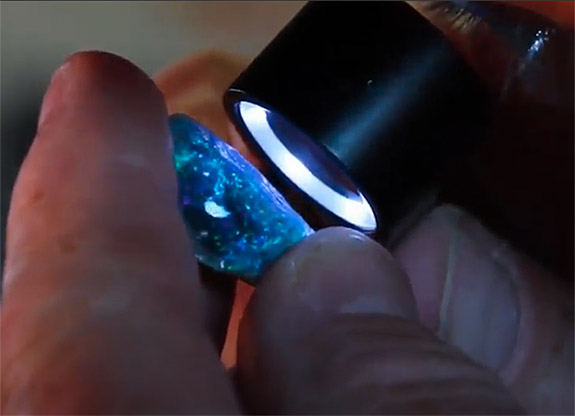
Within a few minutes, Cooke encountered a small, but valuable, stone that presented hints of green, blue, red and orange.
"There's a gem there for sure. We're on the money, mate," said Cooke. "This is fantastic."
But then the mining veteran turned absolutely giddy when he spied the "king stone," the best stone of his parcel.
"These come up two or three a lifetime, if you’re lucky,” said the gleeful Cooke as he rotated the stone for the Discovery Channel's viewers.
Although initially valued at AU$55,000 on camera, the team later met with an opal carver who confirmed that the actual value was AU$120,000. The gem, which Cooke dubbed "Fire and Ice" because of its brilliant flashes of red and deep blue, is the most valuable opal unearthed to date by any of the Outback Opal Hunters.
About 90% of the world’s finest opals are mined in the harsh outback of Australia, where a unique combination of geological conditions permitted the formation of opal near the margins of an ancient inland sea.
Scientists believe that between 100 million and 97 million years ago, Australia’s vast inland sea, which was populated by marine dinosaurs, began retreating. As the sea regressed, a rare episode of acidic weather was taking place, exposing pyrite minerals and releasing sulphuric acid. As the surface of the basin dried further and cracked, silica-rich gel became trapped in the veins of the rock. Over time, the silica solidified to form opals.
Outback Opal Hunters has entertained audiences in more than 100 countries and territories.
Please check out this clip from the season finale of Outback Opal Hunters.