Wednesday, January 08, 2020

Tsavorite's Name Honors the Kenya-Tanzania Border Region Where It Was Discovered

Tsavo National Park on the border of Kenya and Tanzania is home to lions, black rhinos, cape buffaloes, elephants and leopards. The more mountainous western section of the park is also the singular source of a gorgeous variety of green garnet called tsavorite.

Best known as January's official birthstone, garnet comes in a wide array of natural colors, including deep red, pink, purple, orange, yellow, violet, black, brown — and a vivid shade of green that is sometimes mistaken for an emerald.

Tsavorite is technically a green variety of grossular, a calcium-aluminum garnet that derives its rich color from impurities of vanadium and chromium in its chemical structure.
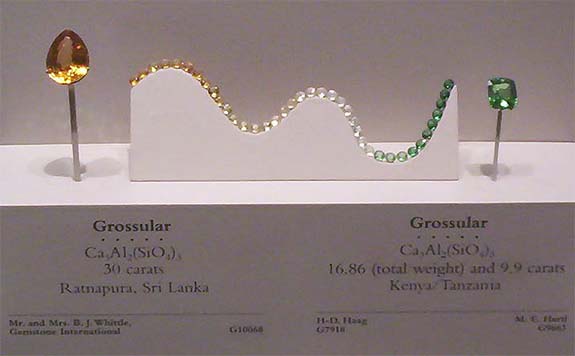
This exhibit at the National Museum of Natural History in Washington, D.C., shows the many shades of grossular garnet — from hessonite (yellow) at the far left to leuco-garnet (clear) in the center to tsavorite (green) at the far right.

According to the Smithsonian's official website, tsavorite was first discovered in 1967 in northern Tanzania and again in 1970 in Kenya’s Tsavo National Park by world renowned geologist, Campbell Bridges. In 1971, Bridges was granted a permit to mine the Kenyan deposit, and in 1973, this variety of green garnet was named tsavorite in honor of Kenya’s Tsavo National Park, by Henry B. Platt, former president of Tiffany & Co., and Bridges, founder of Tsavorite USA. One year later, Tiffany launched a marketing campaign that brought worldwide recognition to the beautiful green gem.

The 7.08-carat tsavorite garnet seen here is on display at the National Museum of Natural History and was donated to the Smithsonian in 1981 by Dr. and Mrs. Marshall Greenman. The gem is set in an 18-karat yellow gold ring and is surrounded by 16 round brilliant diamonds.

Garnets get their name from the Latin word “granatum,” meaning pomegranate seed.

In addition to tsavorite garnets, other varieties often seen in jewelry include pyrope, almandine, andradite, demantoid, grossularite, hessonite, rhodolite, spessartine and uvarovite.

Credits: Tsavorite specimen image by Rob Lavinsky, iRocks.com – CC-BY-SA-3.0 [CC BY-SA]. Display by Alkivar at English Wikipedia [Public domain]. Map by Lencer [CC BY-SA]. Ring photo by Ken Larsen/Smithsonian.

Monday, January 06, 2020

Actor Wilmer Valderrama Proposes to Model Amanda Pacheco With Pear-Shaped Diamond

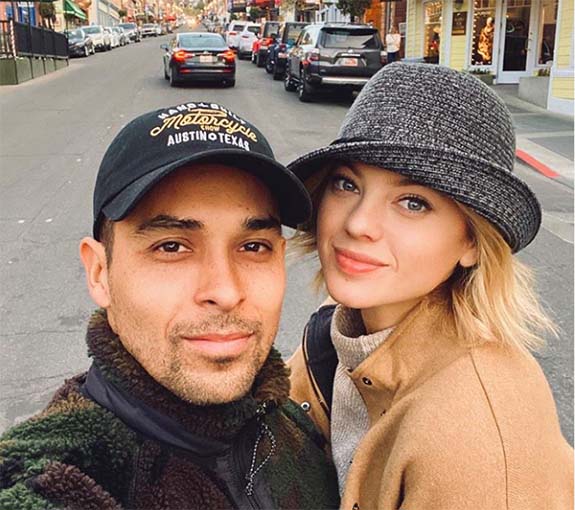
Actor Wilmer Valderrama rang in the New Year by proposing to model Amanda Pacheco with a 4-carat pear-shaped diamond ring. Valderrama announced the engagement with a picture-postcard-worthy addition to his Instagram page, which boasts 1.7 million followers.

Set on the coast of La Jolla, Calif., the photo captures the exact moment when the That ’70s Show star popped the question to Pacheco. The couple is shown in silhouette against a wondrous sky of puffy clouds. Pacheco is standing barefoot on a rocky outcrop while locking eyes with Valderrama, who is on bended knee, clutching an open ring box in his right hand.

He captioned the post, "'It’s just us now' 01-01-2020,” and punctuated the phrase with a blue diamond ring emoji.

On Pachecho's Instagram page (43,600 followers), the model posted the same dramatic photo and caption, but added a closeup shot of the ring, which features the prominent center stone set against a delicate diamond band crafted in rose or yellow gold. Jewelry-industry insiders estimated the pear-shaped diamond's weight at 4 carats and the ring's value at about $100,000.

According to experts contacted by People magazine, the pear-shaped diamond is making a comeback, thanks to high-profile celebrities, such as reality star Kelly Dodd, rapper Cardi B and supermodel Natalia Vodianova — all of whom were recently engaged with diamonds of that shape.

The Knot’s "2019 Jewelry and Engagement Study" recently revealed that the pear shape was the choice of 5% of recently married or engaged couples. That percentage places the diamond shape fifth in popularity, trailing the round brilliant (47%), princess/square (14%), oval (14%) and cushion (9%).

Many brides prefer fancy shapes because they add a sense of personality to their rings and because they tend to look larger than round diamonds of equal carat weight, giving the fancies more bang for the buck.

Valderrama, 39, and Pacheco, 28, had been dating since the spring of 2019. Valderrama had previously dated singer Demi Lovato, a relationship that lasted six years and ended in June of 2016.

Credits: Images via Instagram.com/seaweanie.

Friday, January 03, 2020

Music Friday: Jason Derulo Borrows Iconic Ad Slogan for His New Release, 'Diamonds'

Welcome to Music Friday, when we bring you hot, new songs with jewelry, gemstones or precious metals in the title or lyrics. In Jason Derulo's brand new release, "Diamonds," the singer lavishes praise on his girlfriend with a borrowed phrase from what Ad Age magazine called the best advertising slogan of the 20th century.

Penned for a De Beers marketing campaign in 1947 by NW Ayer copywriter Mary Frances Gerety, the brilliant four-word tagline “A Diamond Is Forever” has inspired an Ian Fleming novel, a James Bond flick, an iconic theme song by Shirley Bassey... and a new tune by Derulo.

He sings, "Flawless like diamonds / Out of all the ones I've seen, you are the finest / I can’t buy your heart; your love is priceless / Diamonds are forever / Diamonds are forever."

Written by Derulo, 1Mind, Rogét Chahayed and Shawn Charles, "Diamonds" is the sixth track on Derulo's extended play called 2Sides. As its title implies, 2Sides will, in fact, have two sides, the first of which was released in November of 2019. The second EP is due later this month.

Born Jason Joel Desrouleaux in Miramar, Fla., the 30-year-old singer-songwriter-dancer-choreographer, has sold more than 30 million singles since launching his solo career in 2009. He changed his last name to Derulo because the French spelling was too hard to pronounce.

Derulo majored in musical theater at the American Musical and Dramatic Academy in Manhattan and got his big break when he won the grand prize on the 2006 season finale of the TV show Showtime at the Apollo. That exposure led to a recording contract with Beluga Heights Records and Warner Bros. Records.

When asked which artists have had the biggest influence on his music, Derulo cited Michael Jackson, Elvis Presley, Madonna, Prince, Usher and Justin Timberlake.

Please check out the official lyrics video of “Diamonds.” The lyrics are also noted below if you’d like to sing along…

"Diamonds"
Written by Jason Derulo, 1Mind, Rogét Chahayed and Shawn Charles. Performed by Jason Derulo.

Flawless like diamonds

Girl you are
Flawless like diamonds
I’m nothing without you
You keep me shining
I can’t buy your love; your heart is priceless
Diamonds are forever
So I know you'll stay this way

Flawless like diamonds
Out of all the ones I've seen, you are the finest
I can’t buy your heart; your love is priceless
Diamonds are forever

Got me shining, yeah
Shining, shining, yeah
Girl, you the baddest, yeah (Yeah)
Diamonds are forever, diamonds are forever (Yeah)

Baby, baby
I need you daily
The love we makin' changed me, changed me
'Cause you remind me of a melody
That kind you keep on singing, singing
My pretty lady
You know you make me better
Better then I’ve ever been
There’s no mistaking
You should be famous
‘Cause baby, you are

Flawless like diamonds
I’m nothing without you, you keep me shining (yeah)
I can’t buy your love; your heart is priceless
Diamonds are forever
So I know you’ll stay this way
Flawless like diamonds
Out of all the ones I've seen, you are the finest (Yeah)
I can’t buy your heart
Your love is priceless
Diamonds are forever
Diamonds are forever, yeah

Got me shining, yeah
Shining, shining, yeah
Girl, you the baddest, yeah (Yeah)
Diamonds are forever

This love is forever
This love is forever, babe
‘Cause you make me better (Ooh-hoo)
Diamonds are forever (Ooh-hoo)
Diamonds are forever, no, no
Woo, oh
Diamonds are forever
Diamonds are forever, babe
No, no
Diamonds are
Oh-oh
Diamonds

Credit: Image by MTV International [CC BY 3.0], via Wikimedia Commons

Tuesday, December 31, 2019

Year in Review: These Are the Rough Diamonds That Rocked Our World in 2019

Welcome to our year-end review of the rough diamonds that rocked our world in 2019. Each is unique in its own way and has a fascinating story to tell...

Diamond in a Diamond.
Revealed to the world via a social media post, Alrosa's “diamond in a diamond” is a head-scratching, natural phenomenon that rates #1 in our survey.

Alrosa had surprised its Instagram followers in September with a video that seemed to show a tiny rough diamond moving freely in the cavity of a larger one. The caption read, “A diamond in a diamond? We couldn’t help but share this very special find with you.”

After its scientists confirmed that both the host and smaller crystal were diamonds, Alrosa named the double-diamond “Matryoshka” because its strange configuration was reminiscent of the popular Russian nesting dolls. In November, the Russian mining company added the 0.62-carat specimen to its collection of rare finds and declared that it was not for sale.

World's Second-Largest Rough Diamond.
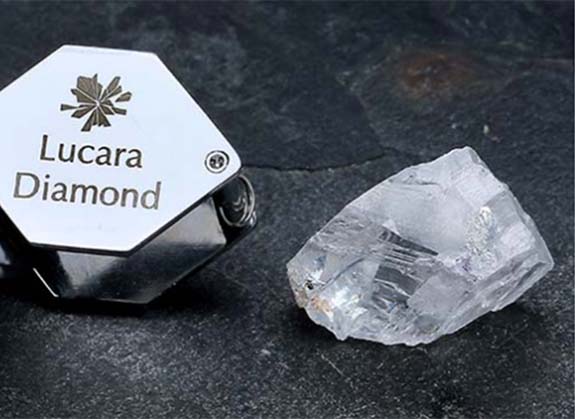
In April, Lucara recovered a massive 1,758-carat grey-black diamond from its Karowe mine in Botswana and, in July, the world's second-largest rough diamond was named “Sewelô,” which means “rare find” in the native Setswana language.

Sewelô is the size of a tennis ball and weighs about 12.4 ounces. Measuring 83mm x 62mm x 46mm, the rough diamond was characterized by Lucara as “near” gem quality with “domains of high-quality white gem.” The unbroken 1,758-carat stone was recovered through Lucara’s XRT circuit in April 2019.

By employing XRT scanners, diamonds can be separated from other material based on their chemical composition. Since commissioning the XRT circuit in 2015, a total of 12 diamonds in excess of 300 carats have been recovered at Karowe, including two greater than 1,000 carats.

Pulled From the Scrapheap.
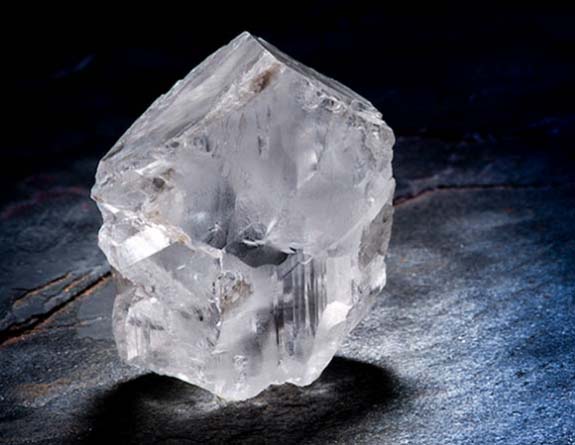
Imagine finding treasure in your trash. That’s exactly what happened when Lucara salvaged a 375-carat gem-quality diamond from a pile of old tailings at its Karowe mine. Tailings are the residue of the diamond-bearing ore that was processed during an original mining operation.

The company revisited the tailings because they were generated prior to the 2015 implementation of its advanced XRT diamond scanners (mentioned in the Sewelô review), which were designed to identify and preserve high-value diamonds of 100 carats or larger. The 375-carat rough diamond was just one of nine 100-plus-carat diamonds recovered from the re-processing of old material.

Lucara’s Karowe Mine has yielded many of the world’s largest diamonds, including the 1,109-carat Lesedi La Rona, the 813-carat Constellation and the 1,758-carat Sewelô.

A Legacy Continues.
Also famous for producing many of the world's largest rough diamonds — including the 3,106-carat Cullinan — the Cullinan mine in South Africa is still going strong after 117 years. In March, Petra Diamonds reported that it had unearthed a D-color, Type IIa rough diamond weighing 425 carats. Type IIa gems are the purest of all diamonds because they are composed solely of carbon with virtually no trace elements in the crystal lattice.

Two months later, the mining company sold the rough gem for just under $15 million to Dubai-based Stargems Group and Belgium-based Choron, and named the impressive stone “Legacy of the Cullinan Diamond Mine” to honor its connection to the legendary diamond source.

Originally known as the Premier Mine, the Cullinan mine has delivered seven of the world’s largest 50 rough diamonds, based on carat weight. These include the Cullinan Heritage (507 carats), Centenary (599 carats), The Golden Jubilee (755 carats) and the biggest gem-quality rough diamond of all time — the Cullinan.

Once-in-a-Lifetime Find.
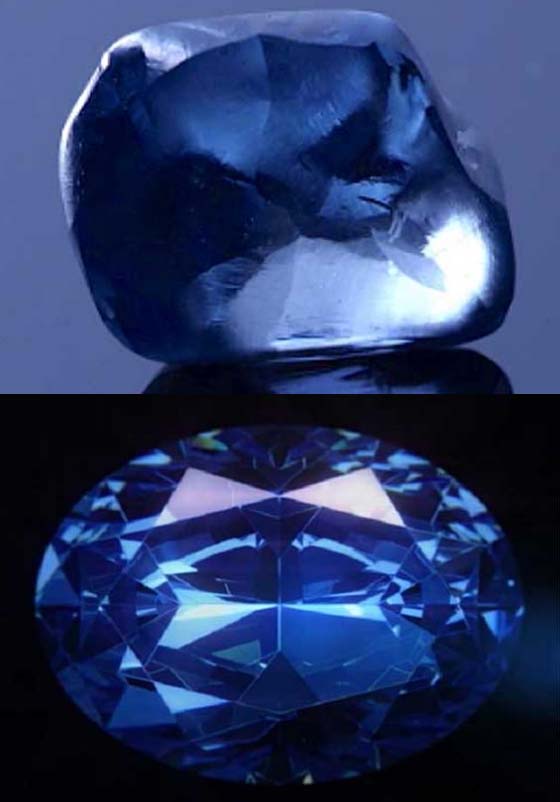
The largest blue diamond ever discovered in Botswana was revealed to the world by the state-run Okavango Diamond Company in April. The 20.46-carat faceted gem was cut from a 41.11-carat rough diamond sourced at the Orapa mine. The gem was named “The Okavango Blue” to honor the World Heritage Site known as the Okavango Delta. The lush delta is the home to hippos, elephants, crocodiles, lions, leopards, giraffes and rhinos.

“It is incredibly unusual for a stone of this color and nature to have come from Botswana. [It’s] a once-in-a-lifetime find,” said Okavango’s managing director Marcus ter Haar.

While the company did not reveal what The Okavango Blue might be worth, a similar diamond sold at a Christie’s auction in 2016 may hold the answer. The Cullinan Dream, a 24.18-carat intense blue diamond with a VS2 clarity rating, sold for $25.4 million at Christie’s New York in June of 2016. Based on that performance, one might presume The Okavango Blue has the potential to yield about $1 million per carat.

Credits: Diamond in a diamond image courtesy of Alrosa; Sewelô image courtesy of Lucara; 375-carat diamond image courtesy of Lucara; Legacy of the Cullinan Diamond Mine image courtesy of Petra Diamonds. Okavango Blue diamond images courtesy of Okavango Diamond Company.

Monday, December 30, 2019

Engraved Jewelry Dating Back 3,500 Years Unlocks Secrets About Life in Ancient Greece

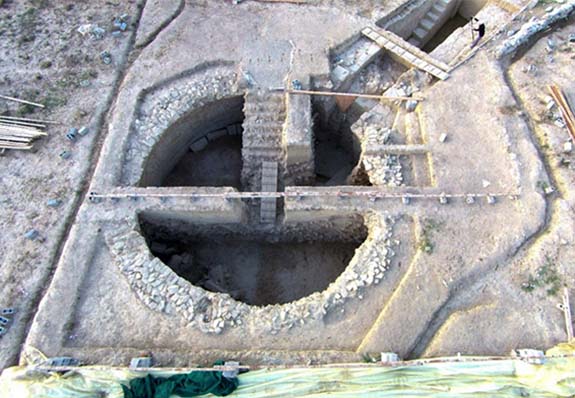
Archaeologists with the University of Cincinnati have unearthed two Bronze Age tombs containing a trove of engraved jewelry that help tell the story of life along the Mediterranean 3,500 years ago.

The two beehive-shaped tombs are located in Pylos, Greece, just a stone's throw from the grave of the “Griffin Warrior,” a powerful Greek figure whose precious jewelry, weapons and grooming supplies were discovered by the same team in 2015.

The researchers were surprised to find that the princely tombs were littered with gold flakes, indicating that gold leaf once adorned the stone walls.

“Like with the Griffin Warrior grave, by the end of the first week we knew we had something that was really important,” said Sharon Stocker, an archaeologist in UC's classics department, who supervised the excavation.

Added Jack Davis, head of UC’s classics department, “It soon became clear to us that lightning had struck again.”

One of the most fascinating jewelry items pulled from the site was a gold ring depicting two bulls flanked by sheaves of grain, specifically barley.

“It’s an interesting scene of animal husbandry — cattle mixed with grain production. It’s the foundation of agriculture,” Davis said. “As far as we know, it’s the only representation of grain in the art of Crete or Minoan civilization.”

An agate sealstone featured two lion-like mythical creatures called "genii" standing upright on clawed feet. They carry a serving vase and an incense burner, a tribute for the altar before them featuring a sprouting sapling between horns of consecration, Stocker said. Above the genii is an unusual 16-pointed star.

“It’s rare. There aren’t many 16-pointed stars in Mycenaean iconography," she said.

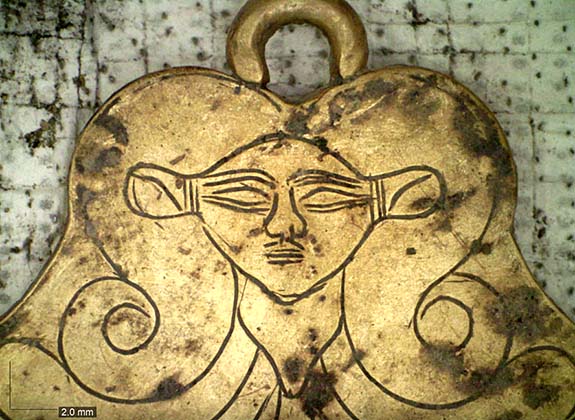
The UC archaeologists also found a gold pendant in the family tombs at Pylos featuring the likeness of Hathor, an Egyptian goddess who was a protector of the dead.

According to Stocker, the evidence gathered from the tombs paints a picture of accumulated wealth and status. The tombs contained amber from the Baltic, amethyst from Egypt, imported carnelian and lots of gold. The tombs sit on a scenic vista overlooking the Mediterranean Sea on the spot where the Palace of Nestor would later rise and fall to ruins.

“I think these are probably people who were very sophisticated for their time,” Stocker said. “They have come out of a place in history where there were few luxury items and imported goods. And all of a sudden at the time of the first Tholos tombs, luxury items appear in Greece. You have this explosion of wealth.”

Although Pylos is considered a remote region of Greece because one has to cross mountains to get there, during the Bronze Age it was an important hub for commerce and trade due to its proximity to the sea.

Stocker said that the tombs were protected from the elements and potential looters by an estimated 40,000 stones the size of watermelons. To access the tombs, each stone had to be removed individually.

The UC’s team is planning to continue its work at Pylos for at least the next two years while they and other researchers from around the globe unravel mysteries contained in the artifacts.

“It has been 50 years since any substantial tombs of this sort have been found at any Bronze Age palatial site. That makes this extraordinary,” Davis said.

Credits: Images courtesy of the Department of Classics, University of Cincinnati.