Wednesday, June 20, 2018

FIFA World Cup Trophy Is Made of 11 Pounds of 18-Karat Gold Worth $168,000

On July 15, after a full month of heart-thumping competition, the members of a single national team will emerge as champions and experience one of the ultimate thrills in professional sports — raising aloft the 18-karat gold FIFA World Cup Trophy. Four years ago in Brazil, that honor went to the soccer team from Germany. This year in Russia, 31 teams will be vying to unseat the defending champs.

The coveted trophy, which is 14.5 inches tall and depicts two human figures holding up the earth, is made of 11 pounds of 18-karat gold and features two rows of green malachite at the base. USA Today reported that the trophy is estimated to be worth $20 million, although the actual precious metal value is closer to $168,000.

For years, FIFA, the governing body of soccer, had said the trophy was made of solid gold, but that claim hasn't held up to scrutiny and it's very likely that it has a hollow center.

Martyn Poliakoff of the United Kingdom's Nottingham University did the math and determined that, based on its dimensions, a FIFA trophy made of solid gold would weigh an unwieldy 154 pounds. Gold is nearly 20 times as dense as water, and to get some perspective on just how heavy that is, consider this... A standard gold bar measures just 7 x 3 5/8 x 1 3/4 inches, but weighs more than 27 pounds.

The winning team will be taking home a gold-plated replica of the actual trophy. The real one will remain in the possession of FIFA. The bottom of the base bears the engraved year and name of each FIFA World Cup winner since 1974. The names are not visible when the cup is standing upright.

The tournament takes place every four years, and FIFA announced recently that the North American triumvirate of the U.S., Canada and Mexico will co-host the games in 2026.

For the past 88 years, there have been only two designs for the FIFA trophy. The current one was conceived by Italian artist Silvio Gazzaniga and presented for the first time in 1974.

In describing his design, Gazzaniga said, “The lines spring out from the base, rising in spirals, stretching out to receive the world. From the remarkable dynamic tensions of the compact body of the sculpture rise the figures of two athletes at the stirring moment of victory.”

In 1970, the Brazilians got to keep the previous version of the trophy — the Jules Rimet Cup — when the team captured its third world title.

Rimet, the founding father of the FIFA World Cup, had stipulated 40 years earlier that any team that won three titles could have the cup permanently. FIFA made good on that promise in 1970, but in 1983 the cup was stolen in Rio de Janeiro and never seen again.

The Jules Rimet Cup, which was originally called “Coupe du Monde,” was designed by French sculptor Abel Lafleur and depicted the goddess of victory holding an octagonal vessel above her. It was 13.7 inches tall and weighed 8.4 pounds. It was made of gold-plated sterling silver, with a base of lapis lazuli.

In 1966, an earlier version of the Jules Rimet Cup was stolen from a public display in London just before the Brits were about to host the World Cup. It was discovered seven days later at the bottom of a suburban garden hedge by a clever canine named Pickles.

During World War II, the Jules Rimet Cup spent some time in a shoebox under the bed of FIFA vice president Dr. Ottorino Barassi, who feared it might fall into the hands of the Adolf Hitler and the Nazis.

Brazil currently holds the record for the most FIFA World Cup victories (5), followed by Italy and Germany with four wins each. Favored teams in the current tournament include Brazil, Germany, Spain, France, Argentina, Belgium and England.

Credits: German team celebration in 2014. Screen capture via YouTube.com. FIFA World Cup by Biser Todorov [CC BY 4.0], from Wikimedia Commons. La Coupe Jules Rimet by Español: El Grafico del 12 de Julio de 1966. Edicion 2440 [Public domain], via Wikimedia Commons.

Monday, June 18, 2018

Philadelphia Eagles' First-Ever Super Bowl Rings Soar With 219 Diamonds and 17 Green Sapphires

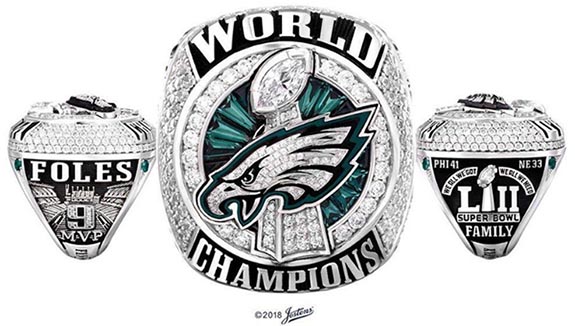
The Philadelphia Eagles marked their historic 2017 season and epic Super Bowl triumph over the New England Patriots with championship rings emblazoned with 219 diamonds and 17 green sapphires. Each ring boasts a gemstone total weight of 9.15 carats.

The 10-karat gold rings are teeming with symbols on every surface to tell the story of an underdog team that overcame all obstacles to roll through the playoffs and eventually defeat the Tom Brady-led Patriots by a score of 41-33 in Super Bowl LII. It was the first time the Eagles raised the Vince Lombardi Trophy aloft in their 85-year history.

The top of the ring features the iconic eagle head logo rendered with 52 pavé-set diamonds to signify Super Bowl LII (52). The eagle head is set atop the Lombardi Trophy, which is, in turn, layered over a series of tapered-baguette green sapphires, fanned out in a circle. Ring manufacturer and designer Jostens noted that the rare green sapphires were specially sourced to match the official team color. The 13 sapphires represent the Eagles' 13 regular season victories, which tied a franchise record.

The top of the trophy is adorned with three diamonds, representing the number of times the Eagles were deemed underdogs, and also the number of post-season victories it took to be crowned World Champions.

A large marquise-cut diamond sits majestically at the top of the Lombardi Trophy to represent the first Super Bowl Championship in the Eagles' franchise history. Bordering the top and bottom of the top of the ring are the words “WORLD" and "CHAMPIONS” in raised white-gold lettering against a black enamel ground.

The ring's bezel is adorned with a waterfall of 127 diamonds, a number that pays tribute to one of the most exciting and memorable moments in the team's history. "The Philly Special" was a trick play that resulted in a touchdown on a fourth-down-and-goal situation at the opponent's 1-yard line. Three key Eagles were involved in the memorable play, and the number 127 is the sum of their jersey numbers — Corey Clement (30), Trey Burton (88) and Nick Foles (9).

Four round, genuine green sapphires adorn the corners of the base of the ring and symbolize the team’s four NFL Championships – three World Championships (1948, 1949, 1960) and one Super Bowl Championship (2017).

The left side of the ring prominently shows the player’s name set above an end zone view of Lincoln Financial Field, the home of the Eagles. The stadium graphic pays tribute to the passionate and dedicated fan base that has supported the team since its formation. The player’s number is studded with pavé-set diamonds and set in the middle of the rendered football field.

The right side of the ring features the score from Super Bowl LII (PHI 41 – NE 33), and one of the team’s messages of unity throughout the season, "We All We Got, We All We Need,” is set above the Super Bowl LII logo. The word “FAMILY” sits below the logo and serves as a reminder of the team’s commitment and dedication to each other.

The words from the team’s fight song, “Fly Eagles Fly” are written on the bottom of the outer band. The top of the inside arbor of the ring is inscribed with the scores from the team’s three postseason victories and an image of an underdog mask, an acknowledgement of how the Eagles embraced their underdog role to galvanize the team, the fans and the entire city of Philadelphia. The bottom of the inside arbor is inscribed with each player’s signature – the first time championship rings have ever featured engraved signatures.

Eagles chairman and CEO Jeffrey Lurie admitted that he didn't realize the level of consideration that goes into the design of a Super Bowl ring.

“I thought, ‘You know, you just sort of come up with some ring, and you make many, and you have a party,’ Luria said in a statement. "I never really thought of the details that were required. You go through so much during a season. What are the statements that you want to make about the team, about the season, about the kinds of players and coaches that we had? It’s kind of like, how do you want to be remembered 20 years from now?”

The Eagles players and coaches received their rings during a special ceremony last week. In all, more than 400 rings were distributed to key personnel at every level of the Eagles organization.

Credit: Image courtesy of Jostens.

Friday, June 15, 2018

Music Friday: Country Stars Sing the Praises of a Gold Ring, 'Size Seven, Round'

Welcome to Music Friday when we bring you the sweetest songs with jewelry, gemstones or precious metals in the title or lyrics. Today, country stars George Jones and Lacy J. Dalton sing the praises of a very special ring in their 1984 ditty, "Size Seven Round (And Made of Gold)."

The song chronicles the love story of a couple, from their wedding day through their golden years. Even as they grow old together, her size-seven wedding band remains a shining symbol of their enduring relationship.

They sing, "Size seven, round and made of gold / This circle joins us heart and soul / And it won't let our love grow cold / Size seven, round and made of gold."

"Size Seven Round (And Made of Gold)" appeared as the seventh track of George Jones's 1984 album, Ladies' Choice, which was composed mostly of duets with female country artists. Twenty-one years later, the song returned on the 2005 reissue of the country legend's LP, My Very Special Guests.

The song peaked at #19 on the U.S. Billboard Hot Country Singles chart and #11 on the Canadian RPM Country Tracks chart.

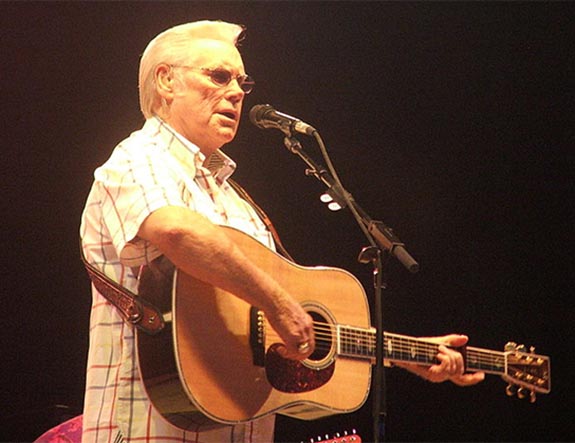
Born in a log cabin in the small town of Saratoga, Texas, Jones got his first guitar at the age of nine. By 1955, at the age of 24, Jones had already served in the Marines, was married twice and recorded his first hit song, “Why Baby Why.” In 1969, he married Tammy Wynette. They were divorced six years later, although they continued to perform together after the breakup.

Jones told Billboard in 2006 that when it comes to his music, “It’s never been for the love of money. I thank God for it because it makes me a living. But I sing because I love it, not because of the dollar signs.”

Over a career that spanned seven decades, Jones is credited with charting 168 country songs. He was inducted into the Country Music Hall of Fame in 1992. Jones passed away in 2013 at the age of 81.

Born Jill Lynne Byrem in Bloomsburg, Pa., Lacy J. Dalton scored a number of hits songs in the 1980s, including "Takin' It Easy," "Crazy Blue Eyes" and "16th Avenue." She's still actively touring at the age of 71.

Please check out the audio track of the Jones/Dalton duet of "Size Seven Round (And Made of Gold)." The lyrics are below if you’d like to sing along…

"Size Seven Round (And Made of Gold)"
Written by Monroe Fields and Gary Lumpkin. Performed by George Jones and Lacy J. Dalton.

With all my love, my dreams and plans
I placed a ring upon your hand
To tell the endless love we found
Love's golden band, size seven, round

Size seven, round and made of gold
This circle joins us heart and soul
And it won't let our love grow cold
Size seven, round and made of gold

The years have passed, our ring is old
But time can't tarnish pure love's gold
Each day our love is young and new
There's just no end to love that's true.

Size seven, round and made of gold
This circle joins us heart and soul
And it won't let our love grow cold
Size seven, round and made of gold.

Size seven, round and made of gold
This circle joins us heart and soul
And it won't let our love grow cold
Size seven, round and made of gold.

Size seven, round and made of gold.

Credit:Credit: George Jones photo by BstarXO Chester L. Roberts (Own work) [CC BY-SA 3.0 or GFDL], via Wikimedia Commons.

Wednesday, June 13, 2018

Rockefeller Jewelry Collection Far Outperforms Pre-Sale Estimates at Christie's New York

In 1940, billionaire banker and philanthropist David Rockefeller married Margaret "Peggy" McGrath, and during their 56-year marriage the couple collected magnificent works of art and fine jewelry. Yesterday, 19 jewelry items from their massive collection hit the auction block at Christie's New York, with most far outperforming pre-sale estimates.

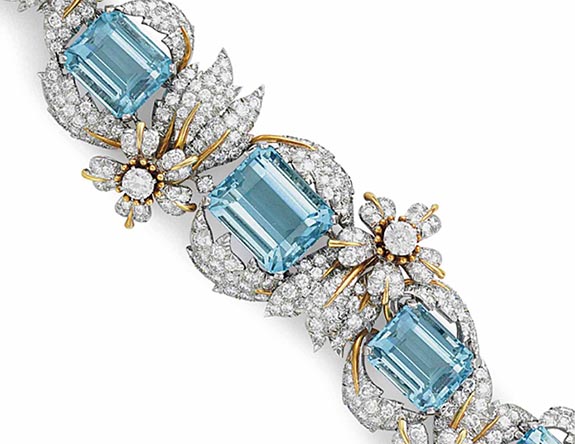
An aquamarine and diamond “Leaves and Flowers” bracelet (circa 1960) designed by Jean Schlumberger for Tiffany & Co., for example, was estimated to sell for $40,000 to $60,000. When the hammer went down, the bracelet had fetched $250,000 — more than four times the high estimate.

Schlumberger designed the bracelet as a series of five rectangular-cut aquamarines weighing from 14.80 to 28.77 carats, within circular-cut diamond leaf surrounds, joined by circular-cut diamonds and polished gold links.

The jewelry offerings at Christie's represented the continuation of the auction house's mammoth Rockefeller family estate sale of some 1,550 lots across six auctions. The proceeds of the sales — a tally that is likely to exceed $1 billion — will be used to support 11 philanthropies.

Before David Rockefeller died in March of 2017 at the age of 101, he ordered that the bulk of his estate — including three homes, and a collection of museum-quality paintings, tapestries, furniture and fine jewelry — would be used to fund bequests to his favorite charities. His beloved wife had passed away in 1996.

Peggy and David Rockefeller's purchases reflected a high level of refinement. They owned impressionist and modern art from Pablo Picasso, Claude Monet, Henri Matisse, Juan Gris and Paul Gauguin, for example. Their sophisticated taste expanded into the realm of fine jewelry, with more of the finest examples shown, below...

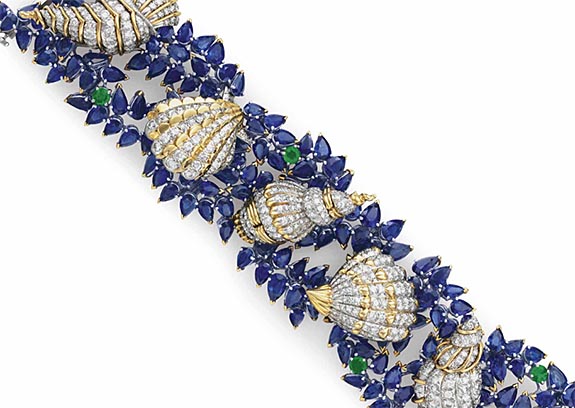
• Also designed by Schlumberger for Tiffany & Co., circa 1958, is this sapphire, diamond and emerald "Sea Shells" bracelet. Christie's set the pre-sale estimate at $50,000 to $70,000, but the realized price was $250,000. The pear-shaped sapphire and circular-cut emerald openwork band is set with six diamond-embellished sculpted gold shells.

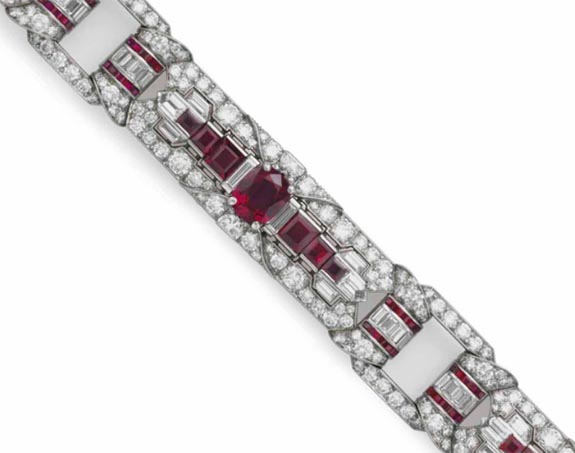
• This ruby and diamond bracelet by Raymond Yard, Rockefeller's personal jeweler, is designed as three articulated circular and fancy-cut diamond panels, each centering upon an oval-cut Burmese ruby. The pre-sale estimate was $40,000 to $60,000, but the selling price climbed all the way to $348,500.

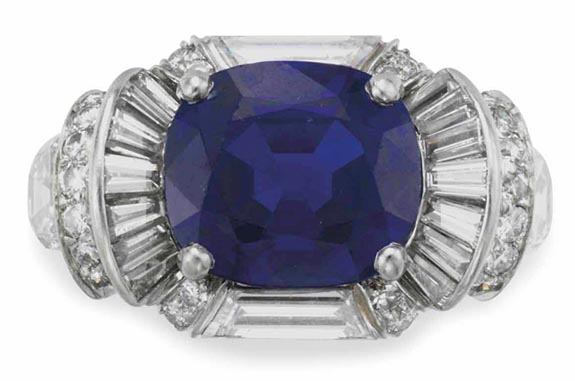
• Another Yard piece (circa 1944) — a sapphire and diamond ring — was one of the auction's top lots. Originally expected to sell in the range of $150,000 to $200,000, the platinum ring set with a 5-carat oval-cut Kashmir sapphire and surrounded by circular, baguette and half moon-shaped diamonds sold for $372,500.

• Lot 174 of the auction included a suite of peridot and diamond jewelry by Van Cleef & Arpels. When the hammer went down at Christie's, the sale price of $348,000 had surpassed the pre-sale high estimate by $228,000. Suspended from the peridot necklace is a detachable pear- and oval-cut peridot pendant-brooch. Also included in the suite are peridot earrings, bracelet and ring.

Credits: Images courtesy of Christie's.

Monday, June 11, 2018

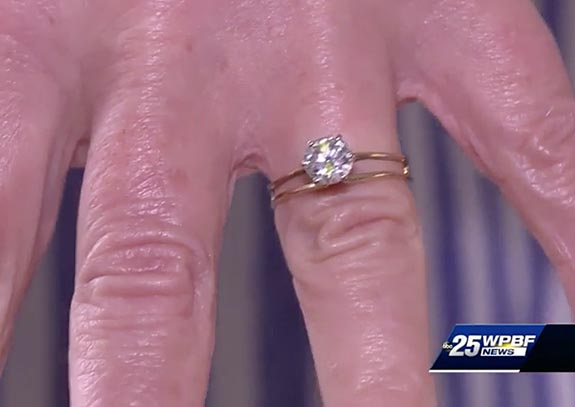
Woman Is on a Mission to Identify Six-Year-Old Who Returned Her Lost Engagement Ring

Former nurse and Jupiter, Fla., resident Carol Winig is on a mission to identify the honest little girl who found her engagement ring in a supermarket parking lot and turned it over to the store's management. Winig wants to give the youngster a reward and a big hug.

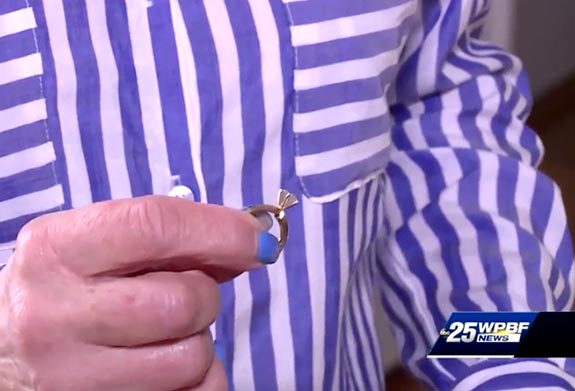
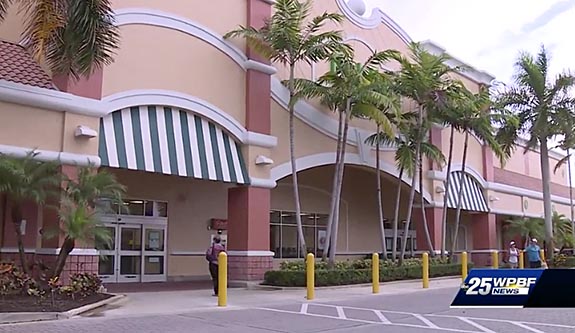
The six-year-old had spotted the diamond solitaire ring in the parking lot of a Publix supermarket on May 14 and promptly turned it in. The girl didn't give her name and her identity remains a mystery.

Earlier that day, Winig had been shopping at the same Publix and stopped into the bathroom to wash her hands. She removed three rings from her hand — her engagement ring, a platinum wedding band and an antique wedding band that once belonged to her husband's grandmother — and slipped them into her back pocket.

“As I did it, I put the rings in my back pocket and I said to myself, ‘This is probably not one of your better moves, putting them there. Just remember to take them out,’” she told local ABC affiliate WPBF.

Winig forgot to take them out, and that's where her story takes a turn for the worse. Standing near her car with a cart of groceries, she reached into her pocket to pull out her receipt. Just then she heard a "ting, ting, ting" as her receipt dropped to the ground in the parking lot.

“All I could find was the receipt,” Winig said. “So even though it made no sense, I thought, ‘Well, if that’s all I’m seeing, then I didn’t lose anything.’”

What she failed to realize was that all three precious rings had fallen from her pocket and were left behind in the parking lot as she drove away.

About 20 minutes later, at about 7 p.m., the mystery youngster found the most precious of the three rings — Winig's engagement ring — lying on the pavement. It was the ring Winig's husband gave her when he first proposed.

The next morning, Winig realized that all three rings were missing, so she scampered back to Publix to try to find them. After searching the parking lot unsuccessfully, she entered the store and asked if any rings had been turned in.

Management handed her an envelope with the engagement ring inside.

“That’s my ring! That’s my ring!” Winig remembered saying to the staff. And then she cried as she placed it back on her finger.

"For me, that was the most incredible gift to have been able to get the ring back," she told WPBF.

Now, Winig is trying to find the honest, heroic young lady responsible for returning her ring. The staff at Publix did not get her name, just the fact that was six years old.

“This little girl needs to be hugged and rewarded," Winig told WPBF.

Winig's story has gotten a fair amount of media attention. It was covered by local ABC affiliate WPBF and was a featured on the website mypalmbeachpost.com, but the little hero has yet to come forward.

Winig still holds out hope that the other two lost rings may eventually be found, but "that would be a miracle," she said.

Credits: Screen captures via wpbf.com.