Friday, September 30, 2022

Music Friday: Jason Derulo Dreams of Proposing 'With the Perfect Diamond Ring'

Welcome to Music Friday when we bring you sensational songs with jewelry, gemstones or precious metals in the lyrics or title. Today, Jason Derulo dreams about proposing with "the perfect diamond ring" in his 2010 tune, "What If."

Derulo explained to the BBC that the song is about meeting someone for the first time and then imagining — at that moment — how both lives may have been profoundly altered.

“So I’m telling this girl y’know, what if in two years, three years from now we’ll be married with children and living in a log cabin?” he told the BBC.

In the key verse, he sings, “Yeah, picture me on one knee / With the perfect diamond ring / We just met, but if you said yes / We’d have our wedding on the beach.”

The official video, which was inspired by the 2004 movie The Butterfly Effect, opens with Derulo and his girlfriend setting up a new apartment. She's out of the room when he pulls a red ring box from the nightstand and opens it to admire what seems to be a platinum and diamond engagement ring. When she enters the room, he quickly hides it in his pocket.

She insists on retrieving the last item from the moving truck, and when she leaves the room he opens the box again, stares at the ring and whispers to himself, "What if? What if I'm the one for you?"

The scene switches to the girlfriend pulling a small box from the truck and closing the cargo door. As she crosses the street to return to the apartment, she is nearly hit by a distracted driver.

Derulo hears the screeching tires and shattered glass and sprints to save his girlfriend, but as he reaches her, the video freezes, and then time moves in reverse. We learn how Derulo and his girlfriend got to this moment through flashbacks, as if their lives are being rewound.

The video, which has been viewed nearly 39 million times, contains a surprise ending that we won’t spoil here. The “butterfly effect,” by the way, is a scientific theory that a single occurrence, no matter how small, can change the course of the universe forever.

“What If” is the fourth single from Derulo’s self-titled debut album. It was first released in the UK and peaked at #12. The single was subsequently released in the U.S., where it reached #26 on the Billboard US Mainstream Top 40 chart.

Born Jason Joel Desrouleaux in Miramar, Fla., the 33-year-old singer-songwriter-dancer-choreographer, has sold more than 50 million singles since launching his solo career in 2009. He changed his last name to Derulo because the French spelling was hard to pronounce.

Please check out the official video of “What If.” The lyrics are below if you’d like to sing along…

“What If”
Written by Jonathan Rotem and Jason Desrouleaux. Performed by Jason Derulo.

What if?
What if I’m the one for you?
And you’re the one for me?
What if?

If you are the one
Then us meeting here is fate
Future with a dog named Red
Buy a house with a fireplace

This is the first I’ve seen your face
But there’s a chance we are soul mates
I know this might sound crazy
‘Cause you don’t know my name

But we can’t, we can’t tell the future, no
But that’s just the beauty of the world we know
So I’ma say du, du, du-du, du-du, du-du, baby, what if?
We all can say du, du, du-du, du-du, du-du, baby, what if?

What if? What if? What if?

Yeah, picture me on one knee
With the perfect diamond ring
We just met, but if you said yes
We’d have our wedding on the beach

It could happen, raise three kids
And we grow old oh, so happily
I know this might sound crazy
‘Cause I don’t know your name

But we can’t, we can’t tell the future, no
But that’s just the beauty of the world we know
So I’ma say du, du, du-du, du-du, du-du, baby, what if?
We all can say du, du, du-du, du-du, du-du, baby, what if?

Don’t know what tomorrow brings
But I’m still hoping that you are the one for me
Oh, and what if I had you and what if you had me
And, baby, what’s the reason we can’t fall in love?

What if? What if? What if?
What if? What if?

But we can’t, we can’t tell the future, no
But that’s just the beauty of the world we know
So I’ma say du, du, du-du, du-du, du-du, baby, what if?
We all can say du, du, du-du, du-du, du-du, baby, what if?

But we can’t, we can’t tell the future, no
But that’s just the beauty of the world we know
So I’ma say du, du, du-du, du-du, du-du, baby, what if?
We all can say du, du, du-du, du-du, du-du, baby, what if?

Credit: Photo by MTV International, CC BY 3.0, via Wikimedia Commons

Wednesday, September 28, 2022

Expert Who Cleaved the 3,106-carat Cullinan Diamond Was Paid in 'Chippings'

With the passing of Queen Elizabeth II, much has been written about the British Crown Jewels and the massive diamonds at the center of the Sovereign’s Sceptre and the Imperial State Crown.

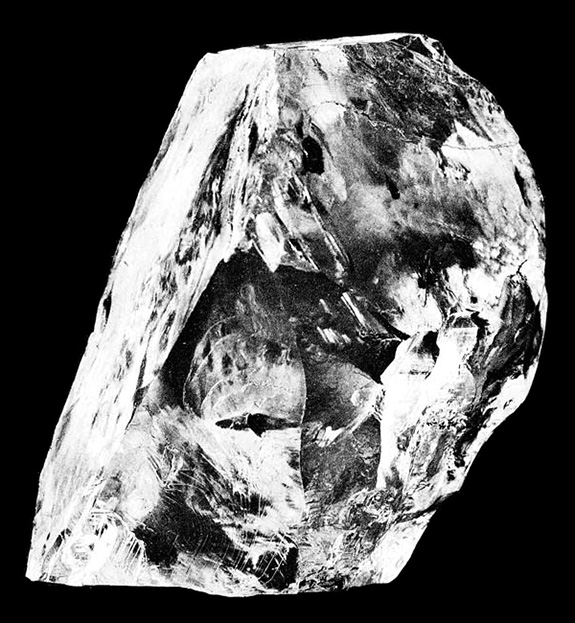
Both diamonds were expertly cut from the 3,106-carat Cullinan — the world’s largest rough diamond — by Joseph Asscher of the Amsterdam-based Asscher Company. What most people don't know is that the expert cutter was paid for his work in "chippings" and that some of those fragments still live more than 100 years later in the bridal sets of Asscher's descendants.

King Edward VII, Queen Elizabeth's great-grandfather, chose the Asschers for the high-profile job because they had successfully cut the previously largest known diamond, the 995.2-carat Excelsior, five years earlier.

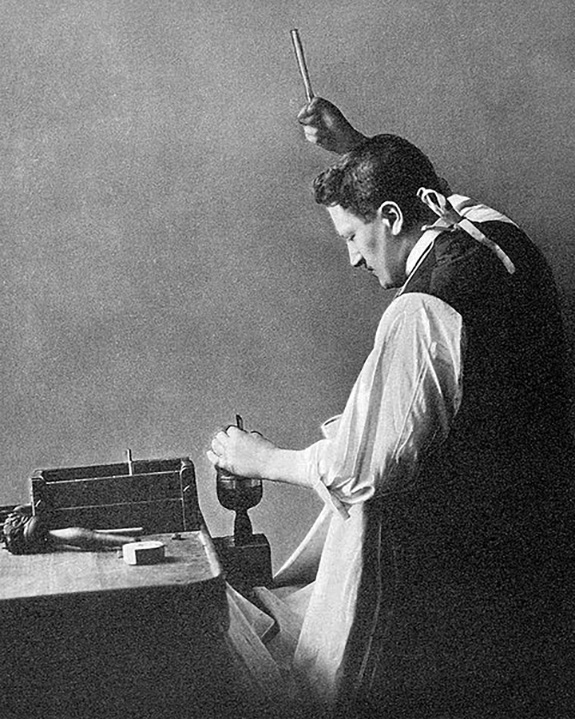
After an extensive period of studying the stone, which had been discovered in 1905 at the Premier Mine No. 2 near Pretoria, South Africa, Asscher started the cutting process by creating an incision in the diamond of approximately 6.5mm deep.

It has been reported that Asscher broke his tool when he initially struck the stone. A week later, after developing stronger tools, Asscher successfully cleaved the the Cullinan into two principal parts, weighing 1,977 carats and 1,040 carats.

Asscher performed the failed first attempt in front of an audience of notables, but his second successful attempt was accomplished with nobody in the room, except for a Notary Public. Legend has it that Asscher struck the diamond so hard on the second try that he fainted after it split.

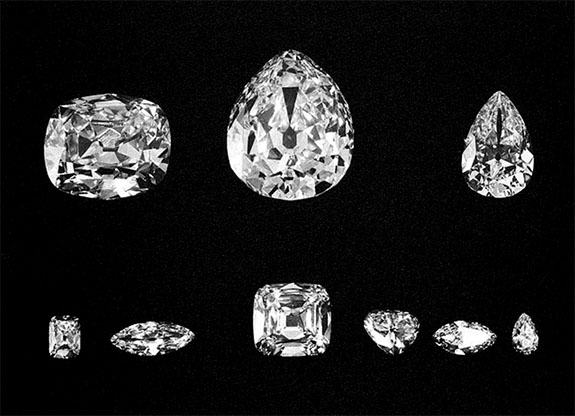
Over the following months, these diamonds were further polished and cut to create nine principal stones, 96 smaller diamonds and a quantity of polished “ends.”

The largest of the Cullinan gems, the Great Star of Africa (Cullinan I), weighed 530.4 carats and was set atop the Sovereign’s Sceptre. The 317-carat Second Great Star of Africa (Cullinan II) was set in the Imperial State Crown.

It took Asscher and his team more than two years to complete their work. Asscher agreed to be paid in “chippings,” the diamond remnants that split off the main stones during the cleaving and cutting processes.

Now, more than a century later and in light of Queen Elizabeth II's passing, members of the Asscher family have come forward with stories about how these "chippings" from the Cullinan diamond are part of their own family heirlooms.

Israeli journalist Shakked Auerbach, who is a descendant of the Asscher family, recounted in a blog item published on the Israeli National Library website that diamonds belonging to her family were originally part of the 3,106-carat Cullinan.

She confirmed that Joseph Asscher, her great-great-great-grandfather, was paid in "chips." His fine work was also acknowledged in 1909 when he received a knighthood from the Kingdom of the Netherlands.

“The Asschers decided that the diamonds would be passed from generation to generation when men would give them on an engagement ring to women that would join the family,” Auerbach wrote.

Auerbach also shared the story of how the fist-sized Cullinan was secretly transported from England to the The Netherlands for cutting.

She wrote that the stone was loaded into the belly of a British battleship in a protective box. But it turned out that this London-to-Amsterdam transport was just a ruse.

It actually traveled in the pocket of Avraham Asher, who sailed from London to Amsterdam on an ordinary ship without carrying luggage. The only thing he brought on the voyage was the "large coat to protect him from the cold and disguise his precious cargo," she wrote.

Auerbach also noted how some of the Cullinan "chips" were hidden from the Nazis by Holocaust survivors, including her grandmother. Those chips have been since passed down through generations of the Asscher family.

"This is how my family was connected to the royal family," she wrote. "And who knows how the journey of the diamond will continue from here?"

Credits: Joseph Asscher photo by Unknown authorUnknown author, Public domain, via Wikimedia Commons. Cullinan rough stone by Unknown authorUnknown author, Public domain, via Wikimedia Commons.

Tuesday, September 27, 2022

Arctic Canadian Diamond Co. Unveils 71-Carat Fancy Vivid Yellow Gemstone

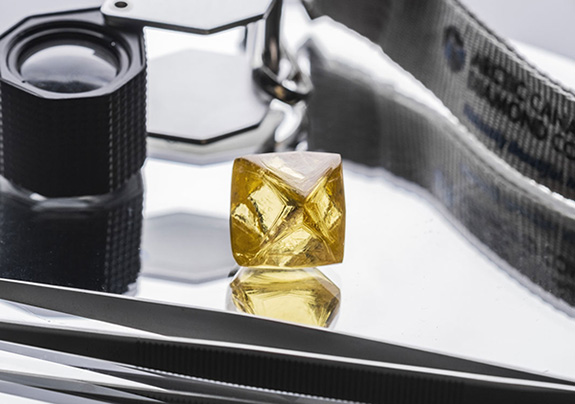
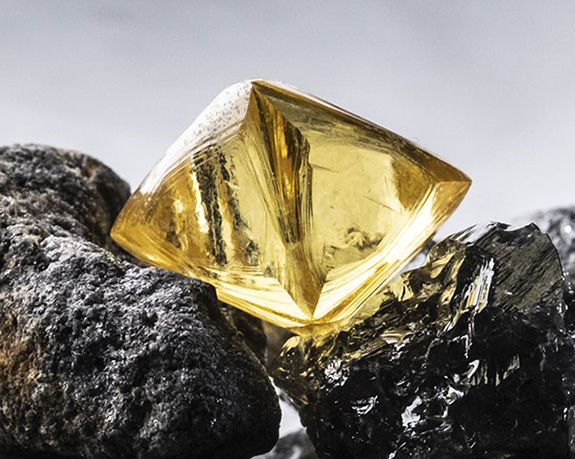
Arctic Canadian Diamond Company just announced the recovery of a yellow octahedron diamond weighing an impressive 71.26 carats. The rough gem is believed to be the largest fancy vivid yellow diamond ever discovered in Canada.

The stone was unearthed last month at the Ekati Diamond Mine in Canada’s Northwest Territories, about 200 km south of the Arctic Circle. More specifically, it can be traced to Ekati's famous Misery Pipe, which has been the source of many of the world's finest precious yellow diamonds.

“This historic fancy vivid yellow gemstone continues to showcase Canada as a major player on the world stage for diamond mining,” said Rory Moore, President and CEO of Arctic Canadian. “Canadian diamonds are some of the most sought-after globally because of responsible mining practices and environmental stewardship.”

Ultimately, a buyer will determine the shape of the finished stone, hoping to maximize its size while bringing out its optimum brilliance. It’s not unusual for half the diamond’s weight to be sacrificed during the arduous cutting and polishing process. Even if 60% of the stone's weight is lost during the transformation, the finished diamond could weigh close to 30 carats.

Ekati is Canada’s first diamond mine and has supplied premium rough diamond assortments to the global market for more than 24 years. The mine is located about 300 km northwest of Yellowknife in the Northwest Territories. Ekati, which derives its name from the Tlicho word meaning "fat lake," is Canada’s first surface and underground diamond mine.

The Ekati diamond mine officially began production in October 1998, following extensive exploration and development work dating back to 1981, according to the mining company.

Back in October of 2018, a 552-carat yellow diamond was unearthed at the Diavik mine, also near Yellowknife. While that rough stone far outweighed the one just unveiled by Arctic Canadian Diamond Company, the 204-carat primary diamond cut from the "552" carried the lower color grade of fancy intense yellow.

Credits: Images courtesy of Arctic Canadian Diamond Company.

Friday, September 23, 2022

Music Friday: Sir Elton John Sings, 'It's Like Trying to Find Gold in a Silver Mine'

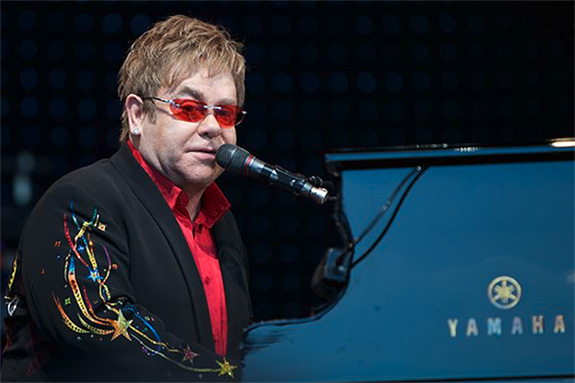
Welcome to Music Friday, when we spotlight songs with jewelry, gemstones or precious metals in the title or lyrics. Today, Sir Elton John trades his simple country lifestyle for the glamor of the big city in "Honky Cat," one of his classic songs from 1972.

John portrays a young man who has been blinded by the city lights and has no intention of getting back to the woods. Meanwhile, his friends are calling him a fool.

They tell him, "Living in the city ain’t where it’s at / It’s like trying to find gold in a silver mine / It’s like trying to drink whiskey from a bottle of wine."

Interestingly, the words that John sings do not reflect his own point of view. John didn't grow up in the country. He was raised near London and loved the city life. Instead, the song likely reflects the experiences of lyricist and long-time creative partner, Bernie Taupin, who was born on a farm in Lincolnshire and preferred that environment.

“Honky Cat” is the first track on John’s fifth studio album, Honky Château, which reached #1 on Billboard 200 albums chart and was ranked one of the 500 Best Albums of All Time by Rolling Stone magazine. The single reached the Top 10 on Billboard‘s Hot 100 list. The album’s title refers to the location where it was recorded in early 1972, specifically Château d’Hérouville in Hérouville, France.

Born Reginald Kenneth Dwight in 1947, John got hooked on rock and roll when his mother brought home records by Elvis Presley and Bill Haley & His Comets in 1956. He learned to play piano and formed his first band, Bluesology, at the age of 15.

In 1967, John met Taupin by chance when both men responded to an advertisement seeking songwriters. At first, they wrote songs for other artists, but then decided go out on their own.

In a career that has spanned six decades, John has sold more than 300 million records. He and Taupin released 31 albums and are credited with more than 50 Top-40 hits. John was knighted by Queen Elizabeth II in 1998.

His single in honor of Princess Diana, “Candle in the Wind 1997,” sold 33 million copies worldwide and, at that time, ranked as the best-selling single in the history of the UK and US singles charts.

Please check out the video of John performing "Honky Cat" live at the Hammersmith Odeon in London on the day before Christmas in 1974. The lyrics are below if you'd like to sing along…

“Honky Cat”
Written by Bernie Taupin. Performed by Elton John.

When I look back boy I must have been green
Bopping in the country, fishing in a stream
Looking for an answer trying to find a sign
Until I saw your city lights honey I was blind

They said get back honky cat
Better get back to the woods
Well I quit those days and my redneck ways
And oh the change is gonna do me good

You better get back honky cat
Living in the city ain’t where it’s at
It’s like trying to find gold in a silver mine
It’s like trying to drink whiskey from a bottle of wine

Well I read some books and I read some magazines
About those high class ladies down in New Orleans
And all the folks back home well, said I was a fool
They said oh, believe in the Lord is the golden rule

They said get back honky cat
Better get back to the woods
Well I quit those days and my redneck ways
And oh the change is gonna do me good

They said get back honky cat
Better get back to the woods
Well I quit those days and my redneck ways
And oh the change is gonna do me good

They said stay at home boy, you gotta tend the farm
Living in the city son, is going to break your heart
But how can you stop, when your heart says no
How can you stay when your feet say go

You better get back honky cat
Better get back to the woods
Well I quit those days and my redneck ways
And oh the change is gonna do me good

You better get back honky cat
Living in the city ain’t where it’s at
It’s like trying to find gold in a silver mine
It’s like trying to drink whiskey from a bottle of wine

Get back honky cat, get back honky cat, get back, oh

Credit: Image by Ernst Vikne, CC BY-SA 2.0, via Wikimedia Commons.

Wednesday, September 21, 2022

British Crown Jewels Play Prominent Roles in Queen Elizabeth II's Funeral

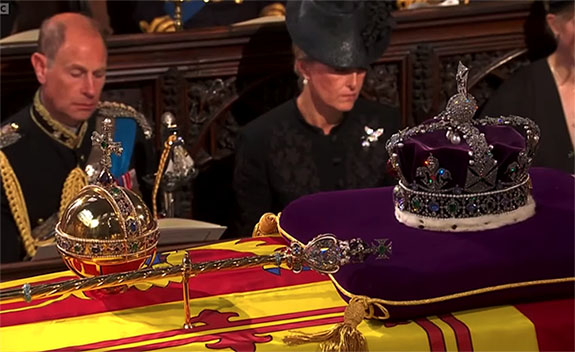
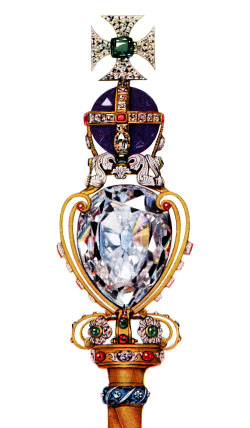
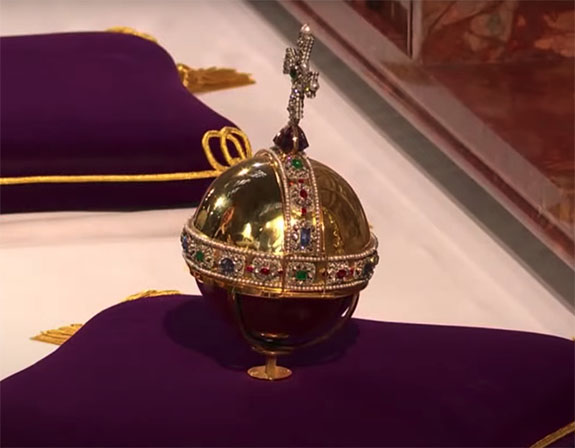
Three bejeweled treasures — The Imperial State Crown, the Sovereign's Sceptre and the Sovereign's Orb — played prominent roles during the State Funeral for Queen Elizabeth II on Monday.

Rarely seen in public, these items from the British royal family's crown jewels rode atop the Queen's coffin during the long procession from Westminster Abbey to St. George's chapel at Windsor Castle.

The royal family took extra precautions to make certain that the three priceless pieces were "expertly fastened" to the coffin to prevent them from falling and becoming damaged as they had been in the past, according to people.com.

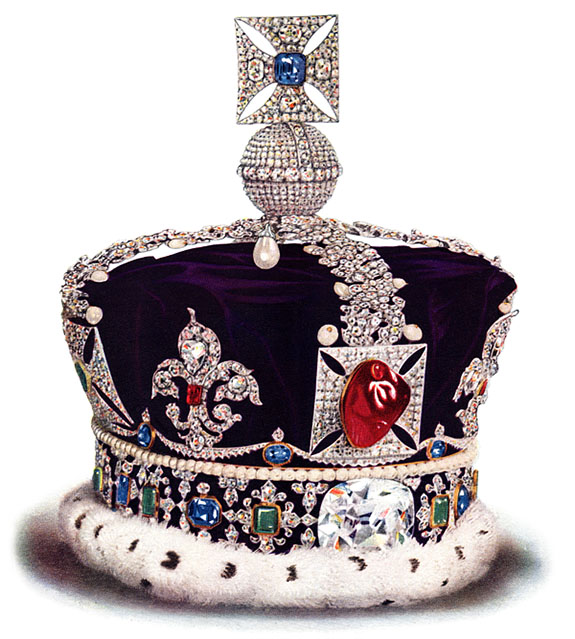
Back in 1845, the prized crown, which reportedly weighs more than 5 pounds, slipped off a cushion held by Lord John Campbell, the Duke of Argyll, as he carried it to Queen Victoria amid the State Opening of Parliament, according to Express UK.

Queen Victoria recorded the incident in her dairy, writing that the crown was "all crushed and squashed like a pudding that had sat down." She also took a swipe at the Duke of Argyll, stating that the crown "was too heavy" for him to carry.

Ninety-one years later in 1936, the same crown was at the center of another mishap when the diamond-encrusted orb and cross at the top of the headpiece snapped off and landed in the street as the coffin of King George V was being moved from King's Cross station, according to an account in The Guardian.

The Imperial State Crown is encrusted with more than 3,000 gemstones, including the Second Great Star of Africa (Cullinan II), a 317-carat diamond that was the second-largest cut from the 3,106-carat Cullinan Diamond.

Discovered in 1905, the rough stone weighed a staggering 621 grams (1.37 pounds) and measured 98mm (3.85 inches) long, 57mm wide and 67mm tall. Thomas Cullinan, then chairman of the Premier Mine in South Africa, sold the diamond to the Transvaal provincial government, which, in turn, presented the stone to Britain’s King Edward VII as a birthday gift in 1907.

In February 1908, Joseph Asscher & Co. was assigned the task of cutting the Cullinan Diamond into nine major finished stones, each of which was given the name Cullinan and a Roman numeral.

The largest of the Cullinan gems, the Great Star of Africa (Cullinan I), weighs 530.4 carats and is set atop the Sovereign's Sceptre, which was originally created for Charles II and has been used at every coronation since 1661.

Also dating back to 1661 is the Sovereign's Orb, a hollow gold sphere rimmed with more than 600 precious stones, including 30 rubies and 12 diamonds. The orb symbolizes the Earth and conveys the message that the British monarch's power is derived from God.

Credits: Screen captures via Youtube.com/BBC. Imperial crown image by Cyril Davenport (1848 – 1941), Public domain, via Wikimedia Commons. Cullinan diamonds by Unknown authorUnknown author, Public domain, via Wikimedia Commons. Sovereign's Sceptre with Cross by Cyril Davenport (1848 – 1941), Public domain, via Wikimedia Commons.