Friday, February 24, 2023

Music Friday Flashback: 'Wear My Ring Around Your Neck,' Sings Neil Sedaka

Welcome to Music Friday when we like to bring you nostalgic tunes with jewelry, gemstones or precious metals in the lyrics or title. Today, Neil Sedaka, the man who topped the charts with timeless singalongs such as "Calendar Girl" (1960), "Happy Birthday Sweet Sixteen" (1961) and "Breaking Up Is Hard to Do" (1962), delivers still another teen-themed hit with "Let's Go Steady Again."
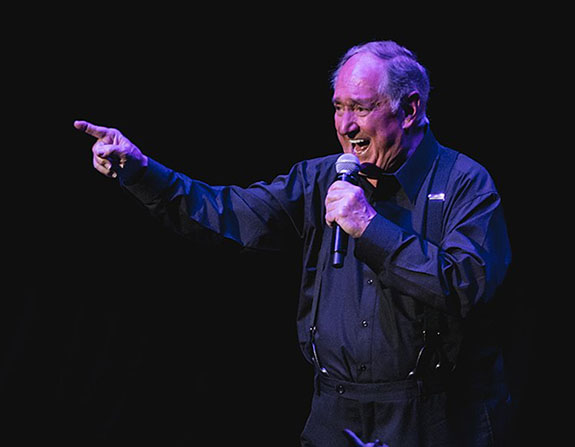
Released exactly 60 years ago when Sedaka was in his early 20s and reaching the height of his popularity, today's featured tune is about a young man who's having second thoughts after breaking up with his girlfriend.

It's been just a week since they said "goodbye," but the separation anxiety is getting the best of him. He wants to hit the restart button on the relationship and pleas with his ex to wear the jewelry symbolizing their love.

He sings, "Let's go steady again like we did before / Let's go steady again and be lovers once more / Wear my ring around your neck like you used to do / Don't you know it's wrong to break up / Come on baby let's kiss and make up."

Co-written by Sedaka and long-time collaborator, Howard Greenfield, "Let's Go Steady Again" peaked at #26 on the pop charts in 1963.

Rooted in the famed Brill Building in New York City, Sedaka and his writing partners have churned out more than 500 songs. Sedaka was inducted into the Songwriters Hall of Fame in 1983 and boasts a star on the Hollywood Walk of Fame.

The son of a taxi driver, Sedaka was born in Brooklyn in 1939. As a second grader, he showed such musical aptitude that his teacher recommended to his parents that he take piano lessons. Sedaka's mom landed a part-time job at a department store to earn enough money to buy her son a secondhand piano.

Her efforts paid off when the young Sedaka earned a music scholarship at the Juilliard School's Preparatory Division for Children. At the age of 13, a neighbor introduced Sedaka to Greenfield, an aspiring lyricist, who was three years his senior. Together, they would become one of the most prolific writing teams of all time.

Trivia: While attending Abraham Lincoln High School in Brooklyn, Sedaka dated singer-songwriter Carole King, who inspired his 1959 hit, "Oh! Carol."

Sedaka's career has spanned eight decades and he's still performing at the age of 83. He'll turn 84 in March. Please check out the audio track of Sedaka singing "Let's Go Steady Again." The lyrics are below if you'd like to sing along…

"Let's Go Steady Again"
Written by Howard Greenfield and Neil Sedaka. Performed by Neil Sedaka.

Down down down rada to, let's go steady again

Let's go steady again like we did before
Let's go steady again and be lovers once more
Wear my ring around your neck like you used to do
Don't you know it's wrong to break up
Come on baby let's kiss and make up

Let's go steady again like in the past
Let's show all of our friends that our love can last
I don't care who was wrong, come back here where you belong
Come on baby let's go steady again

Monday, we said goodbye
Tuesday, all I did was cry
Wednesday, I almost lost my mind

Thursday, I was feeling blue
Friday, was the same way, too
Never had a day sad as Saturday
Even Sunday was no fun day

Let's go steady again like we used to do
Say you're ready and then we can start anew
Seven days we didn't speak
It's been a long and lonely week
Come on baby, let's go steady again

Down, down, down, rada to, let's go steady again

Credit: Photo by Raph_PH, CC BY 2.0, via Wikimedia Commons.

Wednesday, February 22, 2023

North America's Largest Alluvial Diamond Was Unearthed in West Virginia in 1928

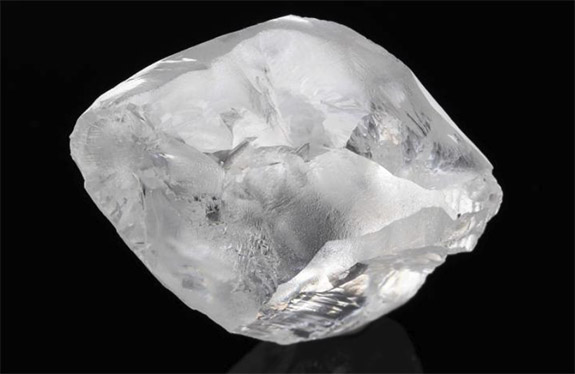
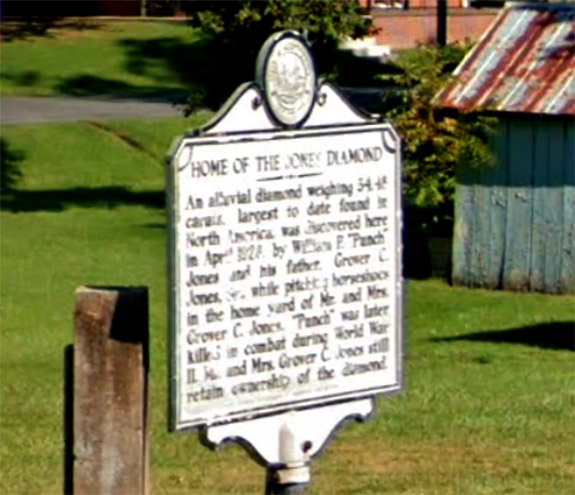
In the tiny town of Peterstown at the southern tip of West Virginia, a weathered historical marker describes the remarkable find of William "Punch" Jones and his father Grover C. Jones Sr., who unearthed North America's largest alluvial diamond — a 34.46-carat silvery octahedron — while pitching horseshoes in April of 1928.

How the enormous diamond ended up in the Jones's sandy lot near Rich Creek remains one of the wildest gemological mysteries of all time. Diamonds are not native to West Virginia.

Known as the Jones Diamond, the Punch Jones Diamond, the Grover Jones Diamond and the Horseshoe Diamond, the gem measured 5/8-inch in diameter and displayed 12 diamond-shaped facets. The 11-year-old Punch and his dad believed, at first, that the shiny stone was clear quartz, which is common to the area. But the young man — the oldest of 17 children — liked the stone and decided to keep it in a wooden cigar box in the family's tool shed.

It remained there for the next 14 years, but then in 1942, Punch showed renewed interest in the shiny rock due to its crystalline shine and brought it to Virginia Polytechnic Institute (now Virginia Tech), where geology professor Roy J. Holden confirmed that the stone was actually a bluish-white alluvial diamond. Alluvial diamonds generally have softer, worn edges because they've been carried by rivers or streams from their primary source.

Dr. Holden told Punch that due to its "carry impact marks" and size, the stone had probably washed down the New River into Rich Creek from a source in Virginia, North Carolina or Tennessee.

Over time, other gem experts tossed around other ideas about how such an extraordinary diamond could have found its way into the Jones's horseshoe pit.

Perhaps the stone was consumed by a waterfowl in Brazil and then deposited over the Jones's property during a migration flight. Still others believe it's impossible to rule out human intervention. It could have been dropped on the property by earlier settlers or Native Americans.

The Joneses lent the stone to the Smithsonian, where it went on display at the Museum of Natural History in Washington, DC., and remained there from 1944 until 1964. Sadly, Punch, the oldest of 16 Jones sons (a record for consecutive male births) was killed in combat during WWII while serving as an Army Private First Class in 1945.

The gem was then returned to West Virginia, where it starred at the State Fair. Otherwise, it stayed out of the public eye — locked up in a safety deposit box at First Valley National Bank in Rich Creek, VA.

The Jones family finally sold the gem at a Sotheby's auction in 1984. The selling price of $74,250 is equivalent to $213,000 in today dollars. It was purchased by an agent representing a lawyer in an undisclosed Asian country.

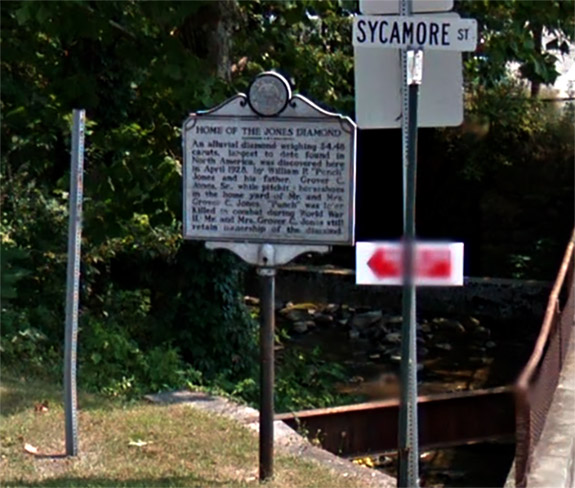
Although the Punch Diamond hasn't been seen in many decades, the historical marker celebrating its discovery remains in Peterstown on U.S. Route 219 at the corner of Sycamore and Market Streets.

Credits: Street view captures via Google Maps. Example of an alluvial diamond courtesy of Lucapa.

Monday, February 20, 2023

Mississippi Opal on Fast Track to Becoming Magnolia State's Official Gemstone

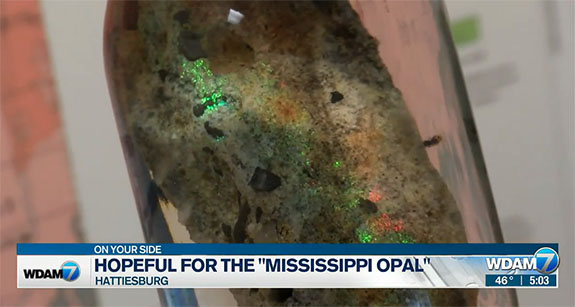
It looks like the Mississippi Opal is on the fast track to becoming the Magnolia State's official gemstone. In early February, the Mississippi House voted 115-0 to recognize the unique gem as its newest state symbol.

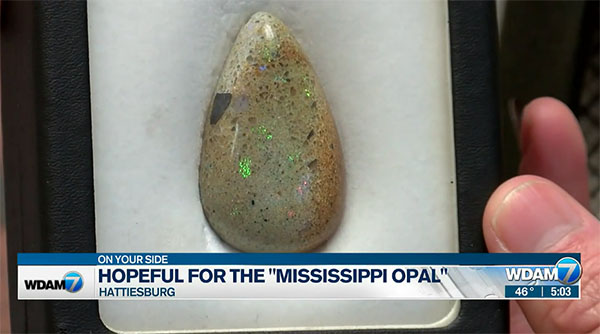
If Bill 2138 passes the Senate, the speckled grey gem that displays opal-like flashes of orange and green will earn the state's special distinction alongside the official bird (mockingbird), flower (magnolia), fish (largemouth bass) and insect (honeybee).

“In Mississippi, we don’t have diamonds, we don’t have rubies… but we do have vast supplies of the opal,” Republican Rep. Becky Currie of Brookhaven told the Associated Press.

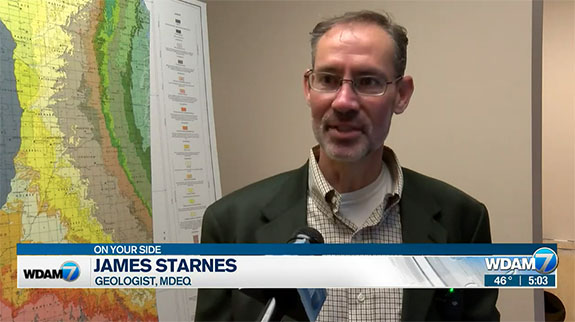
Geologist James Starnes is credited with discovering the Mississippi Opal less than 20 years ago when he and his team at the Mississippi Department of Environmental Quality (MDEQ) were mapping the bluffs overlooking the Mississippi River in Claiborne County, near Vicksburg.

The geologists believe the Mississippi Opal was formed millions of years ago from volcanic ash.

The MDEQ joined forces with members of the North Mississippi Gem and Mineral Society and the Mississippi State Board of Registered Professional Geologists to endorse the Mississippi Opal as the state's official gemstone.

Starnes told NBC affiliate WDAM-TV in Hattiesburg that the Mississippi Opal's elevated status would "encourage folks to take interest in the state's geology."

What's more, Starnes explained that the same geological formations that allowed for the creation of Mississippi Opal in Claiborne County is also present throughout the state's pine belt.

He encouraged amateur gem hunters to seek them out.

"You’re not just looking for the sandstone," he said, "but you’re looking for the flashes of different colors from greens to reds. The color of this opal is different than any opal in the world. It is very electric in color."

The MDEQ would love to hear about any discoveries. Starnes encouraged amateur prospectors to contact the state's environmental quality department via its website at mdeq.ms.gov.

Specimens of Mississippi Opal are currently available for public viewing at both the Museum of the Mississippi Delta in Greenwood and the Oren Dunn City Museum in Tupelo.

Credits: Screen captures via wdam.com.

Friday, February 17, 2023

Music Friday: ‘I Was Your Amber, But Now She’s Your Shade of Gold,’ Sings Demi Lovato

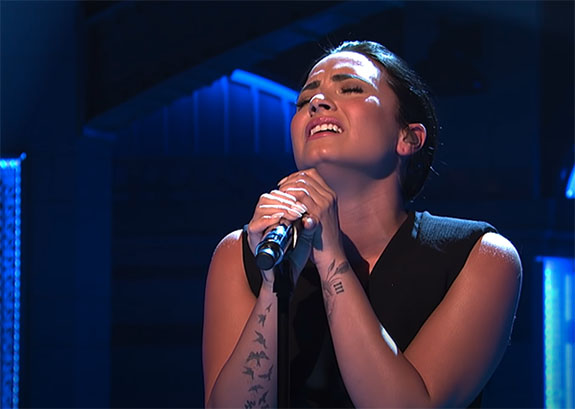
Welcome to Music Friday when we bring you great songs with jewelry, gemstones or precious metals in the title or lyrics. Today’s installment features Demi Lovato performing “Stone Cold,” her rousing, platinum-selling, 2015 power ballad about the pain of watching an ex-boyfriend moving on to a new relationship.

Lovato seems to channel English superstar Adele as she sings, “Stone cold, stone cold / I was your amber, but now she’s your shade of gold.”

Lovato compares herself to amber, a soothing gemstone known to symbolize wisdom, maturity and protection. But Lovato's amber characteristics can't compete with the intoxicating allure of gold.

“This song hurts so unbelievably bad," she told her her 42 million Instagram followers in 2015. "And when I perform it on a TV show, in rehearsals or even in a bathtub, it completely takes me to a different place.” (Her Instagram following has since grown to 149 million.)

Lovato noted that the process of writing and recording “Stone Cold” was therapeutic. For her, the song became a source of healing and catharsis. She said at the time that “Stone Cold” is a song people can listen to when they’re going through a breakup, or they’re thinking about a time when they were heartbroken.

“It’s gonna give them that voice that they need to hear in order to get past things and process how they feel,” she told Radio.com.

Lovato called “Stone Cold” her favorite single from her Confident album and was hoping that it would net her a Grammy.

She told Complex, “I want the Grammy committee to hear [that song] so that one day they can see that I know that I’m capable of getting there. You can’t go higher than the Grammys in the music industry. That was a huge goal for this album. I watched the Grammy nominations last year and I was like, ‘I want to be there so bad.'”

She didn't get a nomination for "Stone Cold," but did eventually capture two Grammy nominations, one in 2017 for Best Pop Vocal Album and in 2019 for Best Pop Duo/Group Performance.

Born in Dallas in 1992, Demetria Devonne Lovato got her first break at the age of 7 as a cast member of Barney and Friends. Acting alongside Lovato on the popular kids' TV show was fellow songstress Selena Gomez. In 2008, Lovato starred in the Disney Channel television film Camp Rock and, shortly thereafter, signed a recording contract with Hollywood Records. At age 19, she became the youngest-ever X Factor judge.

Please check out the video of Lovato performing “Stone Cold” on Saturday Night Live in October of 2015. The lyrics are below if you’d like to sing along…

“Stone Cold”
Written by Demi Lovato and Laleh Pourkarim. Performed by Demi Lovato.

Stone cold, stone cold
You see me standing, but I’m dying on the floor
Stone cold, stone cold
Maybe if I don’t cry, I won’t feel anymore

Stone cold, baby
God knows I tried to feel
Happy for you
Know that I am, even if I
Can’t understand, I’ll take the pain
Give me the truth, me and my heart
We’ll make it through
If happy is her, I’m happy for you

Stone cold, stone cold
You’re dancing with her, while I’m staring at my phone
Stone cold, stone cold
I was your amber, but now she’s your shade of gold

Stone cold, baby
God knows I tried to feel
Happy for you
Know that I am, even if I
Can’t understand, I’ll take the pain
Give me the truth, me and my heart
We’ll make it through
If happy is her, I’m happy for you

Credits: Screen captures via YouTube.com.

Wednesday, February 15, 2023

Mastercard Survey: Surge in January Retail Sales Signals Strong Start to 2023

Bolstered by strong economic indicators and a positive swing in consumer confidence, US retail sales jumped a healthy 8.8% year-over-year in January 2023, according to Mastercard SpendingPulse™. The credit card company’s January report spotlighted the jewelry and restaurant sectors due to their impressive performances.

Jewelry sales were up 6.5% YOY in January, potentially reflecting early Valentine's Day shopping. The positive January sales stats reversed a slight decline seen in December of 2022.

Jewelry-sector sales were down 5.4% YOY in December 2022, but still very respectable considering the sector was trying to keep up with the off-the-charts December 2021 performance, when jewelry sales increased YOY by 32%.

Eateries had a particularly good holiday season and start to 2023. Coming off a strong year of growth in 2022, spending at restaurants remained a high priority for consumers. That segment registered a 24.2% YOY increase in January.

"Consumer spending remains resilient in the first few weeks of 2023,” said Steve Sadove, Mastercard Senior Advisor and Former CEO of Saks, Inc. “Mastercard SpendingPulse insights show that the overall retail story remains largely positive with January posting a solid month of growth across the country.”

The Mastercard analysts believe consumers have been encouraged by the state of the labor market and rising wages.

"The primary factor driving spending decisions is income – not just income today but the expectation for income tomorrow.” said Michelle Meyer, North America Chief Economist, Mastercard Economics Institute. “The strength in the labor market remains a critical support for consumer purchasing power and we’re seeing this reflected in our SpendingPulse insights for January.”

The US unemployment rate dropped to 3.4% in January 2023, the lowest level seen in 54 years. Meanwhile, the US economy added 517,000 jobs in January, the most in six months.

The Conference Board "Consumer Confidence Index" recently published a revised assessment of how Americans view current business and labor conditions.

Exactly 20.2% of respondents said business conditions were "good," up from 19.2% a month ago, while 48.2% said jobs were "plentiful," up from 46.4%.

Mastercard SpendingPulse™ findings are based on aggregate sales activity in the Mastercard payments network, coupled with survey-based estimates for certain other payment forms, such as cash and check.

Credit: Image by Bigstockphoto.com.