Friday, August 12, 2022

Music Friday: 'There's a Lady Who's Sure All That Glitters Is Gold' in 'Stairway to Heaven'

Welcome to Music Friday when we bring you classic songs with jewelry, gemstones or precious metals in the lyrics or title. Today, we present Heart’s amazing rendition of what is arguably one of the greatest rock songs of all time, Led Zeppelin’s “Stairway to Heaven.”

Co-writer and lead vocalist Robert Plant revealed in Led Zeppelin: The Biography that the gilded lyrics came to him in a flash of inspiration.

“I was holding a pencil and paper, and for some reason I was in a very bad mood," he said. "Then all of a sudden my hand was writing out the words, ‘There’s a lady who’s sure all that glitters is gold / And she’s buying a stairway to heaven.’ I just sat there and looked at the words and then I almost leapt out of my seat.”

Plant explained that the story is about a woman who gets everything she wants without giving anything back. She accumulates great wealth, only to find out her life has no meaning and that her money won’t get her into heaven.

Despite that basic premise, the song is filled with thought-provoking metaphors, allusions and mystical references.

“Depending on what day it is, I still interpret the song a different way — and I wrote the lyrics,” Plant said, according to songfacts.com.

Released in 1971 as the fourth track of Led Zeppelin IV, “Stairway to Heaven” became the group’s signature song. Amazingly, it was the most requested song on FM radio stations in the US in the 1970s even through the original version ran 8:02 and was never released as a single.

DJs played promotional singles, which quickly became collector’s items. In 2000, VH1 selected “Stairway to Heaven” #3 on its list of the 100 Greatest Rock Songs of all time.

Led Zeppelin, which is widely considered one of the most successful and influential rock groups in history, disbanded shortly after the death of drummer John Bonham in 1980.
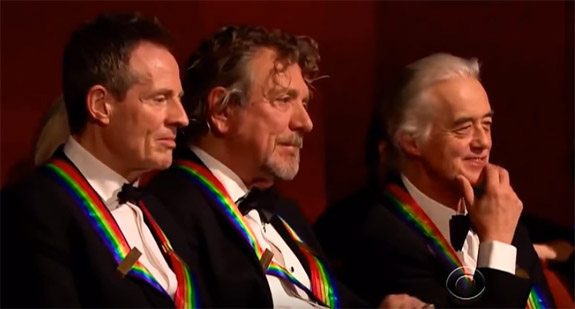
In December 2012, Led Zeppelin’s legacy was the focus of a star-studded tribute at the Kennedy Center in Washington, DC. Surviving members Robert Plant, Jimmy Page and John Paul Jones watched from the balcony with great pride as Ann and Nancy Wilson of Heart — supported by a full orchestra and powerful choir — brought down the house with an inspired performance of “Stairway to Heaven.”

The video of the performance earned more than 86 million views on YouTube.

Playing the drums was Jason Bonham, who looked strikingly like his dad, John, and is a fabulous talent in his own right. Plant is clearly misty eyed as the song builds to a rousing crescendo.

It’s an amazing moment in rock history, and we have a great video to share. We know you will love Heart’s brilliant rendition of “Stairway to Heaven,” which was broadcast on CBS. The lyrics are below if you’d like to sing along…

“Stairway to Heaven”
Written by Jimmy Page and Robert Plant. Originally performed by Led Zeppelin. Tribute performed by Heart.

There’s a lady who’s sure
All that glitters is gold
And she’s buying a stairway to heaven

When she gets there she knows
If the stores are all closed
With a word she can get what she came for

Ooh ooh ooh ooh
and she’s buying a stairway to heaven

There’s a sign on the wall
But she wants to be sure
‘Cause you know sometimes words have two meanings

In a tree by the brook
There’s a songbird who sings
Sometimes all of our thoughts are misgiving

Ooh, it makes me wonder

There’s a feeling I get
When I look to the west
And my spirit is crying for leaving

In my thoughts I have seen
Rings of smoke through the trees
And the voices of those who stand looking

Ooh, yeah.
Ooh, yeah

Your head is humming and it won’t go
In case you don’t know
The piper’s calling you to join him
Dear lady, can you hear the wind blow
And did you know
Your stairway lies on the whispering wind

And as we wind on down the road
Our shadows taller than our soul
There walks a lady we all know
Who shines white light and wants to show
How everything still turns to gold
And if you listen very hard
The tune will come to you at last
When all are one and one is all
To be a rock and not to roll

And she’s buying the stairway to heaven

Credits: Screen captures via YouTube.

Wednesday, August 10, 2022

Crater of Diamonds State Park Celebrates 50th Anniversary With Esperanza Replica

Crater of Diamonds State Park in Murfreesboro, AR, is celebrating its 50th Anniversary by offering park guests a limited-edition replica of the famous 4.60-carat, D-flawless Esperanza diamond pendant.

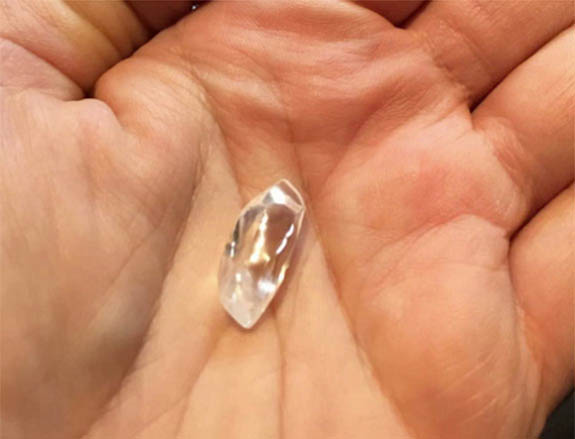
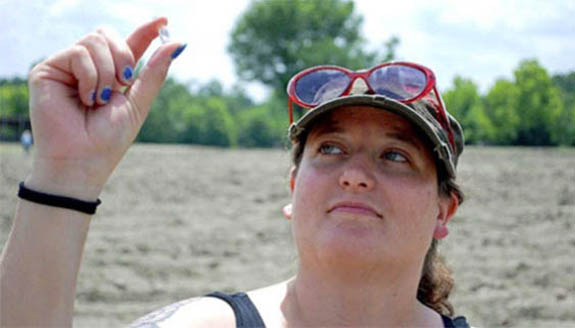
Discovered in 2015 by Bobbie Oskarson, the icicle-shaped Esperanza weighed 8.52 carats uncut and was the fifth-largest diamond ever found at the park. The Coloradan spotted the diamond within 20 minutes of entering “The Pig Pen,” a section of the 37 1/2-acre plowed field that is actually the eroded surface of an extinct, diamond-bearing volcanic pipe.

A ceremonial shovel affixed to an informative sign now marks the exact spot where the Esperanza diamond was unearthed.

Later in 2015, the oblong rough was cut into a first-of-its-kind triolette shape by master diamond cutter Mike Botha during a weeklong live-streamed event at Stanley Jewelers Gemologist in North Little Rock, AR.

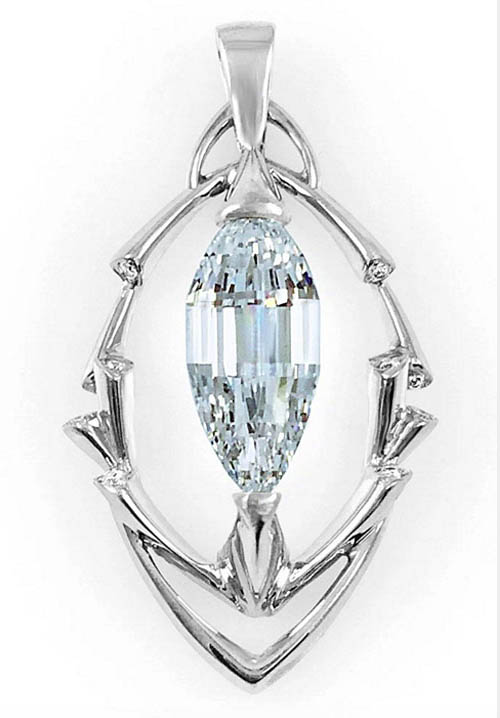
Botha’s 147-facet triolette resembles a teardrop and merges the elements of both emerald and trapezoid shapes. The painstaking cutting and polishing process took 130 hours.

Upon completion, the diamond was shipped to the American Gem Society Laboratories, where it was graded as colorless (D) and internally flawless (IF). The Gemological Institute of America later affirmed the D-flawless grading.

Now owned by a team of three investors, the Esperanza (meaning “hope” in Spanish) is said to be worth upwards of $1 million, making it one of the most valuable diamonds ever found in the U.S.

Master jeweler Ian Douglas designed a custom setting for the Esperanza, featuring flowing shapes that complement the diamond’s cut. Jewelry manufacturer Byard Brogan crafted the pendant out of platinum.

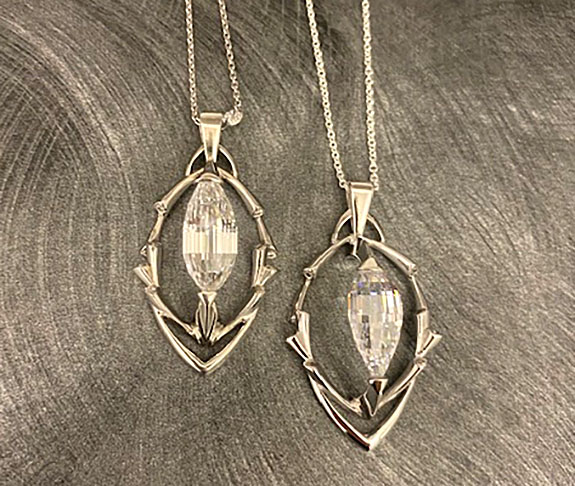
The replicas — in a limited series of 35 units — feature a cubic zirconia faux Esperanza set in sterling silver. Each piece was crafted under the strict supervision of the original team. The photo above shows the actual Esperanza diamond pendant (left) alongside its near-identical replica, minus the diamond accents.

Each replica comes with a certificate of authenticity signed by Mike Botha - Master Diamond Cutter, and may be purchased at the park for $500.

More than 33,100 diamonds have been found by park visitors since the Crater of Diamonds became an Arkansas state park in 1972.

Credits: Images courtesy of Crater of Diamonds State Park; Facebook.com/theesperanza; Laura Stanley.

Monday, August 08, 2022

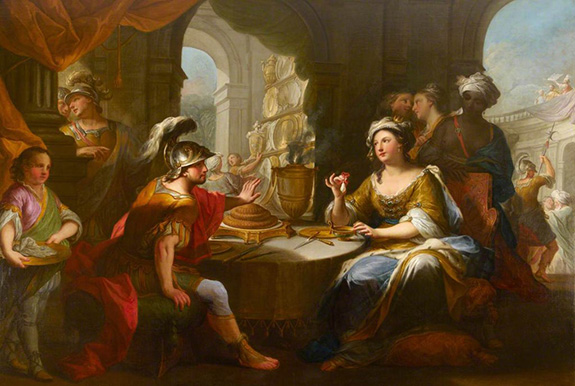
Cleopatra Demonstrated Her Wealth to Marc Antony by Drinking a Pearl Cocktail

Legend has it that in the year 41 BC Cleopatra gulped down a pearl-infused cocktail to demonstrate to her lover — the Roman leader Marc Antony — her immense wealth and power.

Roman naturalist and philosopher Pliny the Elder (23 - 79 AD) offered a detailed account of the event in his book, Natural History. It's been called one of the most celebrated banquets in literature and here's how it went down.

Pliny the Elder wrote, "There were formerly two pearls, the largest that had been ever seen in the whole world: Cleopatra, the last of the queens of Egypt, was in possession of them both, they having come to her by descent from the kings of the East."

The 28-year-old Cleopatra (69 - 30 BC) was Egypt's hostess with the mostest, and with Antony (83 – 30 BC) as her guest, she spared no expense to impress him. The meals she presented were so extravagant that the Roman politician and general wondered out loud if it was even possible to make the banquets more magnificent.

Cleopatra responded that she could spend 10 million sesterces on a single dinner. (Scholars believe the equivalent value in today's dollars might be $25 million or more).

Pliny the Elder explained, "Antony was extremely desirous to learn how that could be done, but looked upon it as a thing quite impossible; and a wager was the result."

On the following day, Cleopatra — her face set alight by her priceless pearl earrings — hosted another spectacular banquet, but it was no better than what Antony had experienced before.

When the second course was served, Antony curiously looked on as a single vessel filled with vinegar was placed before the queen.

According to Plany the Elder, the liquid possessed the sharpness and strength to dissolve pearls.

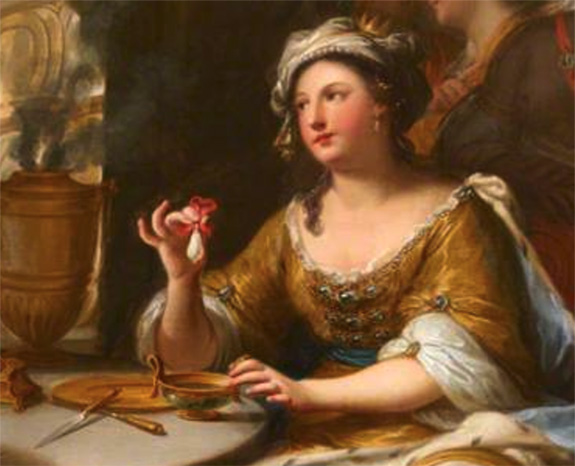
"At this moment she was wearing in her ears those choicest and most rare and unique productions of Nature," he wrote, "and while Antony was waiting to see what she was going to do, taking one of them from out of her ear, she threw it into the vinegar, and directly it was melted, swallowed it."

Lucius Plancus, who had been named umpire in the wager, placed his hand upon the other pearl at the very instant Cleopatra was making preparations to dissolve it in a similar manner, and declared that Antony had lost the bet.

Pliny the Elder's accounting of this story has sparked the imagination of scientists and gemologists, who wondered if melting a pearl in vinegar is really a thing.

Youtubers have tried to duplicate the feat, and scholars have written about it in professional journals. The bottom line is that, yes, pearls can be dissolved in vinegar but, no, they don't dissolve instantly, as Pliny described.

Pearls consist of calcium carbonate. Vinegar is acetic acid. When combined, there is a chemical reaction that initiates the breakdown of the pearl into calcium acetate, water and carbon dioxide.

In the Youtube experiments, pearls can be seen losing their form and turning into a gel-like substance within a few days of vinegar submersion.

Tip: In addition to vinegar, pearls shouldn't be exposed to chlorine bleach, hydrogen peroxide, ammonia, hairspray, perfume, cosmetics or any harsh chemicals.

It is plausible that Cleopatra crushed the pearl before immersing it in vinegar and swallowing it down. Many recent accounts of the Cleopatra-Antony banquet wager attempt to correct Pliny the Elder's apparent scientific inaccuracies by describing the pearl as crushed or pulverized.

Credit: Painting by Andrea Casali (1705-1784). Andrea Casali, Public domain, via Wikimedia Commons.

Friday, August 05, 2022

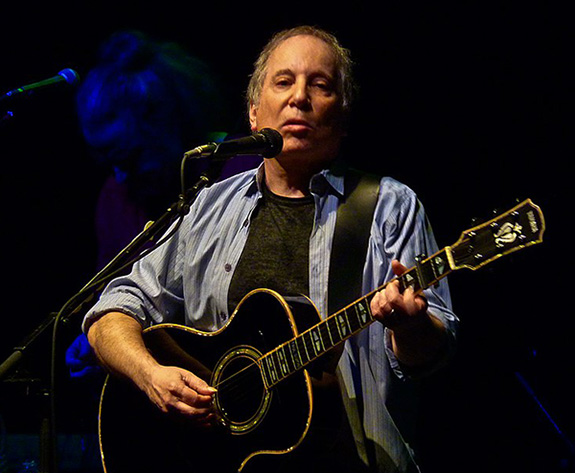
Music Friday: Paul Simon Sings About a Girl With 'Diamonds on the Soles of Her Shoes'

Welcome to Music Friday when we bring you fabulous songs with jewelry, gemstones or precious metals in the title or lyrics. Today, rock legend Paul Simon tells the story of an unlikely romance between a poor boy and a rich girl in New York City. Simon says the boy is as "empty as a pocket" and she's got "diamonds on the soles of her shoes."

The meaning behind the gem-embellished footwear has been hotly debated since Simon first performed "Diamonds on the Soles of Her Shoes" on Saturday Night Live in 1986. Do the diamonds simply symbolize conspicuous consumption or is there something much deeper that the singer-songwriter wanted to convey?

Simon sings, "People say she’s crazy / She’s got diamonds on the soles of her shoes / Well, that’s one way to lose these / Walking blues / Diamonds on the soles of her shoes."

Some critics see the girl in Simon's story as an unlikeable character who is so rich she can afford to set diamonds into the bottoms of her shoes. Others believe she is metaphorically hiding her wealth.

But, perhaps Simon has created an enchanting character who sees the best in everything. One contributor to songmeanings.com compared wearing diamonds on the soles of one's shoes to looking at the world through rose-colored glasses.

"Everywhere you go, your interaction is done through the diamonds on your shoes," he wrote, "and diamonds as a symbol of wealth, happiness and love mean you are interacting with your world through a constant 'happy' filter, you have a skip to your step, you are happy."

The same writer believes the poor boy may have not been poor in the literal sense of the word. He wears ordinary shoes, which may mean he's just poor in spirit.

After a night of dancing, the couple falls asleep in a doorway on Upper Broadway in Manhattan. At that point, the lyrics change. They're now wearing diamonds on the soles of "their" shoes. The poor boy has finally discovered love and true happiness.

"Diamonds on the Soles of Her Shoes," which features guest vocals by a South African group called Ladysmith Black Mambazo, was released as the fifth track on Simon's wildly successful Graceland album. Frequently cited as one of the best albums of all time, Graceland sold more than 14 million copies and won the 1987 Grammy for Album of the Year.

Born in Newark, NJ, and raised in Queens, NY, the 80-year-old Simon is one of the world's most accomplished singer/songwriters. He’s won 12 Grammy Awards and has been inducted into the Rock and Roll Hall of Fame twice (once as a solo artist and the other time as half of Simon & Garfunkel). He also was named by Time Magazine as one of the “100 People Who Shaped the World.”

Trivia: The brainy Simon attended Brooklyn Law School for one semester in 1963.

Please check out the video of Simon's live performance of "Diamonds on the Soles of Her Shoes" at The African Concert in 1987. The lyrics are below if you'd like to sing along…

"Diamonds on the Soles of Her Shoes"
Written by Paul Simon and Joseph Shabalala. Performed by Paul Simon with Ladysmith Black Mambazo singing group.

(a-wa) O kod wa u zo-nge li-sa namhlange
(a-wa a-wa) Si-bona kwenze ka kanjani
(a-wa a-wa) Amanto mbazane ayeza

She’s a rich girl
She don’t try to hide it
Diamonds on the soles of her shoes

He’s a poor boy
Empty as a pocket
Empty as a pocket with nothing to lose
Sing, Ta na na
Ta na na na
She got diamonds on the soles of her shoes
Ta na na
Ta na na na
She got diamonds on the soles of her shoes
Diamonds on the soles of her shoes
People say she’s crazy
She’s got diamonds on the soles of her shoes
Well, that’s one way to lose these
Walking blues
Diamonds on the soles of her shoes

She was physically forgotten
Then she slipped into my pocket
With my car keys
She said, “You’ve taken me for granted
Because I please you
Wearing these diamonds”

And I could say, Oo oo oo
As if everybody knows
What I’m talking about
As if everybody here would know
What I was talking about
Talking about diamonds on the soles of her shoes

She makes the sign of a teaspoon
He makes the sign of a wave
The poor boy changes clothes
And puts on aftershave
To compensate for his ordinary shoes

And she said, “Honey take me dancing”
But they ended up by sleeping
In a doorway
By the bodegas and the lights on
Upper Broadway
Wearing diamonds on the soles of their shoes

And I could say Oo oo oo
And everybody here would know
What I was talking about
I mean, everybody here would know exactly
What I was talking about
Talking about diamonds

People say I’m crazy
I got diamonds on the soles of my shoes
Well, that’s one way to lose
These walking blues
Diamonds on the soles of your shoes

Credit: Photo by Matthew Straubmuller (imatty35), CC BY 2.0 https://creativecommons.org/licenses/by/2.0, via Wikimedia Commons.

Thursday, August 04, 2022

Might August's Birthstone — Peridot — Play a Key Role In Reversing Climate Change?

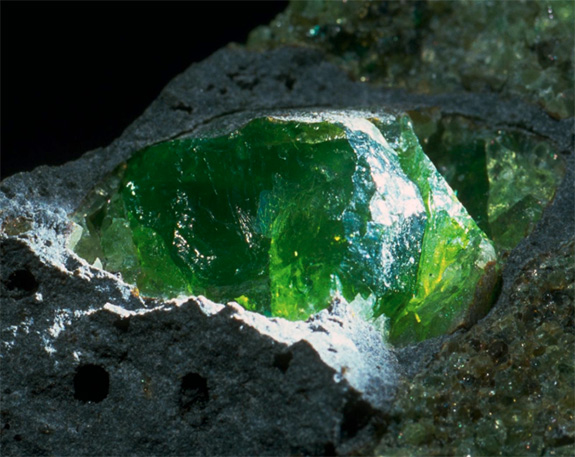
Did you know that olivine, the non-precious variety of August's birthstone — peridot — could play a key role in the global effort to reverse the effects of climate change?

According to scientists at the Project Vesta, olivine's chemical makeup is perfectly suited to counter ocean acidification and permanently remove carbon dioxide from the atmosphere.

They've calculated that a billion tons of olivine sand distributed over 28,000 miles of coastline annually will result in the capture of 1 gigaton of CO2. The wave action of beaches on crushed olivine allows for more rapid weathering than other natural deposits of olivine.

"Olivine absorbs carbon dioxide through a chemical reaction similar to the rusting of iron metals," explained The Daily Beast, "except that instead of iron + water + oxygen = rust, the reaction goes olivine + carbon dioxide + water = silicate + calcium carbonate + magnesium ions."

Olivine is nature's air purifier, sucking carbon dioxide out of the sky and ocean and locking it up in harmless products that can form things like coral reefs, noted The Daily Beast.

“If we spread olivine over 2% of the world’s shelf sea, then that will be enough to capture 100% of human emissions,” Tom Green, executive director of Project Vesta, told fastcompany.com.

The scientists at the Vesta Project emphasized that olivine is globally abundant and accessible. It makes up more than 50% of the Earth's upper mantle and more than a trillion tons can be collected easily.

At full scale, they claim, the distribution of olivine will cost less than 10% of the price of other carbon capture technologies.

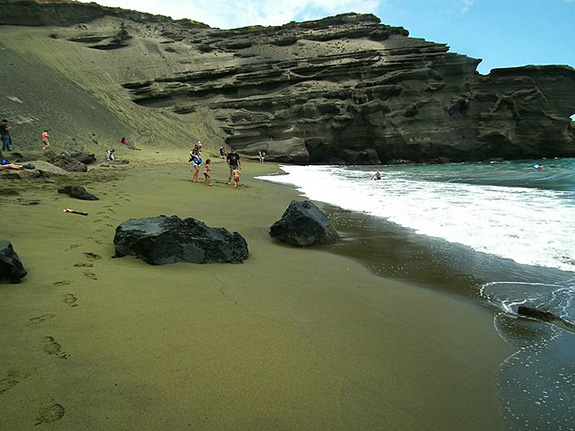
If, and when, the Vesta Project gets off the ground, beaches around the globe will start looking a lot like Hawaii’s Mahana Beach.

Today, that's the most popular of only four “green” beaches in the world. The others are Talofofo Beach on Guam, Punta Cormorant on Floreana Island in the Galapagos Islands and Hornindalsvatnet in Norway.

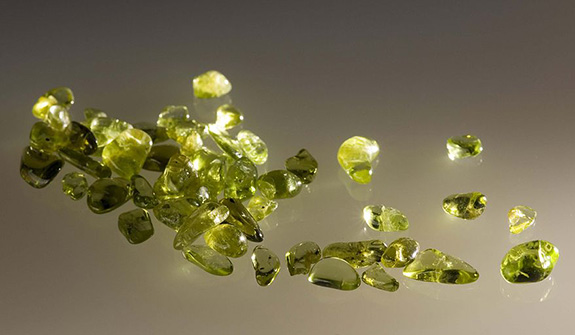
These beaches owe their astounding color to olivine crystals eroded from the belly of ancient volcanoes and delivered to the shore by ocean waves.

Hawaiians refer to peridot as the “Hawaiian Diamond,” and small peridot stones are sold as “Pele’s tears” in honor of Pele, the goddess of volcanoes.

In addition to being the official birthstone of August, peridot is also the 16th anniversary gemstone. Colors range from pure green to yellowish-green to greenish-yellow, but the finest hue is green without any hint of yellow or brown, according to the Gemological Institute of America.

Peridot is currently sourced in Burma, the US, Norway, Brazil, China, Australia and Pakistan. The world’s largest faceted peridot weighs 310 carats and is part of the Smithsonian’s National Gem and Mineral Collection.

Credit: Peridot photo by Chip Clark / Smithsonian. Beach image by Wasif Malik, CC BY 2.0, via Wikimedia Commons. Closeup of beach sand by Tom Trower, NASA Ames Research Center, Public domain, via Wikimedia Commons.