Friday, April 08, 2022

Music Friday: Billy Joel Leaves a Life of Pearls and Caviar in 'I’ve Loved These Days'

Welcome to Music Friday when we bring you fabulous songs with jewelry, gemstones or precious metals in the title or lyrics. In 1976, music legend Billy Joel said goodbye to Hollywood and returned to a New York state of mind. His wistful farewell to an L.A. lifestyle of fine jewelry, silk robes and caviar is chronicled in the beautiful, but unheralded, “I’ve Loved These Days.”
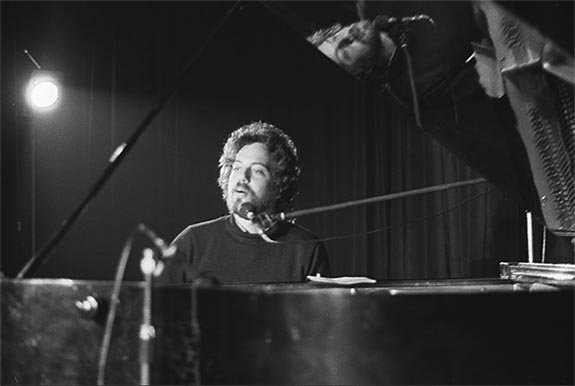
Joel sings, “Now as we indulge in things refined / We hide our hearts from harder times / A string of pearls, a foreign car / Oh we can only go so far / On caviar and cabernet.”

“The song is essentially one man’s farewell to a lifestyle that is as alluring as it is unsustainable,” wrote Jim Beviglia in his 2012 review in American Songwriter.

“I’ve Loved These Days” made its debut as the seventh track of Turnstiles, Joel’s fourth studio album. It appeared again 24 years later as the eighth track on disc one of 2000 Years: The Millennium Concert. Although it never was released as a single, Joel continues to perform “I’ve Loved These Days” to sold-out concert audiences.

(Trivia: The working title of "I've Loved These Days" was "These Rhinestone Days." You can check out the rare audio track of the demo at the end of this post.)

Turnstiles marked a critical turning point in Joel’s career — a time when he started to take control of his creative process.

“I produced it myself, which, in hindsight, was probably not a good idea,” Joel told WNYC, “but I didn’t want people telling me what band to work with, how to do the songs. I wanted to do it my way.”
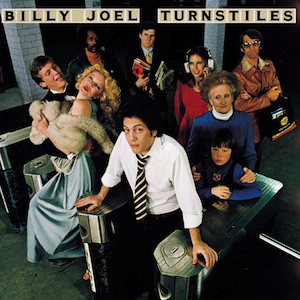
The cover photo of the Turnstiles album features an esoteric cast of characters posing at the Astor Place subway station in New York City. Each character is linked with one of the songs from the album. The wealthy couple represents “I’ve Loved These Days” and, specifically, the life he left behind in Los Angeles.

The 72-year-old Joel, who was born in the Bronx and raised on Long Island, is one of the most prolific and successful recording artists of all time, with more than 160 million records sold worldwide. Boasting 33 Top 40 hits and 23 Grammy nominations, Joel was inducted into the Songwriters Hall of Fame in 1992 and the Rock and Roll Hall of Fame in 1999.

Please check out Joel’s live performance of “I’ve Loved These Days” from 2000 Years: The Millennium Concert, a two-disc set that was recorded on New Year’s Eve 1999 at Madison Square Garden in New York City. The lyrics are below if you’d like to sing along…

“I’ve Loved These Days”
Written and performed by Billy Joel.

Now we take our time, so nonchalant
And spend our nights so bon vivant
We dress our days in silken robes
The money comes
The money goes
We know it’s all a passing phase

We light our lamps for atmosphere
And hang our hopes on chandeliers
We’re going wrong, we’re gaining weight
We’re sleeping long and far too late
And so it’s time to change our ways
But I’ve loved these days

Now as we indulge in things refined
We hide our hearts from harder times
A string of pearls, a foreign car
Oh we can only go so far
On caviar and cabernet

We drown our doubts in dry champagne
And soothe our souls with fine cocaine
I don’t know why I even care
We’ll get so high and get nowhere
We’ll have to change our jaded ways
But I’ve loved these days

So before we end and then begin
We’ll drink a toast to how it’s been
A few more hours to be complete
A few more nights on satin sheets
A few more times that I can say
I’ve loved these days

"These Rhinestone Days" (Demo)

Credits: Photo (top) by Rob Mieremet / Anefo, CC0, via Wikimedia Commons. Album cover by Columbia Records.

Wednesday, April 06, 2022

Copper-Flecked Inclusions Give Oregon Sunstones Their Unique 'Schiller'

Oregon Sunstones are truly unique because they contain tiny flecks of copper that give the stones a reddish-to-golden metallic sheen called "schiller." Sunstones exist in other parts of the world but, oddly, only the ones from Oregon contain copper.

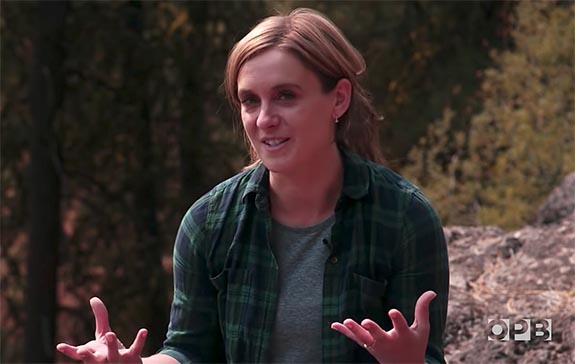
In a nine-minute “Oregon Field Guide” video produced by the Oregon Public Broadcasting (OPB), geologist Emily Cahoon describes her mission to unravel the mysteries behind Oregon's official state gemstone.

In 2016, the volcanologist, geochemist and igneous petrologist stumbled upon Oregon's Ponderosa Mine, one of the world's primary sources of Oregon Sunstones.

At first, she was thrilled like a kid in a candy store.

“I saw these sunstones and was like ‘This is so cool!'" she said.

But then, as she did more research, she was shocked to learn that the scientific community really didn't know how the gems formed, even at the most basic level.

She wondered: If the gems get their schiller from inclusions of copper, did the copper enter the crystal when it was forming or at some later time?

Cahoon dated the lava flows of the flood basalt where Oregon Sunstones are found. Surprisingly, the gems embedded in the lava turned out to be younger than the lava itself — and that really didn't make sense.

She's also trying to noodle out the connection between copper and sunstone, which is a shimmery variety of labradorite that is found very specifically in the state's Columbia River Flood Basalts.

"Copper shouldn't want to go into labradorite," she said. "There's so much to learn still."

As a research associate at Oregon State University, Cahoon is working to understand how sunstones fit into the volcanic history of Oregon and the Columbia River basalts.

"But, also, just being basically on the cutting edge of how a gemstone forms is incredible and just a lot of fun," she told OPB.

Oregon Sunstone is a member of the feldspar family, a mineral that makes up more than half of the Earth’s crust. Oregon Sunstones are found in a wide range in hues, from yellow and green to red and pink. They also can be colorless or multicolored.

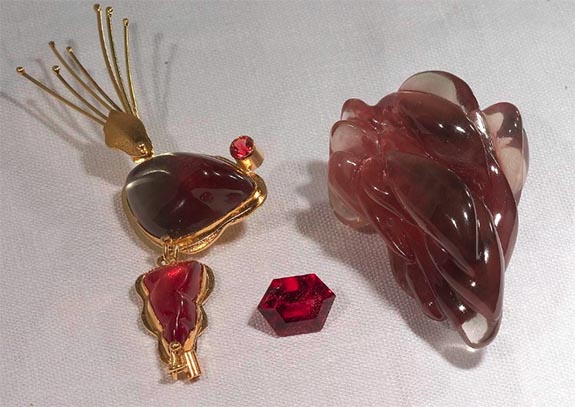
Here are some Oregon Sunstone specimens from the Smithsonian's National Gem Collection. The pendant at the far right was designed and carved by Nancy Chan and Greg Fraser. The center sunstone, “Spitfire,” weighs 4.53 carats and was faceted by Paul Paulson. The sunstones at the far left, “Eternal Flight,” weigh 174 carats and were carved by Bobbie Lorett.

Please check out the OPB video below…

Credit: Photo at top via Astynax, Public domain, via Wikimedia Commons. Screen capture of Emily Cahoon via OPG.com (Oregon Public Broadcasting). Photo at bottom by Ken Larsen / Smithsonian.

Monday, April 04, 2022

Olympic Gymnast Simone Biles Wears a Stand-In Engagement Ring at the Gym

Newly engaged Simone Biles revealed in an Instagram Story that she wears a stand-in engagement ring during her rigorous workouts at the gym.

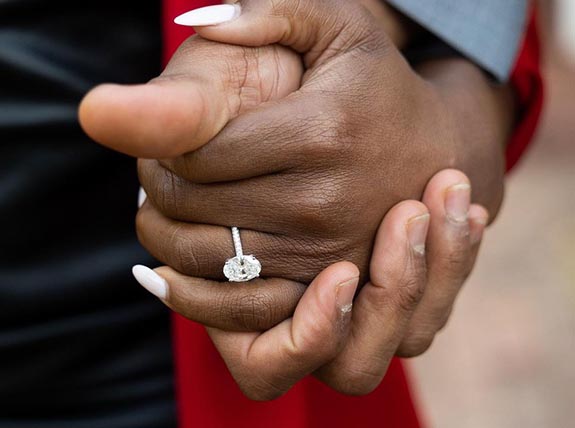
The simple, white silicone ring is punctuated by a petite full-cut diamond set in a bezel of 14-karat white gold.

“Okay HOW CUTE," the 25-year-old captioned a closeup shot of her new bling. "So I can work out & not damage my engagement ring.” She punctuated the post with two white heart emojis and a silly face.

On Valentine's Day, the seven-time Olympic medalist received a 3-carat oval-cut diamond engagement ring from Houston Texans free safety Jonathan Owens. The VVS2, F-color center stone was prong-set on a three-row, micro-pavé diamond band and is estimated to be worth approximately $300,000.

Biles had announced her engagement via Instagram with a series of proposal photos and a caption that read, “THE EASIEST YES. I can’t wait to spend forever & ever with you, you’re everything I dreamed of and more! let’s get married FIANCÉ.”

Four days after her engagement, Biles told the audience of The Today Show how much she loved her new ring.

“It’s definitely my most prized possession now and I’m always wearing it,” she declared during a Zoom-style interview. “It definitely beats a gold medal.”

She went on to admit that she had to consult her mom about whether she should ever take the ring off.

Biles explained, “I was washing my hair the other day and I took it off, just in case — I didn’t know if it was gonna get caught or anything — and I have to ask my mom, ‘When do you take it off, do you ever take it off?’ and stuff like that.”

Silicone rings have become popular choice for people who want to keep their bridal jewelry safe during physical activities. The silicon stand-in is pliable, durable, easy to clean and comfortable — especially when lifting weights, climbing and swimming.

Credits: Screen capture via Instagram.com / simonebiles.

Friday, April 01, 2022

Music Friday: Etta James Wants Diamonds, Not Flowers, in 1961’s ‘Tough Mary’

Welcome to Music Friday when we often bring you vintage songs with jewelry, gemstones or precious metals in the lyrics or title. Today, the spotlight shines on the legendary Etta James and her 1961 satirical romp, “Tough Mary.”

In the song, James steps into the role of Mary, a sassy and pretty girl who attracts more than her share of suitors. Boys come from miles around bearing gifts, but Mary makes it clear that it's going to take diamonds, not flowers, to get her attention.

James belts, “Don’t bring me flowers / Don’t bring me the sea / Just bring me diamonds, that’ll suit me fine / And I’ll love you forever, and you’ll be mine.”

“Tough Mary” is the fifth track on James’ At Last! album, a release that spawned four hits. One of those was the title song, which was to become the R&B legend’s signature tune. In 2012, Rolling Stone magazine ranked At Last! #119 on its list of the 500 Greatest Albums of All Time.

Born to a teen mother in 1938, Jamesetta Hawkins never knew her father and was raised primarily by her grandparents and foster families. She received her first professional vocal training at the age of five and soon became a popular singing attraction at the St. Paul Baptist Church in South Central Los Angeles.

She formed the doo-wop singing group — the Creolettes — with her friends in the early 1950s and scored her first hit single as a 15-year-old. One year later, James started dating B.B. King (“The King of the Blues”) and believed that King’s 1960 blockbuster hit “Sweet 16” was about her.

James went on to become a headliner in the early 1960s with a string of chart-toppers, including “The Wallflower,” “At Last,” “Tell Mama,” “Something’s Got a Hold on Me,” “Stormy Weather” and “I’d Rather Go Blind.”

Her unmistakable voice, unique style and ability to bridge so many musical genres — such as blues, R&B, soul, rock and roll, jazz and gospel — earned James coveted spots in the Rock and Roll Hall of Fame, Blues Hall of Fame and the Grammy Hall of Fame.

Often referred to as the “The Matriarch of R&B,” James passed away in 2012, just five days shy of her 74th birthday.

We hope you enjoy the audio track of James performing “Tough Mary.” The lyrics are below if you’d like to sing along…

“Tough Mary”
Written by Lorenzo Manley. Performed by Etta James.

Tough Mary, Tough Mary (Yeah, that’s me)
Tough Mary is tough

The boys would come from miles around
With presents every day
But when they’d call on Mary
This is what she’d say:

Don’t bring me posies, when it’s shoes I need
(Tough Mary, Tough Mary, Tough Mary, Tough Mary)
Don’t bring me flowers, don’t bring me the sea
(Tough Mary, Tough Mary, Tough Mary is tough)
Just bring me diamonds, that’ll suit me fine
(Tough Mary, Tough Mary, Tough Mary, Tough Mary)
And I’ll love you forever, and you’ll be mine
(Tough Mary, Tough Mary, Tough Mary is tough!)

Well, Mary, she’s a very pretty girl
I guess she was born that way
But whenever they would tell her that
This is what she’d say:

Don’t bring me posies, when it’s shoes I need
(Tough Mary, Tough Mary, Tough Mary, Tough Mary)
Don’t bring me flowers, don’t bring me the sea
(Tough Mary, Tough Mary, Tough Mary is tough)
Come on and bring me some diamonds, that’ll suit me fine
(Tough Mary, Tough Mary, Tough Mary, Tough Mary)
And I’ll love you forever, and you’ll be mine
(Tough Mary, Tough Mary, Tough Mary is tough!)

Tough Mary
Tough Mary
Tough Mary

Don’t bring me no posies, when it’s shoes I need
(Tough Mary, Tough Mary, Tough Mary, Tough Mary)
Don’t bring me flowers, don’t bring me the sea
(Tough Mary, Tough Mary, Tough Mary is tough)
Come on and bring me some diamonds, that’ll suit me fine
(Tough Mary, Tough Mary, Tough Mary, Tough Mary)
And I’ll love you forever, and you’ll be mine
(Tough Mary, Tough Mary, Tough Mary is tough!)

Oh, I’m tough
(Tough Mary, Tough Mary, Tough Mary, Tough Mary)
Yeah, yeah I’m tough

Credit: Photo by John K. Addis, CC BY-SA 3.0, via Wikimedia Commons.

Wednesday, March 30, 2022

Amazon's Virtual Assistant Alexa Says Painite Is the Rarest Gem Mineral Ever

Ask Amazon's Alexa to name the rarest gem mineral ever and the know-it-all virtual assistant is likely to answer, "Painite."

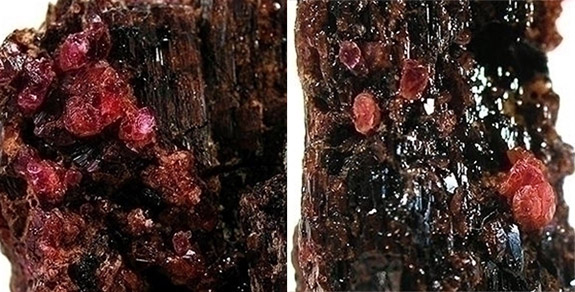
Unearthed in Myanmar by British mineralogist and gem dealer Arthur C.D. Pain in the 1950s, the rare borate mineral was originally misidentified as a ruby and then reclassified as a new gem species — named painite, to honor its discoverer — in 1957. Only two more painite crystals would surface over the next 44 years.

After 2001, new discoveries from the areas surrounding the Myanmar city of Mogok resulted in an influx of more than 1,000 orange-red and brownish-red crystals. This one place on Earth remains the only source of painite.

In 2005, the Guinness Book of World Records named painite as the world's rarest gem mineral. Painite has also been called the "Holy Grail" of rare gemstones.

Chemically, painite contains calcium, zirconium, boron, aluminum and oxygen, along with trace amounts of chromium and vanadium, which are responsible for painite's topaz-like colorations. The gem is strongly pleochroic, which means that different hues appear when the stone is viewed from various angles.

Painite's extreme rarity is attributed to the unlikely convergence of zirconium and boron in nature.

Painite boasts great brilliance, attractive colors and an impressive hardness of 8 on the Mohs scale (on par with topaz or spinel). On the other hand, painite is somewhat compromised by its tendency to display natural feather-like inclusions and fractures, rendering it difficult to facet. To minimize loss and damage, cutters generally favor small sizes and shallow faceting.

The best painite crystals are said to fetch up to $60,000 per carat.

Painite is often mistaken for ruby, spinel, almandine, garnet and tourmaline. On the flip side, what was thought to be a brown tourmaline in the Natural History Museum in London turned out to be a painite.

Credits: Images by Rob Lavinsky, iRocks.com – CC-BY-SA-3.0, CC BY-SA 3.0, via Wikimedia Commons.