Thursday, May 30, 2019

Flawless 'Bubble Gum Pink' Diamond Fetches $7.5 Million at Christie's Hong Kong

An internally flawless bubble gum pink diamond weighing 3.44 carats was the colorful star of Christie's Hong Kong auction on Tuesday as it sold for $7.5 million, or $2.2 million per carat.
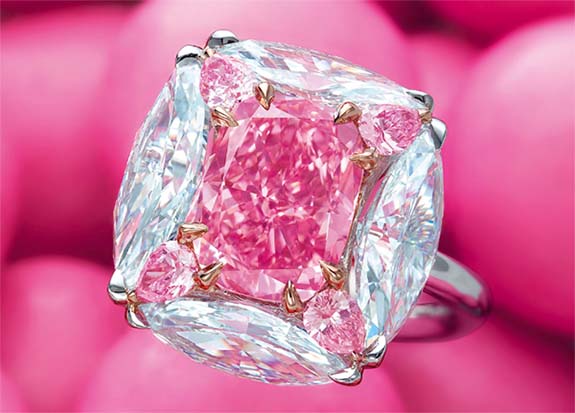
The cushion modified brilliant-cut diamond — aptly dubbed "The Bubble Gum Pink" — is set in a ring by luxury jeweler Moussaieff. The fancy vivid purplish-pink diamond is framed by small pear-shaped pink diamonds on the corners and larger marquise-cut white diamonds on the sides.

Celebrated for its superb color, The Bubble Gum Pink was classified by Christie's Chairman Francois Curiel as "probably the strongest pink I have ever seen in my 50-year life of jewelry specialty at Christie’s."

The hammer price for the auction's top lot was on the high end of Christie's pre-sale estimate of $6 million to $8 million.

Other top lots at the Magnificent Jewels event include the following:

• A pair of emerald earrings called The Grand Muzos fetched $4.5 million. The Colombian-sourced emeralds weigh 23.34 carats and 23.18 carats, respectively, and are accented by white diamonds and pearls. Each of the diamonds weighs exactly 3.01 carats and share identical F-color and VS2 clarity gradings. Christie's had estimated the pair would sell in the range of $3.8 million to $6.5 million.

• A necklace featuring 47 jadeite beads ranging in size from 9.8mm to 13.3mm and accented with a ruby and diamond clasp yielded $1.9 million, slightly below the pre-sale estimate of $2 million to $3 million. The necklace measures 22.24 inches (56.5cm) in length.
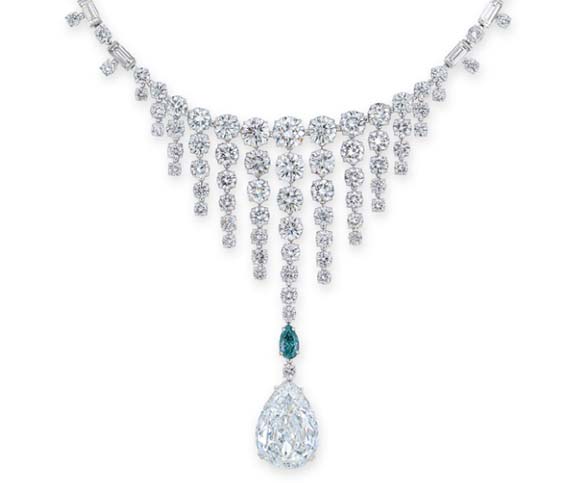
• An elaborate diamond necklace by Bulgari — highlighted by a rare 1.02-carat vivid green-blue modified brilliant-cut diamond and a modified pear brilliant-cut diamond of 11.69 carats — sold for $1.57 million. The large center diamond is internally flawless. The hammer price was just below the pre-sale estimate, which Christie's set at $1.6 million to $2.3 million.

The Christie's Magnificent Jewels sale in Hong Kong presented more than 260 lots and netted $44.4 million.

Credits: Images courtesy of Christie's.

Wednesday, May 29, 2019

'We're Closer Than Ever to Finding the Mother Lode' at Lulo Mine: Lucapa Chairman

The chairman of Lucapa Diamond Company told stockholders Monday that his exploration team is closer than ever to striking the mother lode at the flagship Lulo site in Angola.

While Lulo already has a reputation for turning out large, high-quality diamonds at its alluvial deposit, chairman Miles Kennedy believes the prospect of "huge wealth" is well within reach.

“There are no silver bullets in the kimberlite exploration game...” Kennedy said. “But the patient and methodical approach adopted by our exploration team is narrowing down and confining the search areas of our quest. It may take us another couple of years, but I am more confident than ever that we can indeed find the diamond source at Lulo.”

“And while kimberlite exploration can by nature be painstakingly slow," he added, "I am equally of the view that we are closer than ever to finding the mother lode...”

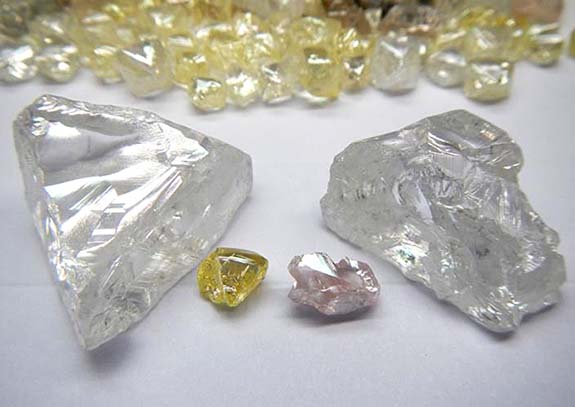
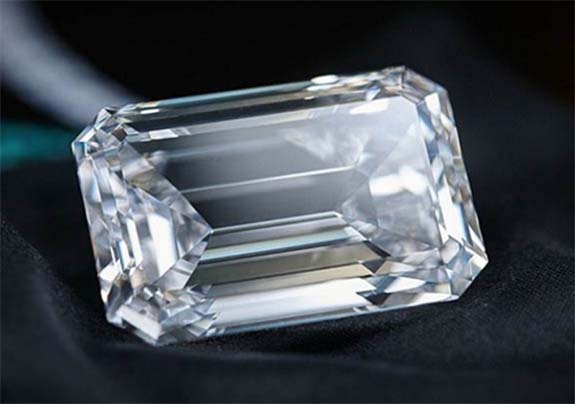
The Lulo mining area, which comprises 1,100 square miles along the length of the 31-mile Cacuilo River, has already generated a series of high-quality, impressive finds. The largest to date was discovered in 2016 and named "4 de Fevereiro." The 404.20-carat rough gem was eventually sold for $16 million to luxury jeweler De Grisogono, which cut it into a flawless 163.41-carat emerald-cut diamond.

To identify and protect sizable diamonds that might otherwise be damaged in the sorting process, Lucapa installed a $3.5 million state-of-the-art XRT large-diamond recovery system in 2017. The system uses advanced X-ray transmission technology (XRT) and larger screens (55mm) so diamonds up to 1,100 carats can be cherry picked. XRT technology is also more efficient at recovering low-luminescing, ultra-pure Type IIa diamonds. Diamonds from the Lulo site typically sell for $2,000 per carat.

Lucapa has a 40% stake in the Lulo mine and holds an exploration license that runs until April 2023. The mining firm maintains two partners in the project — Empresa Nacional de Diamantes EP and Rosas & Petales.

Credits: Rough diamond images courtesy of Lucapa Diamond Company. Emerald-cut "4 de Fevereiro" image via PRNewsfoto/de GRISOGONO.

Tuesday, May 28, 2019

Gold-Loving Fungus Is the Latest in a Series of Low-Impact Exploration Tools

A fluffy pink fungus that thrives on gold is the latest in a series of low-impact exploration tools available to Australian miners.

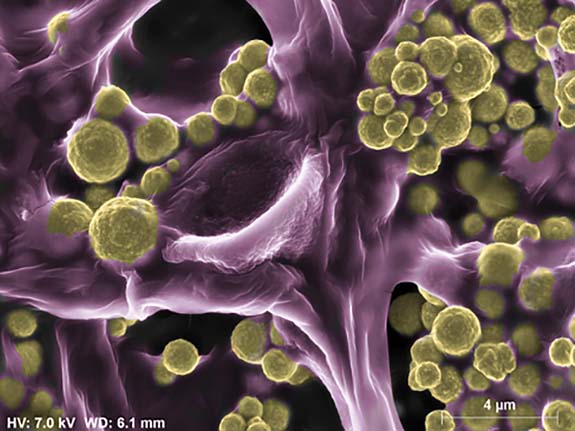
Geologists from Australia’s national science agency, CSIRO, reported that a thread-like fungus found 130 km southeast of Perth, has the ability to draw gold from the soil. What's special about the fungus, called Fusarium oxysporum, is that it uses a special chemical to dissolve the gold and another chemical to turn it back to a solid in the form of tiny nanoparticles.

A microscopic view of the fungus shows how its strands are coated in gold.

The presence of gold-rich fungi on the surface could provide valuable clues about new deposits underground. The geologists at CSIRO believe the fungi could provide a cost-effective way to find gold while reducing the impact on the environment.

Australia is the world's second largest gold producer, and while gold production reached all-time highs in 2018, forecasts show that production will decline in the near future unless new gold deposits are found.

And nature seems to be providing valuable new ways to support exploration without harming the environment.

Less than a month ago, we reported how leaves from the gum tree are helping miners pinpoint high-yield gold deposits in South Australia. Other Aussie miners are studying termites that harbor gold in their mounds. These tiny traces of gold can be linked to bigger deposits below the surface.

When comparing the fungi, CSIRO geologists noted the specimens with the most gold on their strands seemed to enjoy a biological advantage. They had the ability to grow larger and spread faster than those that didn’t interact with gold.

The geologists were surprised by the fungi's ability to synthesize gold.

"Fungi are well-known for playing an essential role in the degradation and recycling of organic material, such as leaves and bark, as well as for the cycling of other metals, including aluminium, iron, manganese and calcium," noted CSIRO lead author Dr. Tsing Bohu. "But gold is so chemically inactive that this interaction is both unusual and surprising – it had to be seen to be believed."

In the future, this gold-loving fungus might be employed not only to help pinpoint new gold deposits, but also to extract gold from sewage sludge and e-waste, such as discarded electronics.

The CSIRO gold-loving fungus findings were published in Nature Communications. The discovery was made possible thanks to collaboration among CSIRO, the University of Western Australia, Murdoch University and Curtin University.

Credit: Image courtesy of csiro.au.

Friday, May 24, 2019

Music Friday: YouTube Sensation Vidya Vox Is All About Diamonds and Gold

Welcome to Music Friday when we bring you fun songs with jewelry, gemstones or precious metals in the title or lyrics. Today, Youtube sensation Vidya Vox merges Indian classical music with Western pop, hip-hop and electronica in her 2017 release, "Diamonds."

This high-energy track opens with the description of a bedazzled Indian dancer. Vox sings, "Diamonds and gold / Mehndi and bangles / So beautiful / She moves like an angel / Dance like she don't got a / Care in the world like / Eh le le le le, le le le lo."

Indian culture puts a high value on fine jewelry and gemstones, and the Chennai-born artist who immigrated with her family from India to the US at the age of eight, is impressively adorned in the opening scene of her video.

She's wearing more than a dozen gold bangles, multiple rings, a lavish necklace, diamond nose chain and a "tikka" pendant on her forehead. The term "mehndi," which is noted in the lyrics, above, refers to the art of painting elaborate patterns on the skin with henna.

Co-written by Vox and her boyfriend Shankar Tucker, "Diamonds" was published to her official YouTube channel, which currently boasts 5.8 million subscribers. The "Diamonds" video has been viewed more than 26 million times.

Born Vidya Iyer in India in 1990, Vox grew up in Virginia, but always remained connected to her Indian roots. After majoring in psychology and biomedical sciences at George Washington University, she returned to her native India for two years to study music.

Due to her popularity on YouTube, the 28-year-old vlogger, dancer and actress has earned a cross-cultural, international following. She also regularly performs as a vocalist with the Shankar Tucker Band.

Please check out the video of Vox performing "Diamonds." Featured in the video is British singer-songwriter Arjun Coomaraswamy. The lyrics are below if you'd like to sing along...

"Diamonds"
Written by Shankar Tucker and Vidya Vox. Performed by Vidya Vox.

Diamonds and gold
Mehndi and bangles
So beautiful
She moves like an angel
Dance like she don't gotta
Care in the world like
Eh le le le le, le le le lo

Flames reachin' high
But can't touch the fire
Catchin' her eye
Her burning desire
She know she got it
When she sing her song like
Eh le le le le, le le le lo

Look up at the sky
The stars never shine all alone
Tonight is the night
Take a deep breath
Let it go

Eh le le le le, le le le lo

Lost in the night
Your rhythm takes over
Flames in the eyes
Keep drawing him closer
Exotic hypnotic she knows
He's about to move up on her
She got it, she got it
God knows he can't hold back no longer
Dancing so close
The temperature's rising
She just don't know
How sexy that smile is
She knows she's got it
When she sings the song like
Eh le le le le, le le le lo.

Look up at the sky
The stars never shine all alone
Tonight is your night
Just take a deep breath
Let it go

Eh le le le le, le le le lo
Eh le, eh le, eh le, lo

No, no, no, no, (Eh le, eh le, eh le, lo)
Girl, you're one of a kind (Eh le, eh le, eh le, lo)
I know you're feelin' the vibe (Eh le, eh le, eh le, lo)
Just give me tonight (Eh le, eh le, eh le, lo)
It's the way that you smile (Eh le, eh le, eh le, lo)
Baby, I'm losin' my mind (Shining like gold)
You gotta be mine
Girl, you're one of a kind
I know you're feelin' the vibe
Just give me tonight
It's the way that you smile (Don't shine alone)
Baby, I'm losin' my mind
You gotta be mine
Girl, you're one of a kind (Shining like gold))
I know you're feelin' the vibe
Just give me tonight (Woah)
It's the way that you smile
Baby, I'm losin' my mind

Eh le le le le, le le le lo (Let it go)
Eh le le le le, le le le lo (No)
Eh le le le le, le le le lo (Let it go)
Eh le le le le, le le le lo

Credit: Screen capture via YouTube.com.

Wednesday, May 22, 2019

Swiss Lab Employs Cutting-Edge Science to Affirm Age, Provenance of Historic Pearl

A Swiss gem lab used radiocarbon age-dating to affirm the 16th century origins of a 30.24-carat natural saltwater pearl once owned by a Spanish princess. It was the first time such a procedure had been conducted on a natural pearl.

The Swiss Gemmological Institute (SSEF) used the cutting-edge science to date the historic "Ana Maria Pearl," which was worn by Ana María de Sevilla y Villanueva, XIV Marquise of Camarasa (1828-1861). The natural pearl was presumed to have been discovered during the Spanish conquest of the Americas in the 16th century. The test confirmed that the historic formation age for the natural pearl was between the 16th and mid-17th century.

"The Ana Maria Pearl is a perfect example to show how scientific analyses can add supporting evidence to a documented historical provenance of a jewel," SSEF director Michael Krzemnicki told townandcountrymag.com. "The SSEF offers radiocarbon age dating of pearls as a new service to our clients in collaboration with the Federal Institute of Technology. This method uses the slow decay of radiocarbon in biogenic materials (e.g. pearl) as a physical clock, by which its age can be calculated."

The carbon dating was conducted in the lead-up to the pearl's appearance at a Christie's auction in Geneva on May 15. Slightly baroque in shape, the Ana Maria Pearl is currently set as a detachable drop hanging from of an emerald brooch. The flip side of the carved brooch contains an "invisible" watch designed by Audemars Piguet in the 1960s.

Christie's Geneva estimated that the Ana Maria Pearl would sell in the range of $800,000 to $1.2 million. On auction day, the highly touted Lot 264 didn't find a buyer and was withdrawn.

Despite that disappointment, the Ana Maria has had an enormous impact on the verification process itself, Krzemnicki told townandcountrymag.com.

"This is especially true with natural pearls, where the origin is not clear to the naked eye, or behind the loop—or even under a microscope," he said.

Credits: Images courtesy of Christie's.