Wednesday, January 10, 2024

Man Who Intended to Liquidate 'Gems' From Ruby Slippers to Get No Prison Time

The man who pleaded guilty in October to stealing a pair of Ruby Slippers from the Judy Garland Museum in 2005 — and then ditching them when he discovered the footwear's embellishments included no precious gemstones — will be spared prison time due to his fading health.
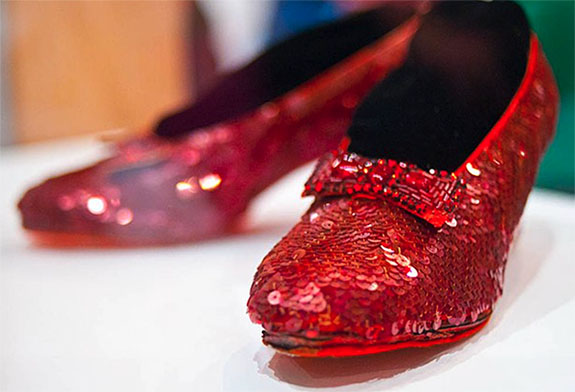
In May of 2023, a federal grand jury returned an indictment against 76-year-old Minnesota resident Terry Martin for snatching the shoes worn by Dorothy in the 1939 MGM film, The Wizard of Oz, from the Grand Rapids, MN, museum after closing time in a smash-and-grab event. There was no surveillance video of the crime, and the only clue left behind was a single red sequin amidst a sea of shattered plexiglass.

Martin said he used a sledgehammer to break through the museum doors and smash a case holding the slippers. He also claimed that he transferred the stolen items to a fence after coming to the realization that the famous "Ruby Slippers" contained no actual rubies. Attorney Dane DeKrey reportedly argued in court that Martin's involvement with the slippers spanned just a two-day period in 2005.

MGM’s chief costume designer Gilbert Adrian had created multiple pairs of Ruby Slippers to be worn by the 16-year-old Garland during the filming, but only four pairs are known to still exist. Each of the pairs is believed to be worth $3 million or more if ever offered at auction.

The prop designer's original intention was to use bugle beads to simulate ruby, but they proved to be too heavy. Instead, most of the bugle beads were replaced with sequins, 2,300 on each slipper. The butterfly-shaped bow on the front of each shoe features red bugle beads outlined in red glass rhinestones in silver settings.

The case finally broke in the summer of 2017, when an individual approached the company that had originally insured the slippers for $1 million and said he had information on how they could be returned. After a yearlong investigation coordinated by FBI field offices in Chicago, Atlanta and Miami, the slippers were recovered during an undercover operation in Minneapolis.

In court documents released on January 4, 2024, prosecutors recommended no prison time in the Ruby Slippers heist, citing Martin's fragile condition. The defendant is suffering from chronic COPD, requires oxygen at all times, is homebound and confined to a wheelchair.

“Given that Martin is already immobilized, the United States recommends no detention or house arrest be imposed,” the prosecutors wrote in a presentence investigation report (PSIR).

“The offense is a serious one. As far as thefts go, Martin’s violation was disgraceful. After all, Martin targeted and stole rare and valuable pieces of Americana with the intent to destroy them and liquidate them for their gemstones," reads the PSIR. "Once Martin realized his error, he transferred the ruby slippers to a fence, presumably recognizing the difficulty of selling well-known artwork.”

The stolen Ruby Slippers actually belonged to Hollywood memorabilia collector Michael Shaw, who had loaned them to the Judy Garland Museum. The collector reportedly told CBS in 2018 that the shoes were in pristine condition when he got them back.

Before announcing the recovery in 2018, the FBI had sent the sequined shoes to the Smithsonian for verification. A similar pair of Ruby Slippers has been one of the most popular attractions at the National Museum of American History in Washington, DC.

The pair had been pulled from its exhibit in 2016 to undergo conservation care funded by a Kickstarter campaign. Smithsonian objects conservator Dawn Wallace had spent more than 200 hours examining the slippers and was intimately familiar with every detail.

Wallace confirmed that the FBI’s pair was, in fact, authentic, but in a surprising turn of events revealed that the pair that had been donated anonymously to the Smithsonian in 1979 was mismatched. The left and right shoes were of different sizes. The heel caps and bows on each shoe were not identical.

What’s more striking is that the FBI’s recovered pair had the same issues. When the four shoes were laid side by side, two identical pairs were temporarily united.

The Smithsonian believes that the mix-up may have occurred in the run-up to a 1970 auction of MGM costumes and memorabilia. That’s when the Smithsonian’s pair was originally obtained and could have been confused with the other pair because all four shoes had felt bottoms and were intended for dance sequences.

Credit: Image by Chris Evans from same, United States, CC BY 2.0, via Wikimedia Commons.

Monday, January 08, 2024

Chinese Researchers: Mercury's Surface Could Be Littered With Impact Diamonds

The surface of Mercury, the tiniest planet in the solar system and the one that orbits closest to the Sun, could be littered with an untold wealth of diamonds, according to researchers at Sun Yat-sen University in Zhuhai, China.

NASA’s Messenger was the first spacecraft to orbit the planet back in 2011. It took nearly seven years for the probe to complete the 224-million-mile trip, and one of the important takeaways from the four-year mission was that Mercury's dark grey surface contained a lot of graphite, the same carbon-based material that's in your #2 pencil.

But, in a study published last week in the journal Nature Astronomy, the Chinese scientists argued that there's a strong probability that the Mercury also contains diamonds, which form when the carbon molecules are subjected to immense heat and pressure.

“If the primary crust of Mercury was made of graphite, we can imagine that the continuous evolution in 4.56 billion years — with countless impact events, mixing and destruction — would have seen most of the early graphite undergo phase changes and become other forms, including diamond,” lead author Xiao Zhiyong, a professor with Sun Yat-sen University’s school of atmospheric sciences, told the South China Morning Post.

The Chinese scientists' conclusions align neatly with the theories of Kevin Cannon, a planetary scientist and assistant professor at the Colorado School of Mines, who spoke about the likelihood of Mercury diamonds at the Lunar and Planetary Science Conference in Houston back in March of 2022.

He explained at the time that since Mercury’s composition is high in carbon, when high-speed foreign objects smash into the surface, the perfect recipe of heat, pressure and carbon results in a diamond byproduct.

“The pressure wave from asteroids or comets striking the surface at tens of kilometers per second could transform that graphite into diamonds,” Cannon noted. “You could have a significant amount of diamonds near the surface.”

According to wired.com, Cannon and his team modeled what was likely to happen to Mercury’s crust after being pummeled for billions of year. Cannon theorized that the graphite on the surface of Mercury could be more than 300 feet thick and that the impact pressure from asteroids would have produced enough energy to transform 30% to 60% of that material into “shock diamonds.”

According to Cannon, there could be 16 quadrillion tons of diamonds on the surface of Mercury.

If you're thinking about the possibility of mining some of those riches, the good news is that Mercury is not that far away. In fact, the BepiColombo mission launched in 2018 will finally arrive at that planet in 2025. A joint effort of the European and Japanese space agencies, BepiColombo is equipped with high-resolution cameras that could provide conclusive evidence of diamonds on that planet's surface.

The bad news about the idea of Mercury-based space mining is that its inhospitable daytime temperatures can reach 800 degrees, higher than the temperature inside a commercial pizza oven.

Credit: Image courtesy of NASA/Johns Hopkins University Applied Physics Laboratory/Carnegie Institution of Washington, Public domain, via Wikimedia Commons.

Friday, January 05, 2024

Music Friday: Twenty One Pilots' Tyler Joseph Dedicates 'House of Gold' to Mom

Welcome to Music Friday when we bring you fun songs with jewelry, gemstones or precious metals in the title or lyrics. Today, Twenty One Pilots’ frontman Tyler Joseph delivers a heartfelt tribute to his mom in the 2013 release, “House of Gold.”

In this song about the fear of growing old, Joseph’s mom asks her singer/songwriter son if he’ll take care of her in her twilight years. Written as an exchange between Joseph and his mom, he sings, “She asked me, ‘Son, when I grow old / Will you buy me a house of gold? / And when your father turns to stone / Will you take care of me?'”

The devoted son responds that he will not only make her the “Queen of everything you see,” but he’ll also bring her fame and cure her of disease.

Joseph told British Rock Sound magazine that he wrote the song to express his love for his mother, but didn't reveal "exactly" what the song was about because it would leave him "a little too vulnerable."

"But I love my mom very much and I want to always be there for her, like she was for me, and this song is about that," he said.

Initially appearing as a bonus track on Twenty One Pilots’ second studio album, Regional at Best, “House of Gold” became the fourth track of the indie pop group’s third studio album, Vessel. The song, which features Joseph on the ukulele and bandmate Josh Dun on the drums, became a top-10 hit on Billboard‘s US Alternative Songs chart and was certified "platinum" with more than one million digital downloads.

Twenty One Pilots performed "House of Gold" on Conan in their late night debut. The date was August 8, 2013.

The album ascended to #21 on the US Billboard 200 chart and sold more than 500,000 copies. Vessel was re-released as a limited-edition vinyl boxset in early 2023 on the occasion of its 10 anniversary.

The name Twenty One Pilots was derived from an Arthur Miller play called All My Sons, in which a World War II contractor knowingly delivers defective airplane parts, reasoning that fixing the problems would be too costly. The tragic result is the loss of 21 pilots. Apparently, the bandmates were inspired by the lessons of the story — to avoid shortcuts and always act with integrity.

Hailing from Columbus, OH, Twenty One Pilots’ early fan base was made up of Ohio State University students.

The video below was shot in 2013 for The Live Room at Sunset Sound Studios in Hollywood, CA. The lyrics are below if you’d like to sing along…

“House of Gold”
Written by Tyler Joseph. Performed by Twenty One Pilots.

She asked me, “Son, when I grow old,
Will you buy me a house of gold?
And when your father turns to stone,
Will you take care of me?”

She asked me, “Son, when I grow old,
Will you buy me a house of gold?
And when your father turns to stone,
Will you take care of me?”

I will make you
Queen of everything you see
I’ll put you on the map
I’ll cure you of disease

Let’s say we up and left this town
And turned our future upside down
We’ll make pretend that you and me
Lived ever after, happily

She asked me, “Son, when I grow old,
Will you buy me a house of gold?
And when your father turns to stone,
Will you take care of me?”

I will make you
Queen of everything you see
I’ll put you on the map
I’ll cure you of disease

And since we know that dreams are dead
And life turns plans up on their head
I will plan to be a bum
So I just might become someone

She asked me, “Son, when I grow old,
Will you buy me a house of gold?
And when your father turns to stone,
Will you take care of me?”

I will make you
Queen of everything you see
I’ll put you on the map
I’ll cure you of disease

Credit: Screen capture via YouTube / Songkick.

Wednesday, January 03, 2024

Spessartine Garnets Are the Fiery Orange Variety of January's Birthstone

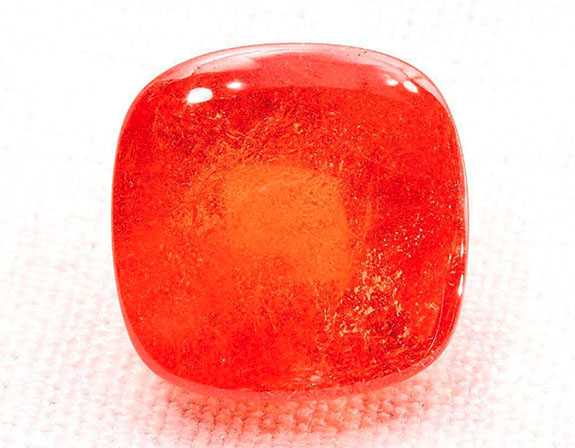
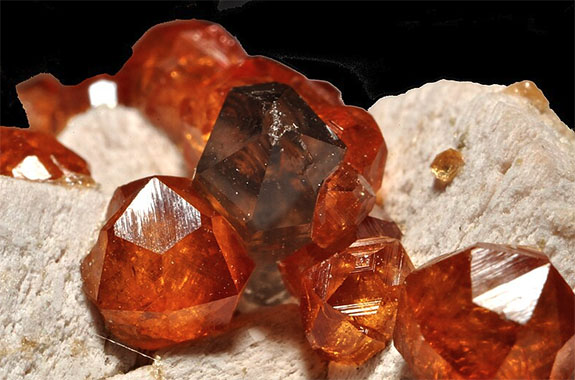
Imbued with the hues of a summer sunset, spessartine garnets are the fiery orange variety of garnet, January's official birthstone. The wonderfully versatile garnet comes in a wide array of natural colors, including red, yellow, pink, purple, violet, green, black and brown.

The 19.77-carat spessartine garnet shown, above, is part of the Smithsonian's National Gem Collection and is housed in the National Museum of Natural History in Washington, DC. A gift from Edward W. Boehm in 2008, the specimen was sourced in Zambia and ranks as the finest spessartine in the collection.

Spessartine's orange color is attributed to its particularly high manganese content. The purest and most intensely orange varieties are often referred to as "mandarin garnets" and are mined primarily in Madagascar.

According to the International Colored Gemstone Association (ICA), the first mandarin garnets were discovered along the hilly border between Namibia and Angola back in 1991. Until then, spessartines had been found in other countries, but were favored by collectors and hardly used in jewelry. This is because specimens of excellent color and clarity were extremely rare.

But the crystals found in Namibia were, indeed, jewelry worthy. ICA states that the raw crystals quickly found their way into the cutting centers and onto the market. Within a short time, however, the mine was exhausted and production ground to a halt.

According to the Smithsonian, gem-quality spessartine comes mainly from Sri Lanka and Brazil, while other important localities include Australia, Burma, India, Israel, Madagascar, Zambia, Nigeria, Namibia and the US.

In addition to today’s featured spessartine garnets, other varieties often seen in jewelry include almandine, andradite, demantoid, grossularite, hessonite, rhodolite, tsavorite and uvarovite.

Garnets get their name from the Latin word “granatum,” meaning pomegranate seed. The beautifully red seeds of a pomegranate closely resemble rhodolite garnet.

Credits: Cabochon spessartine by Ken Larsen / Smithsonian. Spessartine crystals by Géry PARENT, Public domain, via Wikimedia Commons.

Tuesday, January 02, 2024

Newly Engaged 'Wheel of Fortune' Contestant Bungles Obvious Solution

If you're one of the more than eight million viewers who tune into Wheel of Fortune every night, you witnessed in real time what might be the worst blunder of the syndicated show's 41 seasons. If you did not see the December 22 episode, here's what went down — and, yes, there is a jewelry connection.

During Pat Sajak's introduction of contestant Gwen Hardy, we learned that the US Navy flight surgeon from Yuma, AZ, had recently accepted her now-fiancé's marriage proposal on top of a mountain during a 100-mile hike through the Alps.

Then, moments later, with all the vowels bought up and only three letters remaining in a puzzle that read, “SURPRISE _ARRIA_E PROPOSA_”, Hardy confidently told Sajak that she was ready to solve. Slam dunk? Right?

Without hesitation, she blurted out "Surprise Carriage Proposal."

Sajak was silent, the buzzer sounded, the studio audience groaned and Hardy hung her head in shame, realizing her epic mistake. The correct answer would have earned her $8,250.

“I know," Sajak finally interjected. "Sometimes you get excited and your mouth doesn’t say what your brain intended. I’m sorry.”

Instead, Ron Panner, a therapist and amateur magician from Shorewood, IL, guessed "Surprise Marriage Proposal" and won the round.

Later, Sajak tried to lighten the load of Hardy's emotional trauma on national TV, stating, “Well, you know, you watch the show, and stuff happens like that sometimes. But here’s the rule, and you know this, Gwen, as a flight surgeon, put that behind you. That’s done, nothing you can do.”

Fans of the show weren't as empathetic as the popular host, expressing on X (formerly Twitter) that Hardy's goof-up was one for the ages.

One user commented, “Can anybody recommend a good carriage counselor?” while another wrote, “Can’t wait for my partner to surprise me with a carriage proposal!”

Despite her cringeworthy mistake, Hardy still took home a very respectable $11,150 in winnings.

Host Sajak, 77, is finishing out his final season on Wheel of Fortune, where he's shared the spotlight with letter-turner Vanna White since 1982. White will be working with the new host, Ryan Seacrest.

Credits: Screen captures via YouTube.