Wednesday, June 23, 2021

Crystals That Sparked South African 'Diamond Rush' Are Identified as Quartz

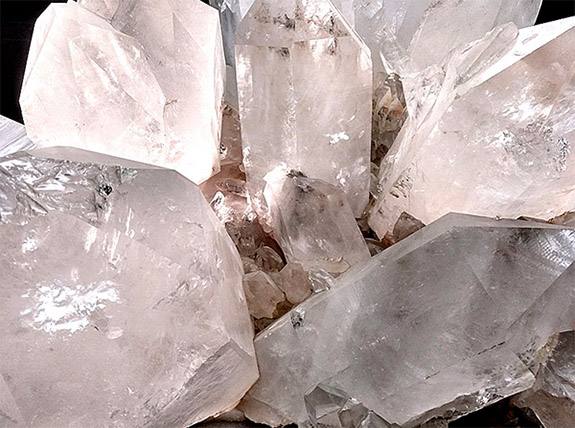
In the world of fine gemstones, looks can sometimes be deceiving. This was the hard lesson learned by 3,000 fortune seekers who descended on Ladysmith, South Africa, early last week after a cattle herder stumbled upon a large clear crystal that appeared to be a diamond.
The resulting "diamond rush" was supported by the fact that South Africa has been a world leader in diamond production for the past 150 years. The country currently hosts seven major diamond mines and generates more than 7 million carats per year. In fact, the largest diamond ever discovered — the 3,106-carat Cullinan — was unearthed in 1905 about 400km northwest of Ladysmith, near Pretoria.

Armed with picks and shovels, people from across the country rushed to the eastern KwaZulu-Natal province, where a 50-hectare (123-acre) search area became a field of dreams.

Sadly, those dreams were dashed when a local official announced on Sunday that the rare "diamonds" of Ladysmith were merely quartz crystals.

“The tests conducted conclusively revealed that the stones discovered in the area are not diamonds as some had hoped,” said Ravi Pillay, a provincial executive council member for economic development and tourism.

Quartz is the second-most-abundant mineral on planet Earth, just behind feldspar. The quartz crystals mined at the site in Ladysmith carried little or no value.

While most of the amateur miners packed up their belongings and headed home, about 500 stayed on the site, convinced that the stones had real value and that the government officials may not have been telling the truth.

Meanwhile, Pillay said that the search area posed a threat to grazing cattle because it was pocked with numerous holes, some as deep as one meter.

Credit: Image by Michael J. Stahl, CC BY-SA 4.0, via Wikimedia Commons.

Monday, June 21, 2021

This 1,098-Carat Gem-Quality Rough Diamond Ranks Among the Largest of All Time

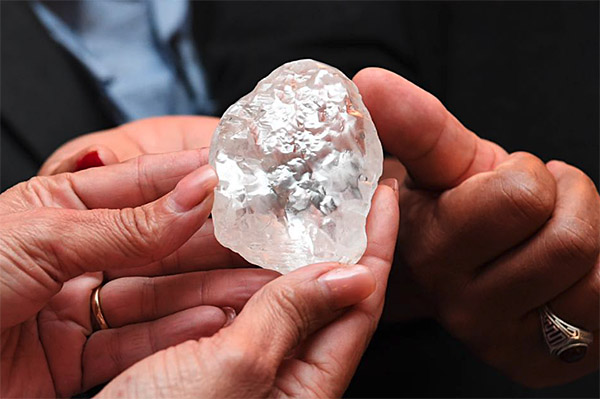
Debswana unveiled on Wednesday a three-inch-tall, 1,098-carat, gem-quality rough diamond discovered at its Jwaneng mine in Botswana. Estimated to be worth more than $55 million, the gem ranks fourth on Wikipedia's list of the largest rough diamonds of all time.

Debswana's acting managing director Lynette Armstrong presented the stone to Botswana President Mokgweetsi Masisi on Wednesday. About the size of a tennis ball, the frosty-white gem measures 73mm (2.87in) long, 52mm (2.04in) wide and 27mm (1.06in) thick. Discovered on June 1, it's the largest diamond ever recovered by the mining company, which has been operating for more than 50 years.

Interestingly, four of the top five rough diamonds on the Wikipedia list were sourced in Botswana, a tiny African nation that is one of the world’s leading producers of top-quality diamonds. Botswana’s Karowe mine was the source of the 1,758-carat Sewelô (#2, 2019), the 1,109-carat Lesedi la Rona (#3, 2015) and a 998-carat unnamed stone (#5, 2020). At the top of the list is the 3,106-carat Cullinan Diamond, which was discovered in South Africa in 1905.

The exciting thing about massive rough diamonds is that they are often transformed into incredibly large finished diamonds. For example, gems cut from the Cullinan Diamond include the Cullinan I (530.20 carats) and the Cullinan II (317.4 carats).

Back in April 2019, luxury jeweler Laurence Graff revealed the principle diamond cut from the 1,109-carat Lesedi La Rona. The 302.37-carat square emerald-cut stunner was believed to be the largest D-flawless gem ever certified by the Gemological Institute of America. Also cut from that large rough were 67 “satellite” diamonds ranging in size from just under 1 carat to more than 100 carats.

Debswana, which is a joint venture between De Beers and the Botswana government, has yet to determine how its 1,098-carat gem will be sold. It might go through the De Beers channel or via the state-owned Okavango Diamond Company. It will be exciting to see if the principle diamond from this stone will weigh 300 carats or more.

Just last month, we reported that Debswana is committed to spending $6 billion on a massive project that will extend by 20 years the lifespan of Jwaneng, which is widely acknowledged as the world’s richest diamond mine. When it reaches full capacity in 2034, Jwaneng will be generating 9 million carats per year. Since 1982, Jwaneng has been an open-pit mine, but the next phase of its operations will see the company channeling underground.

Diamonds are Botswana’s main source of income and account for about 80% of its exports.

Credit: Image via Facebook.com/Debswana Diamond Company.

Friday, June 18, 2021

Music Friday: 'California Gold' Makes a Cameo in Lady Gaga's 'Always Remember Us This Way'

Welcome to Music Friday when we bring you amazing songs with jewelry, gemstones or precious metals in the title or lyrics. Today, Lady Gaga performs her breathtakingly beautiful masterpiece, "Always Remember Us This Way," from the blockbuster 2018 motion picture A Star is Born.

Gaga plays Ally, an aspiring singer/songwriter, whose career is set into motion by Jackson "Jack" Maine, a famous country rock star, played by Bradley Cooper. The two fall for each other and Ally professes her love in our featured song, which contains a first-verse reference to a famous 1849 gold rush.

She sings, "That Arizona sky burning in your eyes / You look at me and babe, I wanna catch on fire / It's buried in my soul like California gold / You found the light in me that I couldn't find."

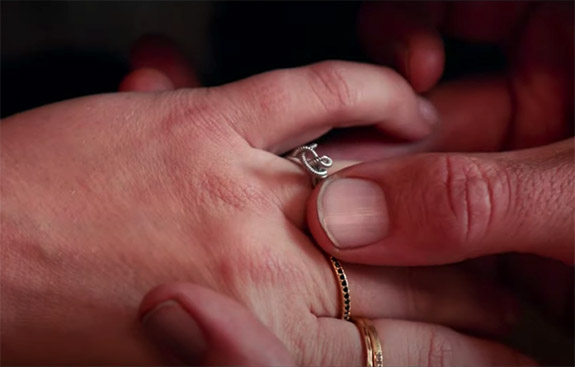
Jack spontaneously proposes to Ally with a make-shift engagement ring made from an intricately twisted guitar string, and the couple weds the same day at a church ministered by a relative of their friend, Noodles.

Written by Gaga (under her birth name Stefani Germanotta) and three collaborators, "Always Remember Us This Way" became an international hit. It charted in 30 countries and was nominated for Song of the Year at the 62nd Grammy Awards. It eventually lost out to "Shallow," another Gaga song from the same film.

As of May 2021, "Always Remember Us This Way" has received over 600 million streams on Spotify, and the official video has been viewed on YouTube more than 317 million times.

The video starts with Jack encouraging an apprehensive Ally to sing her original song at the end of his concert. Ally sits at the piano and delivers a performance that has been called "mesmerizing," "emotional" and "powerful." Many YouTube commenters admitted that the song brought them to tears.

Please check out Gaga performing "Always Remember Us This Way." The lyrics are below if you'd like to sing along…

"Always Remember Us This Way"
Written by Natalie Hemby, Hillary Lindsey, Stefani Germanotta and Lori McKenna. Performed by Lady Gaga.

That Arizona sky burning in your eyes
You look at me and babe, I wanna catch on fire
It's buried in my soul like California gold
You found the light in me that I couldn't find

So when I'm all choked up
But I can't find the words
Every time we say goodbye
Baby, it hurts
When the sun goes down
And the band won't play
I'll always remember us this way

Lovers in the night
Poets tryin' to write
We don't know how to rhyme
But, damn, we try
But all I really know
You're where I wanna go
The part of me that's you will never die

So when I'm all choked up
But I can't find the words
Every time we say goodbye
Baby, it hurts
When the sun goes down
And the band won't play
I'll always remember us this way

Oh, yeah
I don't wanna be just a memory, baby, yeah
Whooo, whooo, who who

When I'm all choked up
And I can't find the words
Every time we say goodbye
Baby, it hurts
When the sun goes down
And the band won't play
I'll always remember us this way, way, yeah

When you look at me
And the whole world fades
I'll always remember us this way

Credit: Screen captures via Youtube.com / Lady Gaga.

Wednesday, June 16, 2021

Gold Coin That Shouldn't Have Seen the Light of Day Fetches $18.9MM at Sotheby's

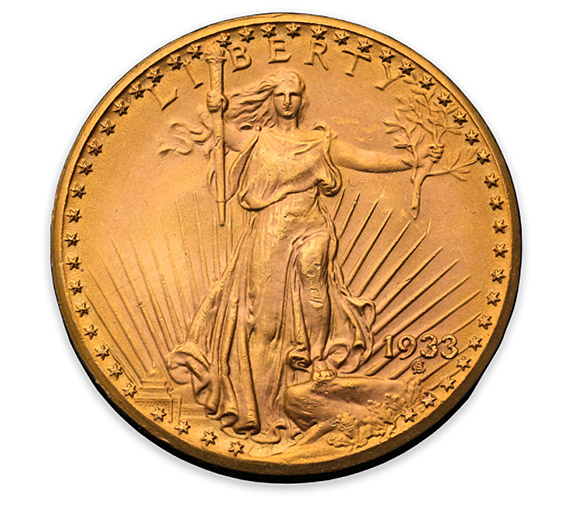
A Depression-Era $20 gold coin that wasn’t meant to see the light of day became the world's most valuable coin last week when it was scooped up by an anonymous bidder at Sotheby's New York for a cool $18.9 million.

Although 445,500 Double Eagle gold coins were struck by the Philadelphia Mint in 1933, none of them were intended for circulation. In the midst of The Great Depression and faced with a banking crisis that spooked consumers into hoarding gold, the federal government outlawed the possession of gold coins.

President Franklin D. Roosevelt insisted that all Double Eagle coins — except for two museum specimens — were to be melted into gold bars.

Two of the beautiful coins had been set aside to be part of the National Numismatic Collection and one additional coin eventually turned up in the collection of King Farouk of Egypt, who had obtained it in 1944. More recently, the U.S. government confiscated 10 Double Eagles discovered by a Philadelphia family at the bottom of an old safe deposit box in 2003. Those Double Eagles are now in the hands of the National Mint.

When King Farouk was deposed in 1952, many of his possessions were liquidated at auction, including his prized 1933 Double Eagle.

The Farouk coin remained under the radar until 1996, when it resurfaced in the possession of British coin dealer Stephen Fenton. He was arrested by U.S. Secret Service agents at the Waldorf-Astoria Hotel in New York as part of a sting operation. Fenton testified that the 1933 Double Eagle was from the Farouk collection and the charges against Fenton were subsequently dropped. The case was settled in 2001 when the defendant agreed to relinquish ownership to the U.S. government and the coin could be sold at auction.

In 2002, the coin was sold to a then-anonymous bidder at a Sotheby’s auction for $7.59 million. We've since learned that the winning bid was cast by luxury shoe designer Stuart Weitzman.

Last week, the only privately owned, legally obtained 1933 Double Eagle set a new auction record at a hammer price that was more than double what the 79-year-old designer paid 19 years ago. Sotheby's had estimated that the coin would sell in the range of $10 million to $15 million.

The design for the $20 Double Eagle was the work of famous sculptor Augustus Saint-Gaudens, who chose an advancing figure of Liberty for the obverse and a flying eagle on the reverse. The coin was nicknamed “Double Eagle” because $10 coins at that time were called “eagles.”

Along with the Double Eagle, Weitzman also offered two other high-profile items for sale at Sotheby's. One was a grouping of four famously misprinted stamps called the “Inverted Jenny," which fetched $4.9 million, and a rare stamp called the 1856 British Guiana One-Cent Magenta, which sold for $8.3 million.

Weitzman told news agencies that he will use the proceeds from the three items to help fund his charitable ventures.

Credits: Images courtesy of Sotheby's.

Monday, June 14, 2021

Celestial Bling: Here's Why Solar Eclipses Sometimes Look Like Bridal Jewelry

In August of 2017, the "Great American Eclipse" introduced astronomy enthusiasts to a phenomenon called the “Diamond Ring Effect.” On Thursday of last week, a breathtaking "ring of fire" solar eclipse — also known as a wedding band in the sky — dazzled viewers in Canada, Greenland and the Arctic.

Here's why a solar eclipse can sometimes look like an engagement ring and at other times look like a wedding band…

During a total solar eclipse, the Moon's orbit places it precisely between the Sun and Earth. With the Moon at just the right distance in its elliptical orbit around the Earth to completely blot out the sun, the Diamond Ring Effect can occur in the instant just before the total solar eclipse and in the moment just after.

Francis Baily in 1836 surmised that the Diamond Ring Effect owed its magic to the rugged surface of the moon. As the moon slowly grazes past the sun, tiny beads of sunlight, now known as Baily’s Beads, can shine through in some places and not in others. When only one single point of sunlight remains, the burst resembles a solitaire diamond and the halo of the sun still visible behind the moon looks like a ring.

Scientists described Thursday's eclipse as "annular," a word derived from "annulus," which means ring-like object. The annular eclipse differs from a total solar eclipse because the apparent diameter of the Moon and the Sun are not exactly the same. The Moon, in its elliptical orbit, is near its farthest point from Earth and seems smaller than average.

With the "ring of fire" solar eclipse, the Moon passes direct in front of the Sun, but does not block it out completely. In this scenario, the golden halo of the Sun peeks out from the blacked-out center, giving the appearance of a wedding band. The rare display lasted for 3 minutes and 51 seconds.

Viewers in a swath of territory across Eastern Canada, Greenland and the Arctic got to see the wedding band in the sky. Viewers in other parts of the Northern Hemisphere experienced a partial eclipse, but no celestial bling.

Solar eclipses happen due to a fascinating mathematical coincidence. The Moon is 400 times smaller than the Sun, but is 400 times closer to the Earth. This results in two celestial discs that are virtually the same size visually.

The next total solar eclipse over North America will take place on April 8, 2024. The next annular eclipse over North America is set for October 14, 2023.

Credits: Ring of Fire image by Brocken Inaglory, CC BY-SA 3.0, via Wikimedia Commons. Diamond Ring Effect image by Lutfar Rahman Nirjhar, CC BY-SA 3.0, via Wikimedia Commons.