Wednesday, March 10, 2021

'Dragon Stone' Plays Central Role in Disney's 'Raya and the Last Dragon'

A radiant, powerful "dragon stone" plays a central role in the newly released — and critically acclaimed — Disney fantasy film, Raya and the Last Dragon.

The stone is a symbol of power and peace in the mythical land of Kumandra. When the stone is fractured, its powers dissipate and the peaceful land becomes vulnerable to the nasty Druun (amorphous, dark purple and black clouds) that have the power to turn their enemies into statues.

In the mythical land of Kumandra, 500 years ago, humans and dragons lived peacefully, but when their land is invaded by the Druun, the dragons sacrifice themselves to save the land and their two-legged friends. The dragons leave behind a glowing, orb-like stone that has the power to keep the Druun at bay. They also leave behind a single dragon named Sisu, who hides away.

Five centuries later, we find the land of Kumandra in turmoil. The divided territory is now run by rival factions. Benja guards the precious dragon stone, but his rivals believe incorrectly that his control of the stone has delivered great wealth. Benja teaches his young daughter, Raya, how to protect the stone. But the youngster is tricked by Namaari, the daughter of the powerful rival, Virana.

The orb is compromised and fractures into several pieces, ruining its ability to hold back the lurking Druun.

The beautifully animated and skillfully voiced movie follows a grown-up Raya and the last dragon (Sisu) as they try to reunite the pieces of the dragon stone while being chased by Virana and Namaari.

As each fragment is collected, Sisu gains the power of one of her fellow dragons and becomes more confident in her abilities. The overall messaging is that of trust, cooperation and compromise for the greater good.

The PG film earned a 96% rating on Rotten Tomatoes. It runs 1 hour 54 minutes and can be seen in theaters and on Disney+.

Credit: Image courtesy of Disney Animation Studios.

Tuesday, March 09, 2021

Gem and Mineral Museum in Tucson Is One Step Closer to Opening

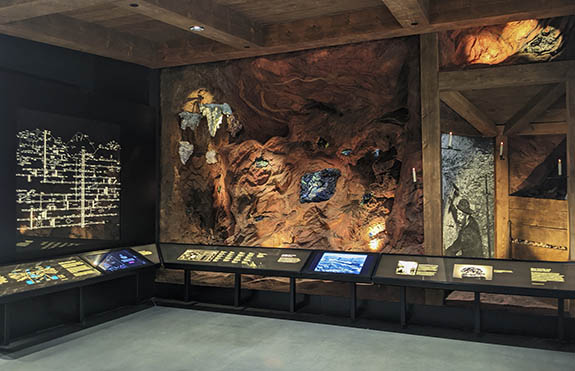
The University of Arizona's Alfie Norville Gem & Mineral Museum, a brand new 12,000-square-foot facility at the historic Pima County Courthouse in downtown Tucson, is one step closer to opening.

With the buildout and renovation complete, the museum staff is now working on completing exhibits and displays. While an opening date for the museum has not yet been determined, UArizona is working closely with Pima County to be able to safely open to the public this year.

The facility will display more than 2,200 gems and minerals from collections held by the University of Arizona and loan partners. The museum's three main galleries and new showcases will focus on the evolution of minerals, minerals native to Arizona and Mexico, gemstones, jewelry and gem science. Visitors of all ages will be able to take part in hands-on, interactive activities.

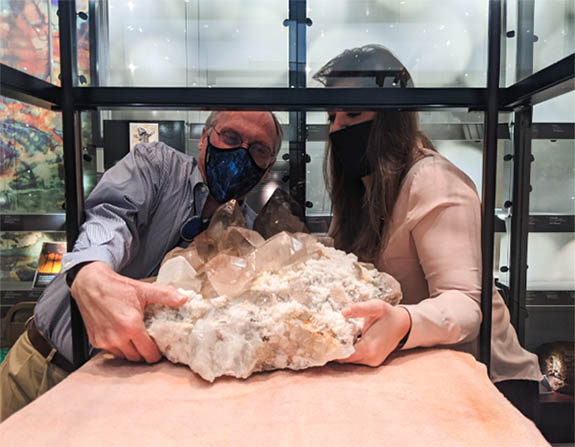
"The vision of creating a world-class gem and mineral museum in the heart of Tucson has reached a significant milestone," said Eric Fritz, manager of the museum. Fritz is shown in the photo, above, adding a large specimen to a display case with the assistance of exhibit specialist Elizabeth Gass. Construction on the museum began in 2018.

Tucson is an ideal location for the museum because each year in February the city transforms into the dynamic center of the gem and jewelry world as 65,000 visitors stream in to participate in dozens of trade shows and exhibitions.

In fact, the Alfie Norville Gem & Mineral Museum is named for the late Alfie Norville, a co-founder of the Gem and Jewelry Exchange show that runs during the annual Tucson Gem, Mineral & Fossil Showcase. An initial gift by the Norville family made it possible for the renovation and the move of the mineral museum from the UArizona campus to downtown Tucson.

Credits: Images courtesy of the Alfie Norville Gem & Mineral Museum.

Thursday, March 04, 2021

Proposal Photo Plays Critical Role in Recovery of Lost Ring on Tybee Island, GA

A joyous moment captured by a professional photographer played a critical role in the recovery of a diamond engagement ring that was lost in the sand on Tybee Island, GA, just seconds after Brian Quercia dropped to one knee and popped the question to Anna Davis.

Davis said "Yes" to Quercia's proposal, but then the mood turned very, very dark.

"He stood up to hug her and the ring fell out of the box," photographer Taylor Brown told The Jeweler Blog.

Brown explained that the ring got buried in the wet sand, and although she and the couple spent more than an hour trying to find it on Saturday, they came up empty.

Devastated by the loss of her diamond solitaire ring, Davis turned to the Tybee Island Facebook group for help.

On Sunday, Davis posted the proposal photo with this caption: "LOST ENGAGEMENT RING!! Hey everyone! Yesterday my boy proposed to me right passed the jetties on North Beach. It was magical & I said yes!!! Unfortunately, my beautiful ring somehow fell out of the box when we hugged and the ring is now lost. It was a silver ring with an oval diamond and small diamonds around the band. We are devastated but still hopeful. This is a picture for location reference. If you happen to find it please send me a private message. There will be a reward!"

Her post immediately sparked an outpouring of hopeful sentiments and offers to assist in the search.

Most importantly, the couple's plight caught the attention of a metal detectorist known locally as "Mr. Foy."

Using Brown's photo to pinpoint the location where the proposal took place, Mr. Foy was able to unearth the ring in 20 minutes. It was only about 1 inch below the surface.

Davis posted a photo of her and Mr. Foy on her Facebook page, along with a closeup of her cherished ring — safely on her finger.

Her caption read: "UPDATE!!!!! Thanks to so many sweet people who went and searched for my ring. Sweet Mr. Foy here found my ring within 20 minutes of searching Tybee today! We are so excited and relieved!!! I absolutely love it Brian Quercia."

On Monday, Davis shared some of her engagement photos on Instagram, while adding, "The ring is actually on my finger! I wanna show off my incredible FIANCÉ!!! It’s been a crazy 24 hours. What a story tell our kids & grandkids about this one day! So excited to do life with you."

The couple is reportedly planning a wedding in nearby Savannah.

Credits: Proposal photo courtesy of Taylor Brown Photography (www.taylorbphoto.com). Mr. Foy and ring images via Facebook.com/anna.davis.100.

Wednesday, March 03, 2021

Nat Geo's Mega Gemstone Mine Dig Kit Blends Education With Thrilling Discoveries

With National Geographic's Mega Gemstone Mine Dig Kit, kids will experience the thrill of digging in a real gem mine as they chip away at a hardened block of sand to reveal 15 crystal treasures.

Designed for kids 8 and older, the product emphasizes fun, exploration and discovery! Amazon.com reviewers awarded the product 4.8 out of 5 stars, and YouTube reviewers, both young and old, gave the dig kit high marks.

Brittany Shifflett, aka TheToyReviewer, couldn't have been more enthusiastic as she methodically cut through the block with the provided plastic chisel to reveal a wide array of colorful stones.

Her review on YouTube takes the viewer on a 19:29, step-by-step dig kit journey — from the unboxing through her 15th, and final, gemstone discovery. We get to share in her excitement as she unearths green fluorite (7:22), blue fluorite (8:23), rose quartz (8:27), amethyst (9:32), snowflake obsidian (10:53), agate (11:15), quartz (11:52), red jasper (12:45), crystal geode (13:52), sodalite (14:15), pyrite (14:51), tiger's eye (15:25), hematite (16:02), aragonite (16:45) and adventurine (17:14).

After washing each stone, Shifflett adds her colorful commentary while rotating each stone so viewers can see all the details. Shifflett was disappointed that her kit did not include a desert rose selenite, which is shown in the learning guide. Other YouTube reviewers did get that specimen in their kits.

Shifflett called the Nat Geo kit "awesome" while adding that the amethyst was her favorite find. Amethyst is her birthstone, and the amethyst crystal formation that emerged from the sand slab was very similar to the amethyst jewelry she regularly wears on a chain.

The kit comes with a chisel, brush, magnifying glass and 16-page full-color learning guide. The illustrated publication helps fledging scientists to identify their newly discovered stones and gives details about how gems are formed and what makes them unique.

In her video, we can see that Shifflett uses a bit of force to extract the embedded stones. Children younger than 8 will certainly love the discovery process but may need a bit of assistance from an older sibling or an adult. Shifflett also recommended adding water to the sand slab to make it softer and more workable.

In her YouTube summary, Shifflett noted that the kit makes an exciting addition to any at-home STEM study program.

The National Geographic Mega Gemstone Mine Dig Kit is available on Amazon for $19.99.

Check out Shifflett's full review, below.

Credits: Screen captures via YouTube.com/TheToyReviewer.

Monday, March 01, 2021

Hey, March Babies! The Cool, Blue Aquamarine Is Your Official Birthstone

Named after the color of seawater, aquamarine is the stunning cool, blue variety of the mineral beryl and the official birthstone for the month of March.

A museum-worthy example of aquamarine is seen in this Art Deco platinum ring that was once owned by Lady Annie Francis Cullinan (1866-1963), the wife of Thomas Cullinan, who owned the Premier Mine in South Africa when the 3,106-carat Cullinan Diamond was discovered there in 1905.

Showcasing an intense blue square-cut aquamarine, the ring was later obtained by California jeweler Stephen Silver, who donated it to the Smithsonian in 2017. The piece is now part of the National Gem and Mineral Collection at the National Museum of Natural History in Washington, DC.

Aquamarine is one of the most popular varieties of the beryl family, whose members include emerald (intense green), morganite (pink to orange-pink), red beryl (red), heliodor (yellow to greenish yellow), maxixe (pronounced Mah-she-she, deep blue), goshenite (colorless) and green beryl (light green).

Aquamarines can range in color from light blue and pure blue to shades of greenish-blue. The variations in blue color are dependent on trace amounts of iron in the gemstone’s chemical composition.

The name "aquamarine" is a combination of two Latin words, "aqua" for "water" and "marina" meaning "of the sea."

Beryl rates 7.5 to 8 on the Mohs hardness scale, making it suitable for fine jewelry.

Aquamarine is a symbol of youth, hope, health and fidelity. Legend states that Neptune, the Roman Sea God, gifted aquamarines to the mermaids, thus bringing love to all who have owned it.

The largest gem-quality aquamarine ever mined weighed in at 244 pounds and was sourced from the Minas Gerais region of Brazil in 1910. Aquamarines are mined in many countries, including Nigeria, Madagascar, Zambia, Pakistan, Mozambique and the U.S., but most of the finest-quality gemstones come from Brazil.

Lady Annie Francis Cullinan, whose aquamarine ring is featured (above), will be forever linked with the 3,106-carat Cullinan Diamond — the largest rough diamond ever discovered. Her husband, Thomas, sold the diamond to the Transvaal provincial government, which, in turn, presented the stone to Britain's King Edward VII as a birthday gift in 1907.

In its original form, the gem measured 10.1cm x 6.35cm x 5.9 cm, but in February 1908, the Cullinan Diamond was segmented into nine major finished stones, each of which was given the name Cullinan and a Roman numeral. Two of the gems are part of the the British Crown Jewels — the Great Star of Africa (Cullinan I) at 530.4 carats and the Second Star of Africa (Cullinan II) at 317.4 carats. The other seven stones remain in the private collection of Queen Elizabeth II.

Credit: Image by Greg Polley/Smithsonian.