Wednesday, October 09, 2019

'Journey' Ad Campaign Tells the Timeless and Epic Story of Natural Diamonds

The Diamond Producers Association (DPA) is launching an $11 million ad campaign that is an unprecedented, cinematic telling of the natural diamond story. Titled "The Diamond Journey," the video chronicles the history of a beautiful rough diamond from its fiery subterranean origins to its place as the ultimate representation of love, commitment and meaningful moments.

At the epicenter of the campaign is a three-minute hero film that could be mistaken as the trailer for a major motion picture, due to its impressive special effects, period costumes, cast of characters and engaging score by Oscar-winning musician, Atticus Ross.

As the newest part of the “Real is Rare, Real is a Diamond” platform, the campaign was developed in partnership with creative agency BBH London. The film was directed by Ian Pons Jewell, whose impressive client list includes Nike, Audi, Lexus and Michelob.

“We know from research that the majority of consumers are unaware that diamonds are the oldest thing they will ever touch or own," noted Jean-Marc Lieberherr, CEO of the DPA. "It’s a powerful message that resonates and one this campaign celebrates with the tagline ‘Three Billion Years in the Making.’"

The campaign also uses the phrase "Before there was life, there were diamonds."

Elements of the three-minute hero film have been edited into 60-, 30- and 15-second videos, which will be seen on social media platforms. The DPA is also producing striking portrait and landscape still visuals of an embracing pair of hands emerging from a natural scene. One of the hands is adorned with a diamond ring (See image, above).

The featured item in the campaign is a 2-carat cushion-cut diamond engagement ring, set in yellow gold. It was chosen because it evokes a classic, timeless quality with eternal appeal.

The advertising campaign, which has a primary target audience of 21-39 year olds, launches digitally on October 15 with Condé Nast, The New York Times and Sports Illustrated, among others. The creative ads also will be posted to Instagram, Facebook and YouTube.

"The Diamond Journey" commercials will be seen during NFL games on ESPN, holiday movies on the Hallmark channel, and The Today Show on NBC.

The DPA is also targeting high-impact placements in transit hubs and key cities during the busy holiday travel and gifting season. Expect to see "The Diamond Journey" messaging in New York's Grand Central Terminal, JFK and LAX airports, and select in-flight TVs.

Check out the full-length version of "The Diamond Journey" here...

Credits: Image courtesy of the Diamond Producers Association.

Monday, October 07, 2019

Average Guy Knows His Partner Is 'The One' After 7 Months of Dating: Survey

The average American man knows after seven months of dating if his partner is "the one" and nearly half received not-so-subtle hints encouraging the proposal, according to a survey conducted for the Jewelers Mutual Insurance Group.

Two of the top five methods of dropping hints included forwarding emails from jewelry websites (45%) and stopping in jewelry stores to look at rings (40%). Other key signs that a partner was looking to tie the knot included watching TV or movies that involved weddings (54%), discussing other people’s engagements and marriages (52%), and leaving wedding magazines out to be discovered (50%).

The survey also revealed that it took an average of two months to find the perfect diamond. Of those who proposed with a ring, three in five noted that they were guided by their partners about ring preferences.

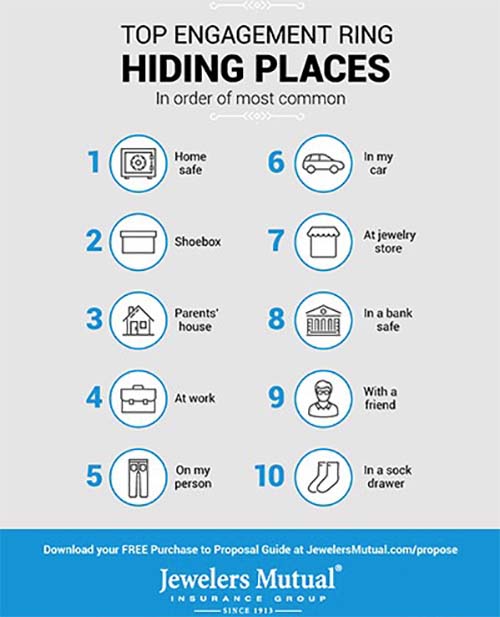
After purchasing the engagement ring, nearly half of the men kept it in a home safe while 30% put it in a shoebox. A quarter of the men kept the ring with them all the time, while 27% gave it to mom and dad for safekeeping. The survey also found the most common methods to protect the investment were a jeweler’s warranty (56%), specialty jeweler’s insurance (43%) and manufacturer’s warranty (42%).

Nearly eight in 10 men (79%) said their proposal went exactly as planned and 85% revealed that their proposal actually surprised their partner. We had previously reported that when it comes to getting engaged, nearly half of American brides-to-be want their engagement rings to be a surprise.

Followers of this blog know all too well that the best laid proposal plans sometimes go awry. We've reported on major snafus that nearly thwarted their engagements — including rings getting flushed down the toilet, trapped in lost luggage, falling into city utility grates, and even being washed out to sea during the proposal.

Luckily, all had happy endings.

“Popping the question and finding that perfect ring to symbolize your love are huge decisions,” said Jessica VandenHouten, brand communications manager for Jewelers Mutual Insurance Group. “Deciding how to protect the ring should be equally important. Given the time, financial and emotional investment, you want to protect the ring for all its worth.”

The survey results are based on responses from 2,000 engaged and married American men and was conducted by OnePoll on behalf of the Jewelers Mutual Insurance Group.

Credits: Top image by BigStockPhoto.com; Infographics courtesy of Jewelers Mutual Insurance Group.

Wednesday, October 02, 2019

Unusual Color-Change Johnkoivulaite Is the Newest Member of the Beryl Family

Johnkoivulaite, a mineral that changes from deep violet to near colorless when viewed with polarized light, is the newest member of the beryl family, which includes emerald, aquamarine and morganite.

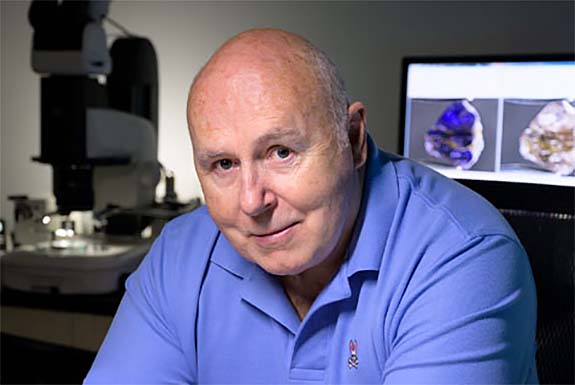
The mineral is named after gemologist and author John Koivula, who is best known for his contributions to inclusion research and photomicrography.

The 1.16-carat crystal, shown above, was discovered in the Mogok Valley of Myanmar by local gemologist Nay Myo and confirmed as a new mineral species by the Gemological Institute of America and the International Mineralogical Association.

GIA Senior Research Scientist Aaron Palke unveiled the newly named mineral at the Geological Society of America (GSA) conference on September 25 in Phoenix.

“We are privileged to be able to name this mineral after John Koivula who has contributed so much to science and the gem and jewelry industry as a prominent gemologist and innovator in photomicrography,” said Tom Moses, GIA's executive vice president and chief laboratory and research officer.

The GIA reported that johnkoivulaite has a hardness of 7.5 on the Mohs scale and a hexagonal crystal structure that is very similar to beryl and other members of the beryl group. But, what makes the mineral especially unique is the way it changes from a deep violet to near colorless when subjected to polarized light. This optical phenomenon is called pleochroism.

The johnkoivulaite specimen has found a new home in the GIA museum collection, located at the Institute’s world headquarters in Carlsbad, Calif. Established in 1931, the GIA is recognized as the world’s foremost authority in gemology.

Koivula has more than 40 years of industry experience in research and photomicrography. In 1986, Koivula co-authored with Edward J. Gübelin the immensely popular Photoatlas of Inclusions in Gemstones, followed by two additional volumes. Koivula also wrote The Microworld of Diamonds and co-authored Geologica with Robert Coenraads.

Credits: Photomicrographs by Nathan Renfro/GIA; John Koivula photo by Kevin Schumacher.

Tuesday, October 01, 2019

Neon Blue Paraiba Tourmaline Is the Most Prized Variety of October's Birthstone

Tourmaline comes in a wide variety of fiery, vibrant hues, such as red, green, yellow, orange, brown, pink and purple. October's birthstone is even available in bi-color and tri-color versions. But, the most coveted tourmaline of all is the neon blue variety that was originally unearthed in Paraiba, Brazil, in 1987.

Gemologists learned that Paraiba tourmalines were distinctly different from the rest because they owed their intense blue color to trace impurities of copper. Other tourmalines got their color from the presence of iron, manganese, chromium and vanadium.

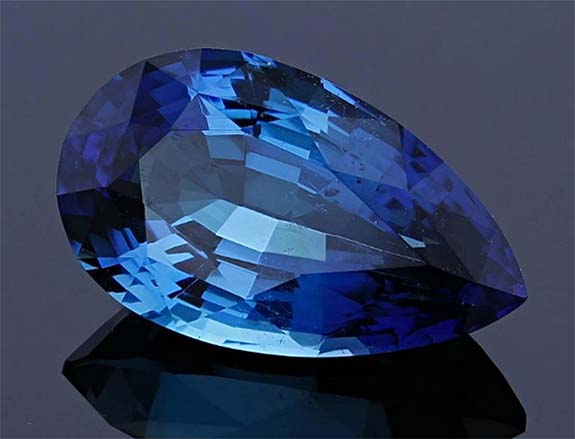
Paraiba tourmalines from Brazil are extremely rare, especially in sizes larger than a few carats. That's why the pear-shaped specimen, above, is so remarkable. It weighs 6.69 carats and is the first Paraiba tourmaline to join the National Gem Collection at the Smithsonian in Washington, D.C.

The popularity of Paraiba tourmaline sparked a mining frenzy in Brazil, and within five years, the supply was largely tapped out, according to the Smithsonian. In 2001, new Paraiba-like tourmalines were discovered in Nigeria. Interestingly, the vivid blue-green gems boasted the same color and chemistry as the Brazilian-sourced goods. Then, only one year later, miners in Mozambique reported a similar find.

Today, gem dealers refer to neon blue or green, copper-infused tourmalines as "Paraiba," regardless of their origin. Tourmalines range from 7 to 7.5 on the Moh’s scale of hardness, which makes them durable enough to be used in any type of jewelry. According to gemstone.org, a small, vivid-color Paraiba gemstone will have a greater value than a larger one of lesser color, all other factors being equal.

The name “tourmaline” is derived from the Singhalese words “tura mali,” which mean “stone with mixed colors.”

Tourmaline has been an official birthstone for October since the original list was published by the National Association of Jewelers in 1912. Opal is the month's other official birthstone.

Credit: Photo by Greg Polley/Smithsonian.

Monday, September 30, 2019

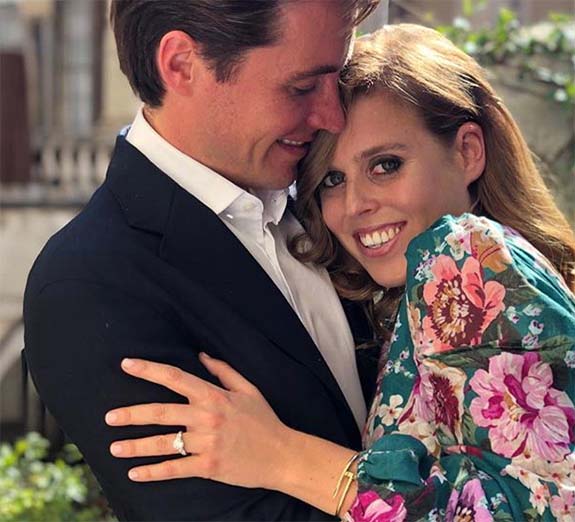
Princess Beatrice's New Engagement Bling Is Inspired by Her Grandma's Ring

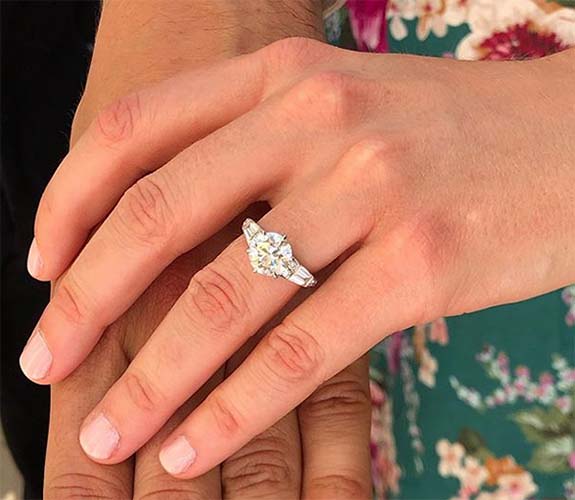
Princess Beatrice, the granddaughter of Queen Elizabeth II, is rocking a new 3.5-carat diamond engagement ring from Italian real estate tycoon Edoardo Mapellu Mozzi. The ring, which reflects "Victorian and Art Deco fusion," features a round center stone flanked by smaller diamond baguettes in a platinum setting.

Unlike her sister, Eugenie, who got engaged nearly two years ago with an avant-garde padparadscha, Beatrice's bling is said to be inspired by her grandmother's platinum engagement ring, which also has a large white center stone flanked by smaller white diamonds.

The 93-year-old queen has been wearing her ring since the day she accepted Prince Philip's marriage proposal in July of 1947. The prince celebrated his 98th birthday in June.

Eugenie’s ring — an oval padparadscha surrounded by a halo of white diamonds — was strikingly similar in design to the engagement ring of her mother, Sarah, Duchess of York, whose ruby center stone complemented her red hair.

Eugenie’s choice of center stone had sparked the obvious question: What's a padparadscha? Followers of the British royal family soon learned that the beautiful gemstone is one of the rarest and most valuable varieties of sapphire, boasting a rich salmon color.

Beatrice's more traditional engagement ring was revealed in a series of photos posted to Eugenie's official Instagram page. The post included a congratulatory message from Eugenie, along with a comment from the new bride-to-be. The photos were taken by Eugenie on the grounds of Windsor Great Park.

Eugenie wrote, "Beabea - wow! I'm so happy for you my dearest big sissy and dear Edo. It's been a long time coming and you two are meant to be. [Photo] by me!!"

Beatrice added, “We are extremely happy to be able to share the news of our recent engagement. We are both so excited to be embarking on this life adventure together and can’t wait to actually be married. We share so many similar interests and values and we know that this will stand us in great stead for the years ahead, full of love and happiness.”

Beatrice's new fiancé collaborated with British jeweler Shaun Leane on the ring's design. Jewelry experts believe the ring's value is approximately £100,000 ($122,000). The two have known each other for many years, but began dating about a year ago. The couple is expected to walk down the aisle some time in 2020.

Credits: Princess Beatrice images by Princess Eugenie/Instagram. Padparadscha ring screen capture via YouTube.com/The Royal Family Channel.