Wednesday, May 15, 2019

Socialite's Emerald Necklace, 36-Carat Diamond Share Spotlight at Sotheby's Geneva

An art deco-style emerald necklace from the collection of American socialite Helene Beaumont and a 36.57-carat near-flawless diamond shared the spotlight at Sotheby's Magnificent Jewels and Noble Jewels sale in Geneva yesterday. These top two items sold for $3.6 million and $5 million, respectively, accounting for more than 20% of the auction's total sales of $41.8 million. In all, 448 lots were offered.

As the wife of Louis Dudley Beaumont, one of the founders of the May Company department store chain, Helene was a renowned collector of fine jewelry from the most prominent design houses. The magnificent emerald necklace in yesterday's auction is believed to have been designed by Van Cleef & Arpels, circa 1935.

The front of the necklace is set with a line of 11 graduated sugarloaf cabochon emeralds, ranging in size from 3.27 carats to 18.09 carats. The necklace front may be detached and worn as a bracelet, and the two segments in the back can be combined to form a single necklace. A grading report states that the emeralds are of Colombian origin.

Sotheby's pre-sale estimate for the decadent piece was $2.9 million to $3.9 million.

The second headliner from yesterday's auction was a magnificent 36.57-carat diamond ring that was put up for sale by a private collector.

The D-color round diamond displays excellent cut, polish and symmetry, according to a grading report by the Gemological Association of America. It carries a clarity rating of VVS1, but could advance to "flawless" after minor replacing, noted the report.

The impressive diamond is claw-set between tapered baguette diamond shoulders.

Sotheby's spot-on pre-sale estimate was $4.4 million to $5.4 million.

Yesterday's sale also yielded a number of surprising overachievers.

One of those pieces was a fancy intense blue diamond ring, which sold for $853,799 — more than three times the pre-sale high estimate of $250,000. Designed by Tiffany and Co., the ring features a 1.01-carat step-cut blue diamond framed by baguette diamond shoulders. The diamond earned a clarity rating of VS1.

The performance of this emerald and diamond bracelet also impressed auction watchers, as the beautiful piece designed by Van Cleef & Arpels sold for $285,427, nearly six times the pre-sale high estimate of $49,640.

The bracelet is composed of clusters set with oval and circular-cut emeralds each within a frame of brilliant-cut diamonds.

Also beating the Sotheby's pre-sale high by nearly six times was a pair of turquoise and diamond earrings that sold for $136,509. Signed by Van Clef & Arpels, the earrings are set with cabochon turquoise entwined in brilliant-cut diamonds.

Credits: Images courtesy of Sotheby's.

Monday, May 13, 2019

Golden Spike Symbolized Completion of Transcontinental Railroad 150 Years Ago

This past Friday marked the 150th anniversary of the completion of the Transcontinental Railroad, an epic project that spanned six years and 1,800 miles, with the Central Pacific Railroad working from west to east and the Union Pacific Railroad from east to west.

When the two railroad lines met at Promontory Summit, Utah, on May 10, 1869, the engineering marvel was culminated with railroad magnate Leland Stanford driving the ceremonial final spike — a glistening symbol made from 14 ounces of 17.6-karat gold.

As Stanford gently tapped the copper-alloyed spike through a pre-drilled hole in a special tie of polished California laurel, a famous telegraph announced the news in real-time: “The last rail is laid. The last spike is driven. The Pacific railroad is completed. The point of junction is 1,086 miles west of the Missouri River and 690 miles east of Sacramento City.”

Celebrations ensued from coast to coast.

“It psychologically and symbolically bound the country,” Brad Westwood, Utah’s senior public historian, told the Associated Press.

The Transcontinental Railroad united a nation recovering from the Civil War and laid the foundation for its growth, economic progress and improved way of life. A coast-to-coast trip that once took six months, could now be accomplished in 3 1/2 days.

The accomplishment also symbolized American ingenuity and technical achievement, which was, at the time, as spectacular as landing a man on the moon. Incidentally, the first moon landing would take place 100 years later on July 20,1969.

The idea of using a golden spike to commemorate the completion of the Transcontinental Railroad was the brainchild of David Hewes, a San Francisco financier and contractor.

The spike is engraved on all four sides.

One side says, "The Pacific Railroad ground broken January 8, 1863, and completed May 8, 1869." A second side says, "May God continue the unity of our Country, as this Railroad unites the two great Oceans of the world. Presented by David Hewes San Francisco." The third and fourth sides list the names of the railroad directors and officers involved in the project.

Interestingly, the date on the Stanford spike is wrong because the celebration had to be delayed two days due to bad weather. Fearing that the golden spike would be stolen if it was left in place, Stanford (who would later establish Stanford University) extracted the spike from the laurel tie and brought it back to California. Today, it resides at the Cantor Arts Center at Stanford.

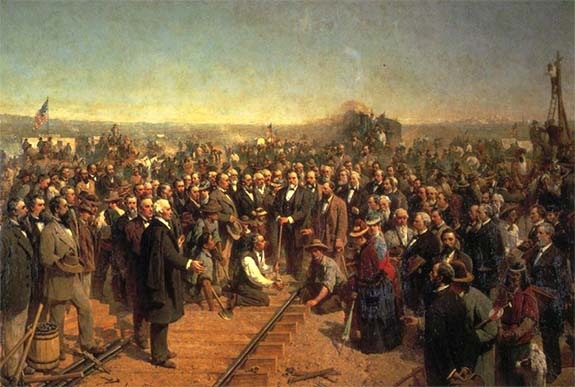
A duplicate golden spike, which was engraved later with the correct date, became the property of the Hewes family. That spike is on permanent display, along with Thomas Hill's famous painting "The Last Spike," at the California State Railroad Museum in Sacramento.

Throughout this past weekend, revelers celebrated the historic meeting of the rails at Golden Spike National Historic Park northwest of Salt Lake City. Visitors came from far and near, decked out in period attire, including top hats and bonnets.

Other celebrations throughout the state included art displays, musical performances, historical exhibits, storytelling, lectures, community festivals, parades, film screenings, model train shows, historical site tours and reenactments of the golden spike ceremony.

Credits: Photo of "duplicate" golden spike by Neil916 at English Wikipedia [Public domain], via Wikimedia Commons. "The Last Spike" painting by Thomas Hill [Public domain], via Wikimedia Commons. Photo of Samuel S. Montague, Central Pacific Railroad, shaking hands with Grenville M. Dodge, Union Pacific Railroad, by Andrew J. Russell [Public domain], via Wikimedia Commons. Modern reenactment photo courtesy of the National Park Service. Utah state coin by the United States Mint [Public domain], via Wikimedia Commons.

Friday, May 10, 2019

Music Friday: Insecure Charley Pride Asks His Wife, 'Does My Ring Hurt Your Finger?'

Welcome to Music Friday when we bring you throwback songs with jewelry, gemstones or precious metals in the lyrics or title. Today, music legend Charley Pride portrays a troubled and insecure husband in his amusing 1967 country hit, "Does My Ring Hurt Your Finger?"

Pride's character tells his wife that he feels so proud when she wears her engagement ring for all the world to see, but questions why she goes out at night with the ring conspicuously missing from her left hand.

He sings, "I understand sometimes we all need time alone / But why do you always leave your ring at home?"

Pride wonders if there may be an innocent reason. Maybe the ring just doesn't fit right and the problem can be solved with a simple resizing.

He sings, "When I bought it for you darling it seemed to be just right / Should I take it to the jeweler so it won't fit so tight? / Does my ring hurt your finger when you go out at night?"

"Does My Ring Hurt Your Finger?" appeared as the fifth track of Pride's third studio album, The Country Way. Both the single and the album were big hits for Pride, with "Does My Ring Hurt Your Finger?" reaching #4 on the U.S. Billboard Country chart and #3 on the Canadian country chart. The album performed even better, zooming all the way to #1 on the U.S. Billboard Country Albums chart.

Charley Frank Pride was born in 1934 in rural Sledge, Miss., one of 11 children of poor sharecroppers. When Pride was 14, he was gifted his first guitar and taught himself to play. While he enjoyed music, his first love was baseball. He dreamed of being a professional baseball player.

As an 18-year-old, that dream started to come true, as he pitched for the Memphis Red Sox of the Negro American League. A year later, he signed with the Boise Yankees, the Class C farm team of the New York Yankees. In 1960, he pitched for the East Helena Smelterites, an unusual gig that saw him splitting time between playing baseball and working for a lead smelter.

The team's manager also recognized Pride's singing talents and offered him an opportunity to sing for 15 minutes before each game. Before long, Pride was singing in Montana clubs with a group called the Night Hawks.

His big break came when Pride's demo tape got into the hands of RCA Victor exec Chat Atkins, who offered the singer a record deal. By the mid-1970s, Pride was the best-selling RCA Records performer since Elvis Presley. Pride is credited with 40 #1 singles and was honored with a Grammy Lifetime Achievement Award in 2017.

He is still touring at the age of 85.

Please check out the video of Pride's live performance of "Does My Ring Hurt Your Finger?" The lyrics are below if you'd like to sing along...

"Does My Ring Hurt Your Finger?"
Written by Don Robertson, John Crutchfield and Doris Ann Clement. Performed by Charley Pride.

Does my ring hurt your finger when you go out at night?
When I bought it for you darling it seemed to be just right
Should I take it to the jeweler so it won't fit so tight?
Does my ring hurt your finger when you go out at night?

Did you enjoy yourself last night dear how was the show?
You know that I don't mind it when you go
I understand sometimes we all need time alone
But why do you always leave your ring at home?

Does my ring hurt your finger when you're away from me?
I'm so proud when you wear it for all the world to see
Should I take it to the jeweler so it won't fit so tight?
Does my ring hurt your finger when you go out at night?

Credit: Photo by GREG MATHISON [Public domain], via Wikimedia Commons.

Wednesday, May 08, 2019

Runner Gets Engaged Seconds After Completing the Pittsburgh Marathon

Pittsburgh-area resident Stephanie Solt captured two prizes at the finish line of last Sunday's Pittsburgh Marathon — a medal for completing the grueling 26.2 mile race and a diamond engagement ring from her boyfriend, JT Mylan.

Mylan went down on one knee and popped the question just seconds after Solt turned in a time of 4 hours, 55 minutes.

With about six miles remaining in the race, Solt had seriously considered calling it quits. She was exhausted and her right knee was throbbing.

But, whatever doubts she harbored at that time were overcome by the encouragement of total strangers. Maybe, instinctively, they all knew that this race would be life changing.

“The people on the sideline kept cheering me on and calling me by the name I had on my bib," the 25-year-old told triblive.com. "[They were] giving me high fives and just pushing me along. It was just amazing."

Overwhelmed by their support, Solt said that she was almost in tears as she powered through the Boulevard of the Allies, the home stretch to the finish line.

As she crossed the finish line, Solt was diverted by a security guard away from the other runners and toward her boyfriend.

“And here’s JT at the finish line and I’m like ‘What are you doing here?’ He puts the medal on me and pulls out the ring and goes down on one knee, and I said 'Oh my goodness!’ I was speechless,” Solt told triblive.com.

Pittsburgh Public Safety posted a video of the emotional scene on its Facebook page.

Mylan, 32, said that he counted on a bunch of workout buddies to help him through the planning. One friend suggested that he pop the question at the marathon and a second friend, who was set to work security at the marathon, said he could get JT behind the finish line. A third buddy hooked him up with a photographer who would document the momentous event.

“When the universe lobs you an easy one, you might as well take it,” Mylan said.

Solt said she is ecstatic that she gets to marry her best friend. The couple is planning a spring 2022 wedding, which coincides with her graduation from physical therapy school. Mylan is a health and physical education teacher.

Credits: Screen captures via Facebook.com/Pittsburgh Public Safety; YouTube.com/WTAE-TV Pittsburgh.

Monday, May 06, 2019

Unlike Europeans, US Couples Seek Parents' Blessing Prior to Marriage Proposal: Survey

Unlike their European counterparts, the vast majority of US couples still ask for their parents' blessing prior to the marriage proposal, according to a 14-country wedding survey conducted by The Knot, WeddingWire and Bodas.net.

The first-ever Global Wedding Report — which is based on the experiences of 20,000 couples — sought to discover the cultural differences and varying societal norms related to engagements, wedding planning and celebrations across Europe, North America, Latin America and India.

“Seeking parents’ permission ahead of [the marriage proposal] is one of the areas where we saw some of the biggest differences,” noted Lauren Goodson, Senior Director of Insights at The Knot Worldwide.

She explained that while 67% of U.S. couples will ask for parental blessings, the practice is much less common in France (14%), Spain (9%) and Italy (8%). In those European countries, it's common for the couple to make the decision to marry and then share the news with their parents.

Another interesting finding was that the tradition of popping the question, while still immensely popular in the US, Mexico and Canada, is not as prevalent elsewhere. More than 80% of couples in North America will experience a "bended knee" proposal. But, that number is only 50% in Italy, where couples are far more likely to jointly agree to take the next step in their relationships and buy the ring together.

For nearly all countries surveyed (13 out of 14), December reigned as the most popular engagement month. However, in India, couples most often report getting engaged in either February (20%) or January (13%), likely due to the preference of holding the engagement ceremony, as well as the wedding, on an auspicious or “good-luck” day.

Planning a wedding that is a true reflection of a couple’s unique love story is no easy feat, and doing so takes couples varying amounts of time around the globe, according to survey results.

Couples in Colombia, for example, report planning their wedding in just seven months — the shortest wedding planning timeline worldwide — followed by couples in India (8 months), Chile (8 months) and Peru (9 months). On the other hand, couples in the US and UK tend to have almost twice as much time for wedding planning, with engagements lasting 14 and 15 months on average, respectively.

Internationally, the most important factor determining the wedding cost is the guest count. Although the number of wedding guests varies significantly from country to country, Chile-based couples have the smallest weddings with an average of 91 guests, while couples in India, on average, welcome 524 guests (Indian weddings typically span multiple days).

Couples based in Peru, Chile and Colombia typically pay for roughly 55% of the wedding costs, while couples in other regions tend to receive more financial support from family members — especially in Spain and Italy, where they cover roughly two-thirds of the wedding expenses.

The Global Wedding Survey, which was conducted in December of 2018, provided insights from 20,000 recently married couples in the US, Canada, Mexico, Brazil, Argentina, Colombia, Peru, Chile, the UK, Spain, Italy, France, Portugal and India.

Credit: Image by Bigstockphoto.com.