Wednesday, April 17, 2019

Legendary 'Jonker V' Diamond Returns to Christie's Auction Block After Just Two Years

When the legendary "Jonker V" diamond appeared at Christie's Hong Kong in May of 2017 with a pre-sale estimate of $2.2 million to $3.6 million, some gem experts expected the stunning 25.27-carat emerald-cut gem to yield much more — and they were right.
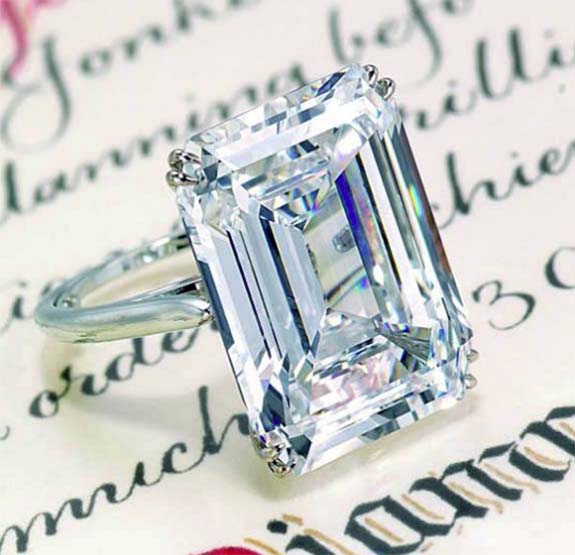
Surpassing the high estimate by nearly 50%, the Jonker V was purchased by an undisclosed buyer for $5.3 million.

On May 15, the Jonker V, one of 13 magnificent diamonds cleaved from the famous 726-carat Jonker rough more than 85 years ago, is set to make an encore appearance at Christie's Geneva. The gem boasts a D-color and VVS2 clarity grading. In its rough state, the Jonker V weighed 54.19 carats, more than twice its finished weight.
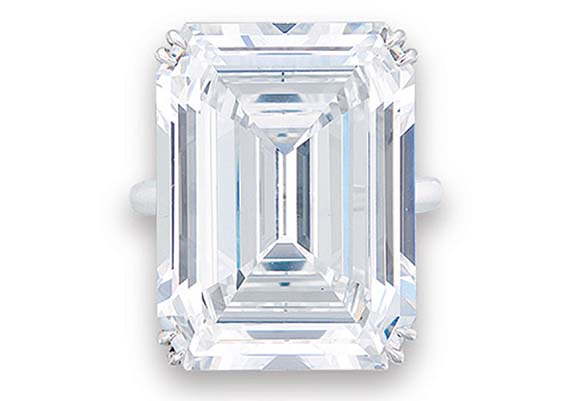
Surprisingly, the auction house's pre-sale estimate for the current offering reverts to the range promoted in 2017. Christie's believes the May 2019 hammer price will be in the neighborhood of $2.5 million to $3.5 million. A representative from Christie's told us that the estimate reflects the current market value for a gem of that size and provenance.

She noted that a bidding war among buyers in 2017 was likely responsible for inflating the Jonker V's sale price well beyond the high estimate. We'll be watching to see if another bidding war escalates the price in Geneva next month.

What makes the Jonker V so special is that it carries a rich history that connects many of the jewelry-industry's most colorful characters.

On January 17, 1934, a rough diamond the size of a hen’s egg was pulled from a bucket of gravel at the Elandsfontein claim, 4.8 kilometers south of the Premier Mine in South Africa. The massive 726-carat rough diamond with a frosty ice-white color would take on the surname of Jacob Jonker, the 62-year-old digger who owned the claim.

At the time, the Jonker was the fourth-largest gem-quality rough diamond ever unearthed. Diamond experts speculated whether the 63.5mm x 31.75mm Jonker and the 3,106-carat Cullinan Diamond had once been conjoined, as their respective cleaved faces seemed to match up perfectly. The Cullinan Diamond had been discovered at the nearby Premier Mine 19 years earlier.

The Jonker rough was acquired by De Beers chairman Sir Ernest Oppenheimer and subsequently caught the attention of diamond dealer Harry Winston, who purchased the rough stone in 1935 for £75,000, the equivalent of £9 million ($11.7 million) today. The Jonker diamond earned celebrity status when it was displayed during the Silver Jubilee Celebrations of the Coronation of King George V and Queen Mary in May of that same year.

The next year, Winston contracted Lazare Kaplan to cut 13 finished gems from the original rough. The Jonker finished diamonds were each named with a Roman numeral, in size order. The largest was the Jonker I at 142.90 carats and the smallest was the Jonker XIII at 3.53 carats. According to a May 1954 article in The New Yorker, Kaplan earned $30,000 for the prestigious assignment (that's equivalent to about $280,000 today).

Credits: Images courtesy of Christie’s.

Monday, April 15, 2019

Principal Diamond Cut From 1,109-Carat Lesedi La Rona Tips the Scales at 302.37 Carats

Back in November, luxury jeweler Laurence Graff revealed that the massive 1,109-carat rough diamond named Lesedi La Rona had yielded 67 "satellite" diamonds ranging in size from just under 1 carat to more than 100 carats and teased that "a principal diamond of unprecedented size" was still in the works.

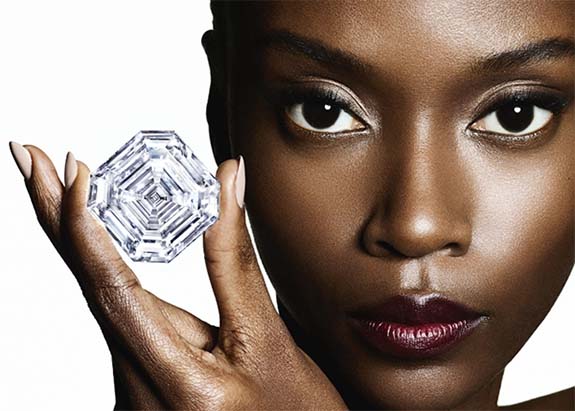
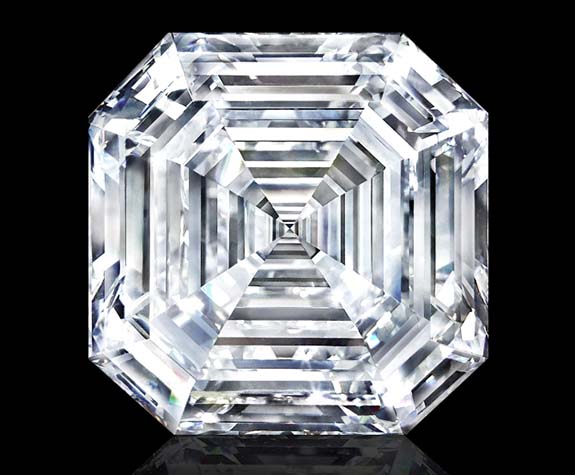
Last week, Graff finally unveiled that principal diamond — a 302.37-carat square emerald-cut stunner that is said to be the largest D-flawless gem ever certified by the Gemological Institute of America. The jeweler named the gem the "Graff Lesedi La Rona" and proclaimed it "one of the greatest diamond achievements in history."

"My love affair with diamonds is life-long, and crafting the Graff Lesedi La Rona has been an honor," the jeweler said in a statement. "This diamond is beyond words. We had an immense duty to cut the very, very best diamond imaginable from this rough. All our expertise, skill and accomplishment went into crafting this incredible diamond masterpiece, which is extraordinary in every way."

Graff explained that since his company had never analyzed a stone of such a prodigious size, a scanner had to be custom built, with brand new imaging software capable of probing its vast expanses.

At first blush, Graff's gemologists believed that a 300-carat principal diamond wasn't possible. However, using the new technology, the gemologists mapped the maze of imperfections and plotted which cuts would yield the largest and highest-clarity diamonds possible. In the final analysis, they were able to surpass the 300-carat mark with a perfect 302.37-carat principal diamond.

Discovered at the Lucara Karowe mine in Botswana in November 2015, the 1,109-carat Lesedi La Rona was the largest rough diamond recovered in more than 100 years and the second largest ever found. It was offered at auction in June of 2016, but failed to yield a buyer when the bidding topped out at $61 million, $9 million below the reserve price.

That same year, Graff had purchased the 373-carat rough diamond that was said to be a fractured chunk from the Lesedi La Rona. Having already studied the properties of the smaller chunk, Graff was ready to make a bid on the larger stone. In September of 2017, Graff secured the Lesedi La Rona for $53 million, $8 million less than the offer made at Sotheby's in 2016.

Graff reported that it took 18 months to complete the principal diamond. That included the initial cutting with precise lasers, followed by the shaping, faceting and polishing by Graff's skilled diamond artisans. All the diamonds derived from the original rough stone have been laser inscribed with the identifier “Graff, Lesedi La Rona."

Credits: Images courtesy of Graff.

Friday, April 12, 2019

Music Friday: Neil Young Is a Miner for a 'Heart of Gold' in the 1971 Classic

Welcome to Music Friday when we bring you classic songs with jewelry, gemstones or precious metals in the title or lyrics. Today, the incomparable Neil Young searches for a soulmate in his 1971 chart-topping classic, "Heart of Gold."

Penned by Young, this song is about a man who has been unlucky in love. The protagonist of the story wonders if he's ever going to find someone who will cherish him unconditionally.

He sings, "I want to live, I want to give / I've been a miner for a heart of gold / It's these expressions I never give / That keep me searching for a heart of gold and I'm getting old."

Ranked #297 on Rolling Stone’s list of the 500 greatest songs, “Heart of Gold” remains Canadian Neil Young’s only #1 on the U.S. Billboard Hot 100. The song also reached #1 on the Canadian RPM Top Singles list.

Interestingly, this ubiquitous song was a result of a couple of serendipitous events:

Young had suffered a back injury and, unable to stand for long periods to play his electric guitar, returned to his acoustic guitar and harmonica. “Heart of Gold” was one song that came out of those sessions. Second, Linda Ronstadt and James Taylor happened to be in Nashville for a television appearance while Young was recording Harvest, the album on which “Heart of Gold” appears. The album's producer arranged for the high-profile artists to sing backup on Young's track.

"Heart of Gold" has been covered by more than 30 artists, including Dave Matthews, Jimmy Buffett, Johnny Cash, Tori Amos and Willie Nelson. Canada’s CBC radio named it the third best Canadian song of all time and it was included in the Eat, Pray, Love movie soundtrack.

Born in Toronto in 1945 to a sportswriter dad and quiz show panelist mom, Young contracted polio as a five year old. The disease damaged the left side of his body and led to seizures he would experience throughout his life.

Young idolized Elvis Presley and listened to rock 'n roll, rockabilly, doo-wop, R&B and country and western music on the radio. Young taught himself to play a plastic ukulele, and he would soon step up to a banjo ukulele and baritone ukulele. Young formed his first band, the Jades, while attending middle school and eventually played with several rock bands in high school. Music dominated his world, so he decided to drop out of school to pursue a musical career.

He formed the influential band Buffalo Springfield with Stephen Stills in 1966 and toured with Crosby, Stills, Nash & Young, starting in 1968.

Young is one of the few artists who had been inducted into The Rock and Roll Hall of Fame twice. He was first honored as a solo artist in 1995 and then as a member of Buffalo Springfield in 1997. In 2000, Rolling Stone named Young the 34th greatest rock 'n roll artist.

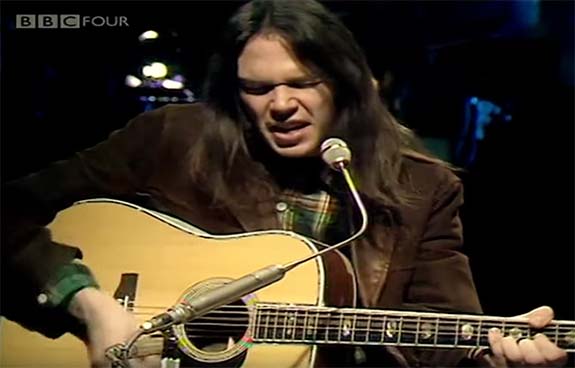
Please check out the video of Young's live performance of "Heart of Gold." The clip is taken from his 1971 appearance on the British TV show BBC In Concert.

"Heart of Gold"
Written and performed by Neil Young.

I want to live, I want to give
I've been a miner for a heart of gold
It's these expressions I never give
That keep me searching for a heart of gold and I'm getting old
Keep me searching for a heart of gold and I'm getting old

I've been to Hollywood, I've been to Redwood
I crossed the ocean for a heart of gold
I've been in my mind, it's such a fine line
That keeps me searching for a heart of gold and I'm getting old
Keeps me searching for a heart of gold and I'm getting old

Keep me searching for a heart of gold
You keep me searching and I'm growing old
Keep me searching for a heart of gold
I've been a miner for a heart of gold

Credit: Screen capture via YouTube.com.

Wednesday, April 10, 2019

Let's Celebrate April's Birthstone With a Close-Up Look at the Oppenheimer Diamond

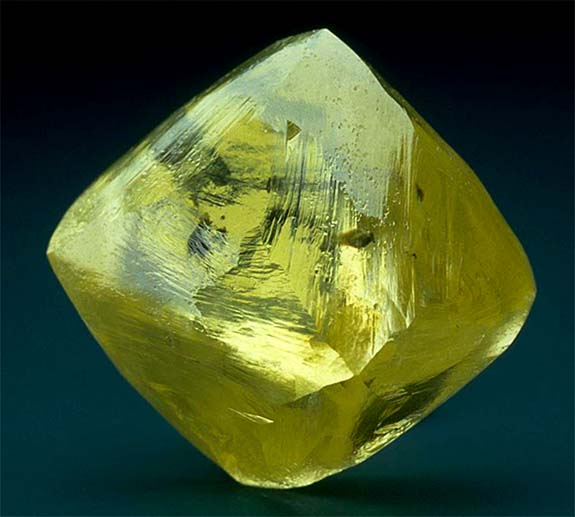
In honor of April's official birthstone, let's take a close-up look at one of the largest uncut yellow diamonds in the world. At 253.7 carats, the Oppenheimer Diamond is a nearly perfectly formed octahedron, a shape that's essentially an eight-sided double pyramid connected at the base.

Named in honor of Sir Ernest Oppenheimer, former chairman of the Board of Directors of DeBeers Consolidated Mines, the 20mm x 20mm gem was discovered at the Dutoitspan Mine near Kimberley, South Africa, in 1964, and acquired that same year by luxury jeweler Harry Winston.

Instead of cutting the rough gem into a hero stone and a series of smaller finished diamonds, Winston decided to leave it in its natural state and donate it to the Smithsonian in memory of Oppenheimer, who passed away in 1957 at the age of 77. The surface of the gem is reminiscent of an icy pond.

Vivid yellow diamonds are extraordinarily valuable. In May 2014, for example, the 100.09-carat Graff Vivid Yellow was sold for $16.3 million at Sotheby's.

The Oppenheimer Diamond is now on display near the Hope Diamond in the Janet Annenberg Hooker Hall of Geology, Gems and Minerals in Washington, D.C.

The gem owes its vivid yellow color to nitrogen impurities that were substituted for carbon atoms as the crystal formed. Similarly, the presence of boron in the chemical composition of a diamond will yield a vivid blue color.

Unlike their yellow and blue brethren, pink and red diamonds get their rich color not from chemical impurities, but from a molecular structure distortion that occurs as the diamond crystal forms in the earth’s crust.

Credits: Images by Chip Clark/Smithsonian.

Monday, April 08, 2019

Researchers Find World-Class Blue Spinel on Baffin Island in the Canadian Arctic

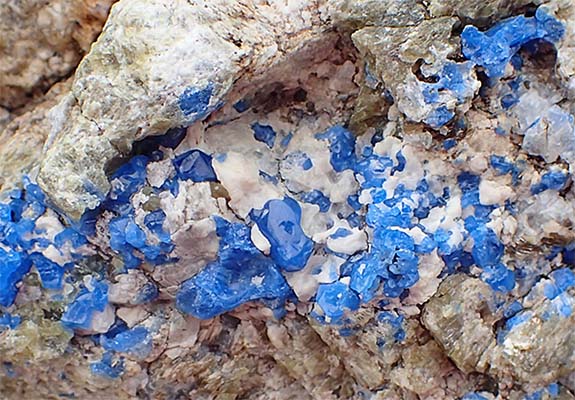
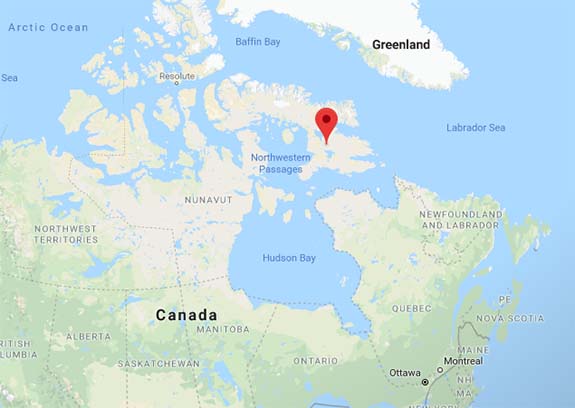
On Baffin Island in the Canadian Arctic, University of British Columbia researchers discovered deposits of cobalt-blue spinel in qualities that rival the finest in the world.

Researchers Philippe Belley and Lee Groat attributed the surprising find to the high levels of a "magic" ingredient present in the area — cobalt.

Pure spinel is colorless, but impurities in its chemical structure give rise to a range of colors, from pink and red to purple and blue. Baffin Island spinel, the researchers found, contains up to 500 parts-per-million of cobalt, which gives it a vivid blue color — a color comparable to the highly coveted material found in Vietnam and the Himalayas.

“Baffin Island is geologically similar to the Himalayas, where some of the world’s finest gems have been found,” said Belley, a recent PhD graduate of the department of earth, ocean and atmospheric science. “Canada hasn’t been widely recognized as a source for fine, colored gemstones, but our research suggests that we have all the right ingredients.”

Belley added, "There’s considerable interest in cobalt-blue spinel for gems and jewelry. There are few stones that match its intense blue color.”

Spinel formed on Baffin Island from sedimentary deposits of dolomite-bearing limestones. These sedimentary rocks metamorphosed at temperatures of about 800º C (1,472º F) under immense pressure.

“We found that cobalt was added at some point during sediment deposition or up to early metamorphism,” said Groat, a UBC mineralogist.

The researchers noted that even small spinel crystals with good transparency and fine cobalt-blue color can sell for about 10 times the price of comparable sapphires. But supply is an issue, and even production from the most significant source, Vietnam, is limited and sporadic.

The researchers explained that, despite the prevalence of hungry polar bears on Baffin Island, finding blue spinel there might be easier than exploring for the gem in the thick jungles of Vietnam or the challenging terrain of the Himalayas.

"[In those areas] most new deposits are found by accident,” said Belley. “But there’s excellent rock exposure on Baffin Island, which facilitates exploration and the use of more advanced techniques like imaging using drones or satellites.”

Spinel, which in 2016 joined the official list of birthstones for the month of August, is famous for being the jewelry-industry's "great imposter." Before modern testing became available, deep red spinel was often mistaken for ruby.

Credit: Image courtesy of Philippe Belley, UBC. Map via Google.