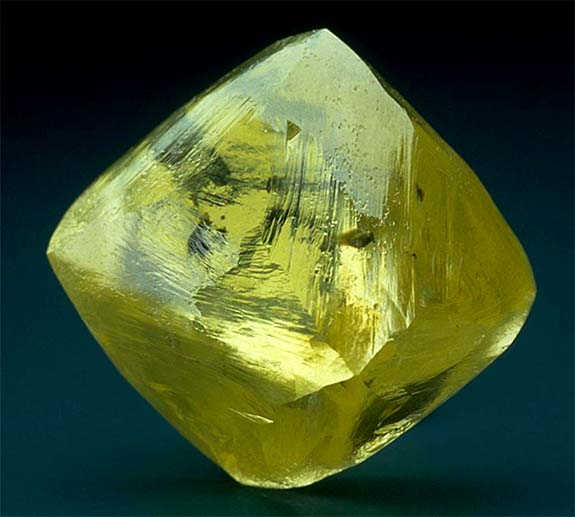
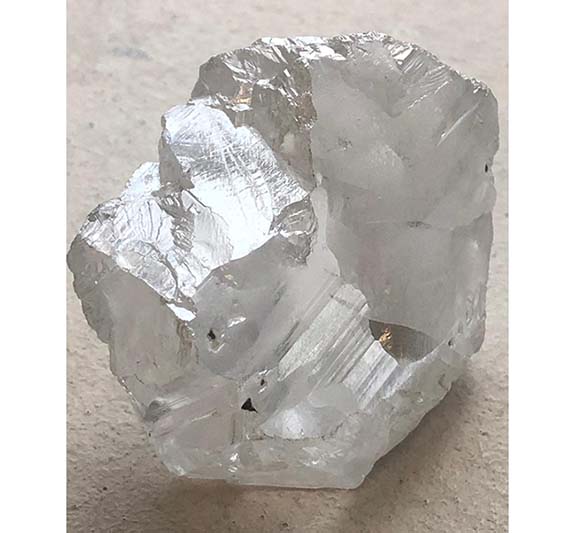
In honor of April's official birthstone, let's take a close-up look at one of the largest uncut yellow diamonds in the world. At 253.7 carats, the Oppenheimer Diamond is a nearly perfectly formed octahedron, a shape that's essentially an eight-sided double pyramid connected at the base.
Named in honor of Sir Ernest Oppenheimer, former chairman of the Board of Directors of DeBeers Consolidated Mines, the 20mm x 20mm gem was discovered at the Dutoitspan Mine near Kimberley, South Africa, in 1964, and acquired that same year by luxury jeweler Harry Winston.
Instead of cutting the rough gem into a hero stone and a series of smaller finished diamonds, Winston decided to leave it in its natural state and donate it to the Smithsonian in memory of Oppenheimer, who passed away in 1957 at the age of 77. The surface of the gem is reminiscent of an icy pond.
Vivid yellow diamonds are extraordinarily valuable. In May 2014, for example, the 100.09-carat Graff Vivid Yellow was sold for $16.3 million at Sotheby's.
The Oppenheimer Diamond is now on display near the Hope Diamond in the Janet Annenberg Hooker Hall of Geology, Gems and Minerals in Washington, D.C.
The gem owes its vivid yellow color to nitrogen impurities that were substituted for carbon atoms as the crystal formed. Similarly, the presence of boron in the chemical composition of a diamond will yield a vivid blue color.
Unlike their yellow and blue brethren, pink and red diamonds get their rich color not from chemical impurities, but from a molecular structure distortion that occurs as the diamond crystal forms in the earth’s crust.
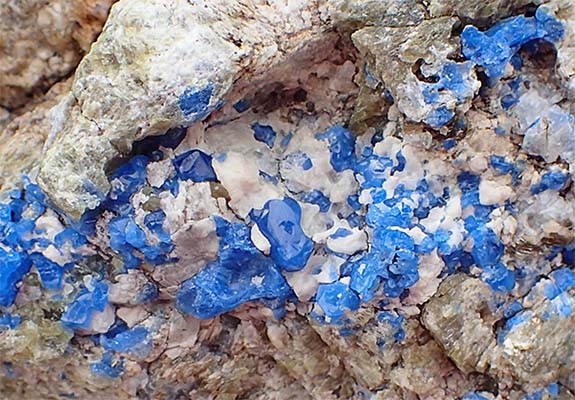
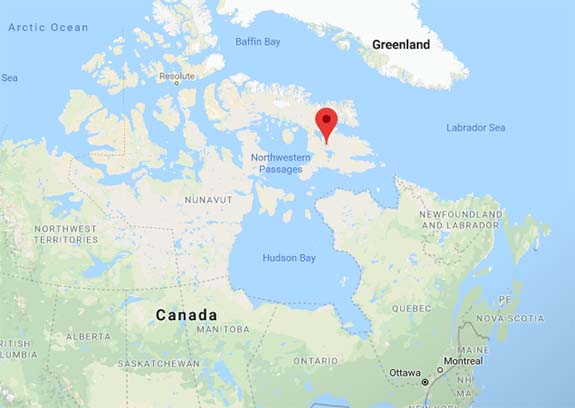
On Baffin Island in the Canadian Arctic, University of British Columbia researchers discovered deposits of cobalt-blue spinel in qualities that rival the finest in the world.
Researchers Philippe Belley and Lee Groat attributed the surprising find to the high levels of a "magic" ingredient present in the area — cobalt.
Pure spinel is colorless, but impurities in its chemical structure give rise to a range of colors, from pink and red to purple and blue. Baffin Island spinel, the researchers found, contains up to 500 parts-per-million of cobalt, which gives it a vivid blue color — a color comparable to the highly coveted material found in Vietnam and the Himalayas.
“Baffin Island is geologically similar to the Himalayas, where some of the world’s finest gems have been found,” said Belley, a recent PhD graduate of the department of earth, ocean and atmospheric science. “Canada hasn’t been widely recognized as a source for fine, colored gemstones, but our research suggests that we have all the right ingredients.”
Belley added, "There’s considerable interest in cobalt-blue spinel for gems and jewelry. There are few stones that match its intense blue color.”
Spinel formed on Baffin Island from sedimentary deposits of dolomite-bearing limestones. These sedimentary rocks metamorphosed at temperatures of about 800º C (1,472º F) under immense pressure.
“We found that cobalt was added at some point during sediment deposition or up to early metamorphism,” said Groat, a UBC mineralogist.
The researchers noted that even small spinel crystals with good transparency and fine cobalt-blue color can sell for about 10 times the price of comparable sapphires. But supply is an issue, and even production from the most significant source, Vietnam, is limited and sporadic.
The researchers explained that, despite the prevalence of hungry polar bears on Baffin Island, finding blue spinel there might be easier than exploring for the gem in the thick jungles of Vietnam or the challenging terrain of the Himalayas.
"[In those areas] most new deposits are found by accident,” said Belley. “But there’s excellent rock exposure on Baffin Island, which facilitates exploration and the use of more advanced techniques like imaging using drones or satellites.”
Spinel, which in 2016 joined the official list of birthstones for the month of August, is famous for being the jewelry-industry's "great imposter." Before modern testing became available, deep red spinel was often mistaken for ruby.
Credit: Image courtesy of Philippe Belley, UBC. Map via Google.
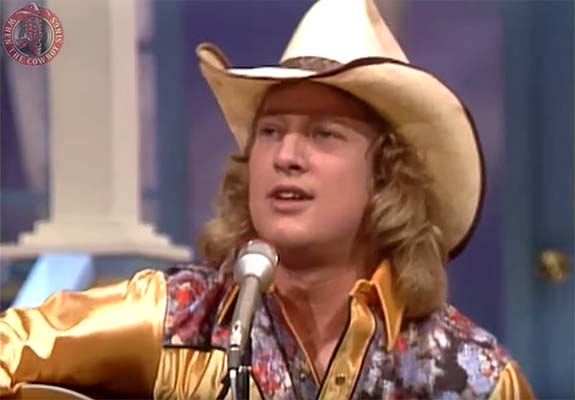
Welcome to Music Friday when we bring you awesome songs with jewelry, gemstones or precious metals in the title or lyrics. Today, country star John Anderson has fun with a well-worn gemstone myth in his Grammy-nominated 1981 hit, "I'm Just an Old Chunk of Coal (But I'm Gonna Be a Diamond Someday)."
In this song written by Billy Joe Shaver, Anderson likens himself to a common chunk of coal, but promises to work hard to rid himself of flaws until he's "blue pure perfect." We're guessing he aspires to be a blue diamond.
He sings, "Now I'm just an old chunk of coal / But I'm gonna be a diamond someday / I'm gonna grow and glow till I'm so blue pure perfect / I'm gonna put a smile on everybody's face."
"I'm Just an Old Chunk of Coal (But I'm Gonna Be a Diamond Someday)" was released as the first single from the singer's self-titled album, John Anderson 2. The song zoomed to #4 on the Billboard U.S. Hot Country Songs chart and #2 on the Canadian RPM Country Tracks chart. The song also earned Anderson a Grammy nomination for Best Male Country Vocal Performance.
While we've all heard about Superman having the power to squeeze a lump of coal into a diamond, and many of us are familiar with the phrase, "a diamond is a chunk of coal that did well under pressure," the concept that coal has the capacity to be turned into a diamond is just a myth.
A piece of coal and a diamond are both primarily composed of carbon, but that's largely where the similarity ends. A diamond is made up of pure carbon that was subjected to intense heat and pressure about 100 miles below the earth's surface. Coal, on the other hand, is hardly pure. It is a mix of carbon and organic plant matter. It also contains hydrogen, nitrogen, oxygen, sulfur, arsenic, selenium and mercury. Thereby, no matter how hard Superman squeezed the chunk of coal, there's no way a material with that many impurities would yield a diamond.
Trivia: "I'm Just an Old Chunk of Coal (But I'm Gonna Be a Diamond Someday)" is briefly sung by the title character in the 2001 animated film, Jimmy Neutron: Boy Genius.
Born in Apopka, Fla., in 1954, John David Anderson grew up admiring rock musicians, but then switched over to country music as a teenager. He moved to Nashville as a 17-year-old and took odd jobs during the day while playing in clubs during the evening. One of his odd jobs was as a roofer at the Grand Ole Opry House.
After six years of perseverance, he earned a record deal with Warner Bros. Anderson's career that has spanned more than 30 years, during which he's scored more than 40 singles on the Billboard country charts and five number ones. Anderson was inducted into the Nashville Songwriters Hall of Fame in 2014.
Please check out the video of Anderson's performance of "I'm Just An Old Chunk Of Coal (But I'm Gonna Be A Diamond Someday)." The lyrics are below if you'd like to sing along...
"I'm Just An Old Chunk Of Coal (But I'm Gonna Be A Diamond Someday)"
Written by Billy Shaver. Performed by John Anderson.
Hey, I'm just an old chunk of coal
But I'm gonna be a diamond someday
I'm gonna grow and glow till I'm so blue pure perfect
I'm gonna put a smile on everybody's face
I'm gonna kneel and pray every day
Lest I should become vain along the way
I'm just an old chunk of coal, now Lord
But I'm gonna be a diamond someday
I'm gonna learn the best way to walk
I'm gonna search and find a better way to talk
I'm gonna spit and polish my old rough edged self
Till I get rid of every single flaw
I'm gonna be the world's best friend
I'm gonna go 'round shaking everybody's hand
Hey, I'm gonna be the cotton pickin' rage of the age
I'm gonna be a diamond someday
Now I'm just an old chunk of coal
But I'm gonna be a diamond someday
I'm gonna grow and glow till I'm so blue pure perfect
I'm gonna put a smile on everybody's face
I'm gonna kneel and pray every day
Lest I should become vain along the way
I'm just an old chunk of coal, now Lord
But I'm gonna be a diamond someday
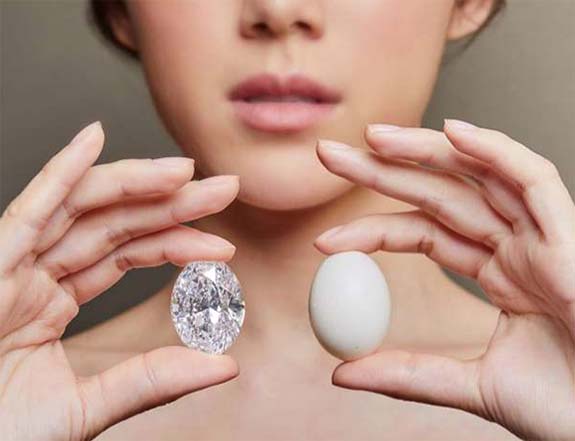
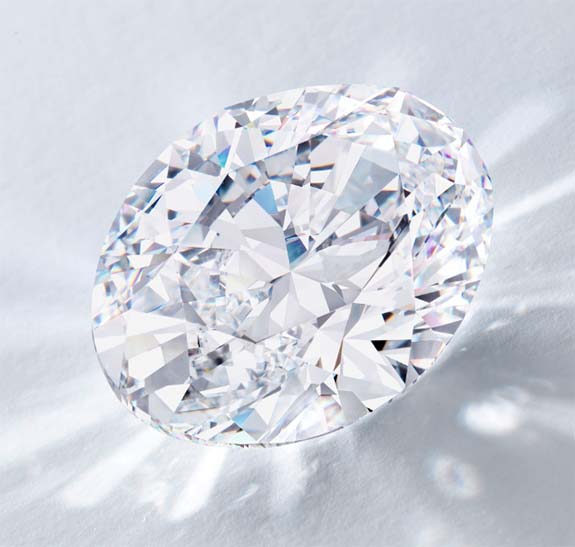
Outbidding two challengers, a Japanese private collector plunked down $13.7 million for a D-flawless 88.22-carat oval diamond at Sotheby's Hong Kong yesterday. He gifted it to his eldest daughter and named it "Manami Star" in her honor.
The diamond had been described by the auction house as "perfect according to every critical criterion." The collector, who remains anonymous, told Sotheby's that the gem first caught his eye while it was on exhibit in Japan during a pre-auction promotional tour.
Given the great interest in the "perfect" diamond, the hammer price easily surpassed the pre-show high estimate of $12.7 million, making the Manami Star the top lot at the Magnificent Jewels and Jadeite auction.
About the size of a small egg, the 88.22-carat faceted diamond was cut from an elongated 242-carat rough stone discovered at the Jwaneng mine in Botswana. The oval shape was chosen to maximize the carat weight.
Sotheby’s noted that the gem is one of only three oval diamonds larger than 50 carats to have appeared at auction over the past few decades. It's also the largest perfect oval seen at auction in the past five years.
The diamond is rated Type IIa, the most chemically pure classification. Diamonds of this quality display exceptional optical transparency and make up less than 2% of all gem-quality diamonds.
The Japanese buyer may have been influenced by the double-eights in the carat weight of the stone. Eight is considered a lucky number in Asian culture and “88” is believed to bring good fortune in abundance.
“We were thrilled to handle a diamond of such rarity, which now takes its place in the roster of top white diamonds to have come to the market here at Sotheby’s Asia," said Patti Wong, Sotheby’s Chairman in Asia. "At 88.22 carats, this lucky stone now carries the name of the fortunate child whose father has chosen to give it her name. A happy moment in the journey of one of the earth’s greatest, oldest treasures."
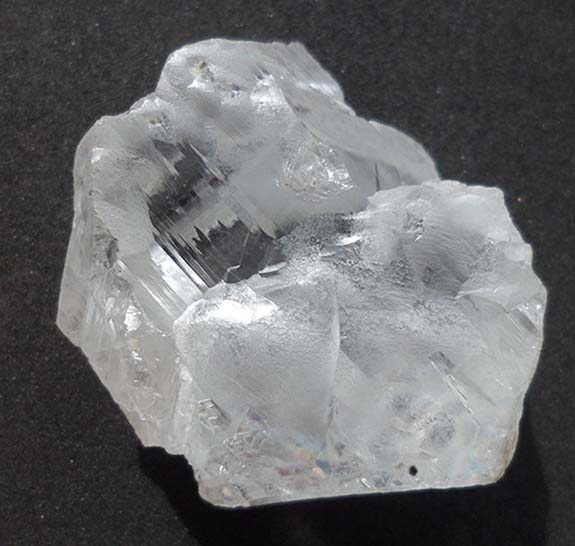
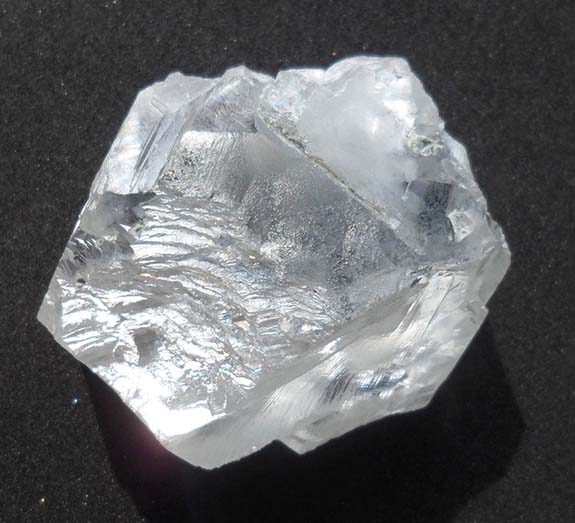
The historic Cullinan Mine, which famously produced the 3,106-carat Cullinan in 1905, added another enormous diamond to its roster of legendary finds. London-based Petra Diamonds announced late last week that it had unearthed a 425.10-carat, D-color, ultra-pure, Type II diamond at the South African mine.
Analysts placed the stone's value somewhere between a high of $35 million and a low of $8 million. A three-dimensional mapping of the rough stone still needs to be conducted to determine the size and number of polished stones it may yield. Petra expects to sell the gem before June 30.
The yet-to-be named diamond is the sixth-largest ever discovered at the mine, which has been operational since 1902.
The diamond ranks 38th on Wikipedia's list of the Largest Rough Diamonds of All Time, just behind The De Beers (428.5 carats, South Africa, discovered 1888) and just ahead of The Regent (410 carats, India, 1698).
The Premier Mine, which was renamed the Cullinan Diamond Mine in celebration of its 100th anniversary, is responsible for producing seven of the world's largest 50 diamonds based on carat weight. These include the Cullinan Heritage (#27, 507 carats, 2009), Centenary (#23, 599 carats, 1986), The Golden Jubilee (#11, 755 carats, 1985) and the granddaddy of them all — the Cullinan Diamond (#1).
The 3,106-carat Cullinan diamond was eventually segmented into nine major stones, each of which was given the name Cullinan and a Roman numeral. Two of the gems are part of the the British Crown Jewels — the Great Star of Africa (Cullinan I) at 530.4 carats and the Second Star of Africa (Cullinan II) at 317.4 carats.
Petra's newest find boasts Type II clarity, the purest of all diamonds because they are composed solely of carbon with virtually no trace elements in the crystal lattice. A spokesperson for Petra said the newest discovery "further demonstrates the prevalence of these types of stones in the Cullinan orebody, as well as the ability of the mine’s plant to recover the full spectrum of diamonds.”