Wednesday, January 24, 2018

Princess Eugenie's Engagement Announcement Sparks the Question, 'What's a Padparadscha?'

Princess Eugenie's official engagement announcement on Monday has the world asking, "What's a padparadscha?"
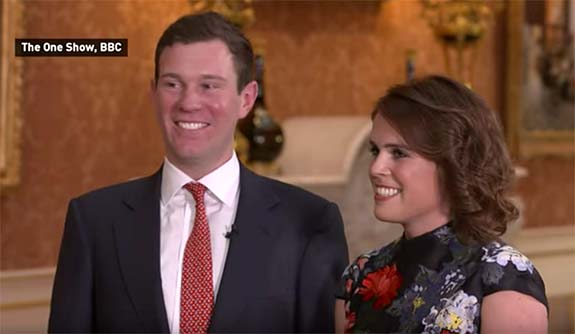
You see, the 27-year-old granddaughter of Queen Elizabeth II received an oval padparadscha engagement ring from her long-time boyfriend Jack Brooksbank. In the official photos released by Buckingham Palace and during a subsequent interview with the BBC, Eugenie proudly showed off her beautiful — but unusual — orange/pink stone. In an instant, the padparadscha had spawned its own storyline.
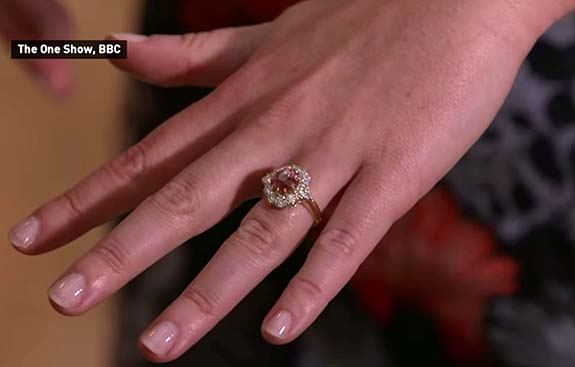
In the BBC interview, Brooksbank, 31, waxed poetic about the gem.

"What's amazing about it and why I love it so much is that it changes color from every different angle that you look at it," he said. "And that's what I think of Eugenie. That she changes color."

Eugenie's oval padparadscha is surrounded by a halo of white diamonds and is set in yellow gold. The engagement ring design is strikingly similar to that of her mother, Sarah, Duchess of York, whose ruby center stone complemented her red hair.

Called “a true Rembrandt among gemstones,” natural padparadscha is one of the rarest and most valuable varieties of sapphire.

Unlike its blue brethren, padparadscha boasts a salmon color reminiscent of the most delicate orange/pink sunset. The gem's name is derived from “padma raga,” which literally means “the color of the lotus flower” in Sanskrit.

Padparadscha belongs to the corundum family of gemstones, which includes rubies and sapphires. The presence of trace elements determines the color of each gemstone. While blue sapphires are naturally colored with iron and rubies with chromium, padparadschas are colored by the presence of both. The delicate interplay of pink and orange hues make this gem one of nature’s greatest marvels.
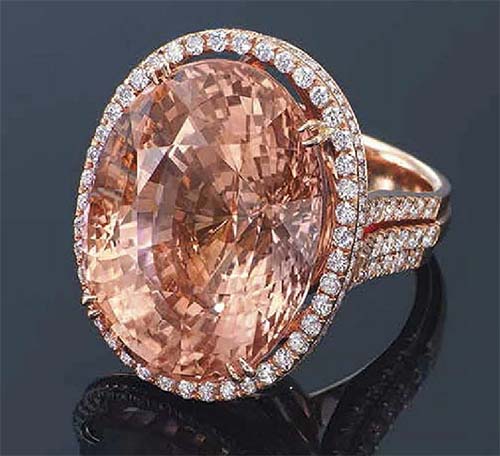
An excellent example of this strikingly beautiful gemstone hit the auction block at Christie's Hong Kong in May of 2013. The oval padparadscha weighed 73.98 carats and was framed with brilliant-cut diamonds mounted in 18-karat rose gold. The ring carried a pre-sale high estimate of $1.55 million.

Princess Eugenie and Brooksbank are expected to get married later this year and the Queen is reportedly delighted.

Credits: Interview screen captures via YouTube.com/The Royal Family Channel; Auction ring photo courtesy of Christie's.

Tuesday, January 23, 2018

Farmer’s Lost Wedding Ring Recovered on Dirt Road 45 Years Later

A Saskatchewan man was reunited with his long-lost wedding ring after it flew off his finger while driving down a dirt road in a small farming community in the early 1970s.

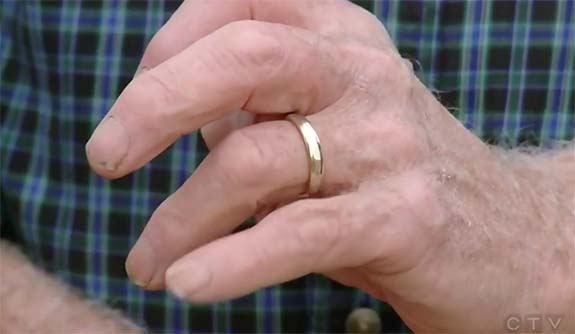
Bill Wilson blamed the loss on a spunky grasshopper that had leaped into the farmer’s work truck and landed on his chest. Wilson quickly reacted by capturing the small creature and flipping it out the window, along with his gold wedding band. He realized it was gone shortly after, but he was hauling a full load and could not turn back.

"We looked off and on for years, even bringing in a metal detector on several occasions. Every time I drove by there, I drove with my head out the window," Wilson said. He noted that if the ring landed on cultivated soil, it would be like “finding a needle in a haystack.”

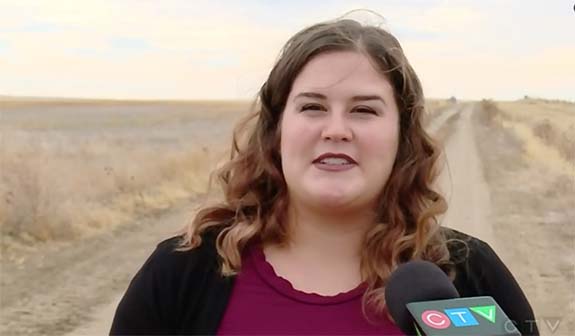
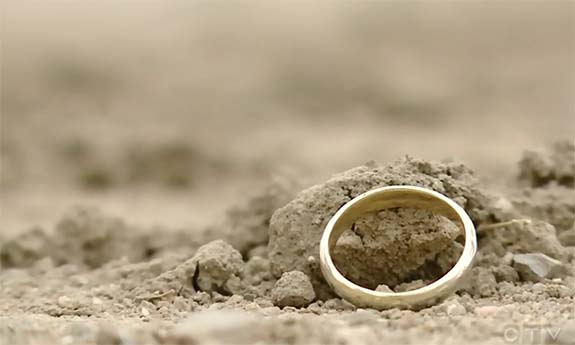
More than four decades later, neighbor Carlee Goodwin was taking a walk along the very same dirt road. It had rained the day before and the bright afternoon sun reflected on something shiny that caught her eye.

“I was thinking it was a piece of metal off a tractor, but soon realized it was a ring and dug it out,” Goodwin told CTV Regina. She tried it on and noticed it was styled for a man. She wondered how and when it got there. She also wondered about the owner.

“A ring isn’t something you just throw out the window,” Goodwin told CTV Regina.

Intrigued, Goodwin called her grandmother, who suggested that the owner might be impossible to find. After all, the only building on the desolate road was a school that had been closed for nearly five decades.

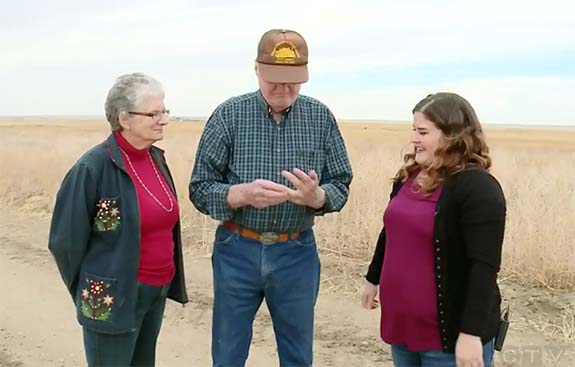
Ironically, Wilson ran into Goodwin’s grandmother at a local auction. She mentioned the ring while making small talk and asked him if he knew anyone who had lost a ring in the area. Stunned, Wilson immediately said yes, noting the design and what was engraved on the inside.

The woman's mouth dropped open and her eyes widened, Wilson said. "I wish I had a picture of her face.”

Goodwin told CBC/Radio-Canada that it was surreal to find a long-lost ring, and then locate the owner.

"I didn't think I would find the owner. I was blown away," she said. "It's almost like the ring wanted to be found."

After getting the ring back, the couple stared at it in awe. The ring was missing for 45 of their 51-year marriage. In fact, most of his children have never even seen the ring.

“I was very surprised and very grateful,” Wilson said.

Interestingly, Wilson had never purchased a replacement ring. "It's a little worse for wear, but back on my finger,” he said.

Right where it belongs.

Credits: Screen captures via CTVNews.ca.

Friday, January 19, 2018

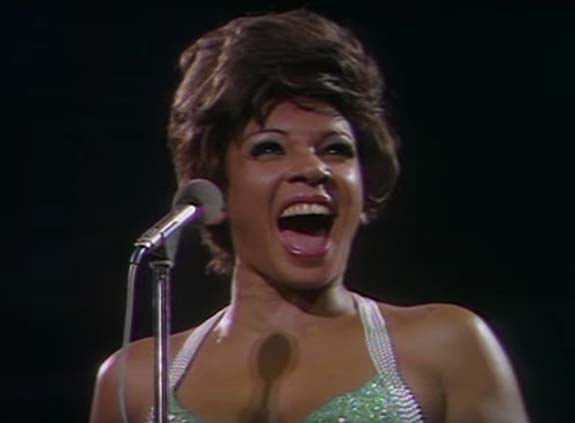
Music Friday: Shirley Bassey Nearly Passed Out Holding the Climactic Final Note of 'Goldfinger'

Welcome to Music Friday when we bring you classic songs with jewelry, gemstones or precious metals in the lyrics or title. Today, we tell the story of how Dame Shirley Bassey nearly passed out while holding the climactic final note to "Goldfinger," the title song of the 1964 James Bond thriller.

Often cited as the best film of the Bond franchise, Goldfinger borrows its name from Auric Goldfinger, a movie villain with a penchant for gilding his victims. In the theme song, which was used for the opening and closing credits, Bassey describes the man with the Midas touch.

She sings, "Golden words he will pour in your ear / But his lies can't disguise what you fear / For a golden girl knows when he's kissed her / It's the kiss of death from / Mister Goldfinger / Pretty girl beware of this heart of gold / This heart is cold."

Written by John Barry, Leslie Bricuss and Anthony Newley, "Goldfinger" presented a challenging recording session for the then-27-year-old Bassey. Repeated takes due to musicians' or technical issues forced the session to extend throughout the night. Bassey remembered how composer Barry demanded that the dramatic final note of the song be held for an extended count — seven seconds to be exact.

"I was holding it and holding it," Bassey said. "I was looking at John Barry and I was going blue in the face, and he's going, 'Hold it just one more second.' When it finished, I nearly passed out."

"Goldfinger" was an instant global phenomenon — at the record stores and on the big screen. The single netted Bassey her only Top-10 hit on the U.S. Billboard Hot 100. The song peaked at #8 and charted in seven countries. The movie had a production budget of $3 million and grossed $125 million at the box office.

Bassey's remarkable rendition of "Goldfinger" has stood the test of time. In 2008, the single was inducted into the Grammy Hall of Fame, and in 2013, a 76-year-old Bassey was asked to perform the song during the 2013 Academy Awards as part of a tribute to the James Bond franchise's 50th anniversary.

A native of Cardiff, Wales, Bassey went on to record the theme songs for two other James Bond films, including Diamonds Are Forever (1971) and Moonraker (1979). In 2000, she become a Dame in a ceremony at Buckingham Palace. She was honored for her services to the performing arts.

Please check out the video of Bassey's live performance of "Goldfinger" at the Royal Albert Hall in 1974. The lyrics are below if you'd like to sing along...

"Goldfinger"
Written by John Barry, Leslie Bricuss and Anthony Newley. Performed by Shirley Bassey.

Goldfinger
He's the man, the man with the Midas touch
A spider's touch
Such a cold finger
Beckons you to enter his web of sin
But don't go in

Golden words he will pour in your ear
But his lies can't disguise what you fear
For a golden girl knows when he's kissed her
It's the kiss of death from

Mister Goldfinger
Pretty girl beware of this heart of gold
This heart is cold

Golden words he will pour in your ear
But his lies can't disguise what you fear
For a golden girl knows when he's kissed her
It's the kiss of death from

Mister Goldfinger
Pretty girl beware of this heart of gold
This heart is cold

He loves only gold
Only gold
He loves gold
He loves only gold
Only gold
He loves gold

Credit: Screen capture via YouTube.com.

Wednesday, January 17, 2018

Tiny African Kingdom of Lesotho Yields 910-Carat, Gem-Quality Diamond; Ranks as 5th Largest Ever

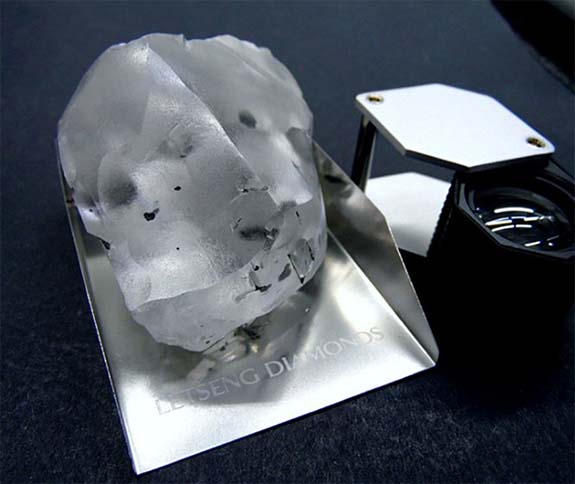
The prolific Letšeng mine in the tiny southern Africa kingdom of Lesotho has produced another mammoth gem-quality diamond. Weighing 910 carats, the D-color, Type IIa stone is the largest ever mined at Letšeng and the fifth-largest gem-quality diamond ever recovered in world history.

The yet-to-be-named gem is probably worth more than $50 million based on recent sales of colossal diamonds exhibiting nearly identical characteristics.

For example, the 1,109-carat Lesedi La Rona (#2 on the all-time list) was sold in September of 2017 for $53 million. In May of 2016, the 812-carat Constellation (#7 on the all-time list) fetched $63 million. Sourced at Lucara's Karowe mine in Botswana, both D-color diamonds were rated Type IIa, which means they are chemically pure with no traces of nitrogen or boron impurities.

Despite having a land mass slightly smaller than Maryland, Lesotho is an international powerhouse when it comes to turning out huge, top-quality stones.

“Since Gem Diamonds acquired Letšeng in 2006, the mine has produced some of the world’s most remarkable diamonds, including the 603-carat Lesotho Promise," noted Gem Diamonds CEO Clifford Elphick. "However, this exceptional top-quality diamond is the largest to be mined to date and highlights the unsurpassed quality of the Letšeng mine."

Here's a list of the most newsworthy stones to come from Letšeng, which is billed as the highest dollar-per-carat kimberlite mine in the world.

2006 – Lesotho Promise (603 carats)
2011 – Letšeng Star (550 carats)
2007 – Lesotho Legacy (493 carats)
2008 – Leseli La Letšeng (478 carats)
2015 – Letšeng Dynasty (357 carats)
2015 – Letšeng Destiny (314 carats)
2014 – Unnamed Yellow (299 carats)

The newly unveiled 910-carat rough diamond has an equivalent weight of 182 grams, or 6.41 ounces. A baseball, by comparison, weighs 5.25 ounces.

The fifth-largest gem-quality diamond ever mined is less than one-third the weight of the granddaddy of them all — the 3,106-carat Cullinan Diamond, which was discovered in South Africa in 1905. Finished gems cut from the Cullinan Diamond include the Cullinan I (530.20 carats) and the Cullinan II (317.4 carats).

The United Kingdom-based Gem Diamonds holds a 70% stake in the Letšeng mine with the government of Lesotho owning the remaining 30%.

Credit: Image via Twitter.com/GemDiamondsLtd.

Monday, January 15, 2018

British Crown Jewels Were Hidden From Nazis in a Biscuit Tin, BBC Documentary Reveals

Priceless gems from the British Crown Jewels were hidden from the Nazis in a biscuit tin and buried underground at Windsor Castle during World War II, a BBC documentary revealed last night.

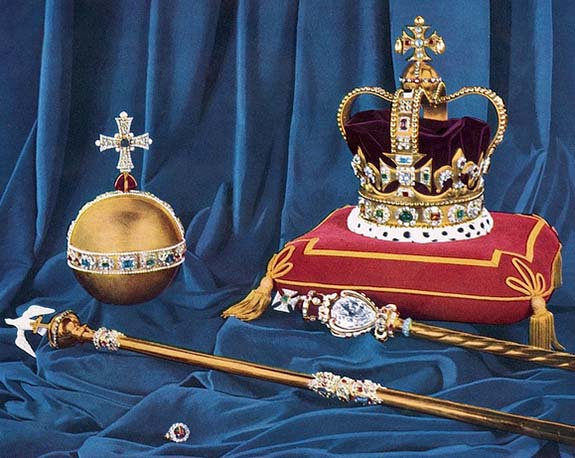
Fearing an invasion, King George VI ordered that the most precious jewels — including the Black Prince’s ruby and Saint Edward’s sapphire — be removed from the royal crowns, stashed in a Bath Oliver biscuit tin and buried under a sally port, which is a secret exit from the castle used in times of emergency.

The treasures were placed deep in the ground at the royal family's country residence in Berkshire and secured with steel doors. The limestone excavation was filled in with soil and covered with turf. Queen Elizabeth II, who was only 14 at the time, first learned of her father's ploy during her BBC interview with Alastair Bruce.

"What was so lovely was that the Queen had no knowledge of it," Bruce noted. "Telling her seemed strangely odd."

Some historians speculated that the royal gems had been whisked away during the war to a vault in Canada or a cave in Wales. But, confidential correspondence from Sir Owen Morshead, the royal librarian, to Queen Mary, the mother of George VI, finally uncovered the secret of the biscuit tin. The British Crown Jewels — 23,578 in all — are currently under armed guard in the Jewel House at the Tower of London.

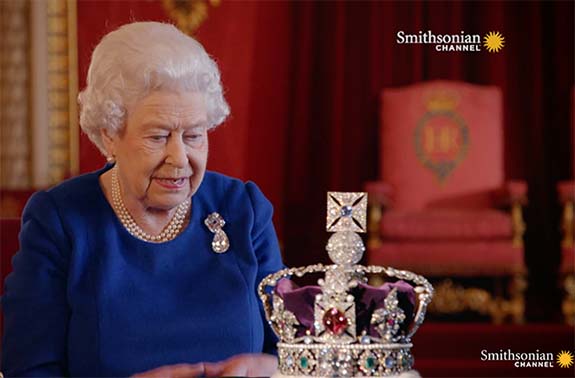
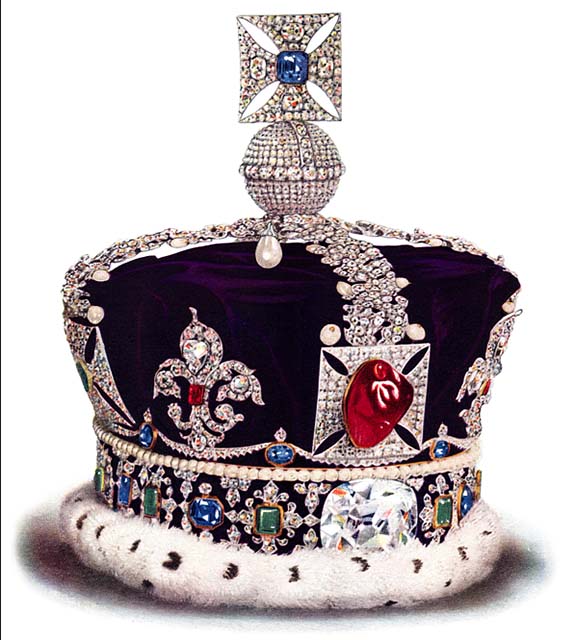
During the interview, the 91-year-old monarch got to take a close look at the Imperial State Crown, the stone's from which were remounted for her father's coronation in 1937. The crown is set with 2,868 diamonds, 17 sapphires, 11 emeralds, hundreds of pearls and a famous ruby that's not actually a ruby.

The Queen pointed out that the 2lb 13oz crown has been reduced in height since her father wore it. She also joked that it's important not to look down when wearing the crown as your "neck would break."

She told Bruce that her favorite gem in the crown is the Black Prince's ruby, which is, in fact, an irregular cabochon red spinel weighing 170 carats. The stone is set in the cross above the 317-carat Cullinan II diamond at the front of the Imperial State Crown and its history dates back to the middle of the 14th century.

The Queen seemed to be saddened by the plight of the pearls mounted in the crown. She said they are “not very happy now” and had been “hanging out for years.”

“I mean, the trouble is that pearls are sort of live things and they need... warming,” she said.

Princess Elizabeth ascended to the throne in 1952 at the age of 25 after her father died unexpectedly.

The BBC documentary was broadcast by the Smithsonian Channel on Sunday night.

Credits: Queen Elizabeth II screen capture via Smithsonianchannel.com; British Crown Jewels, including Saint Edward's Crown, by United Kingdom Government [Public domain], via Wikimedia Commons; Imperial State Crown showing Black Prince's ruby by Cyril Davenport (1848 – 1941) [Public domain], via Wikimedia Commons.