Wednesday, August 23, 2017

Experiment Supports Theory That 'Diamond Showers' Take Place on Uranus and Neptune

At Stanford University, an international team of scientists finally simulated the "shower of diamonds" that they believe is taking place deep within Uranus and Neptune.

Uranus and Neptune are both classified as "ice giants." Unlike the Earth, their solid cores are likely swathed in thick layers of "ice" made from the combination of water and ammonia.

At a depth of 6,200 miles, researchers speculate that the hydrocarbons encounter so much pressure and heat that the bonds between the hydrogen and carbon molecules are broken. Once free from the bonds, the carbon atoms are compressed into microscopic diamonds, resulting in what can be described as "diamond showers."

Previously, no one had been able to directly observe these sparkling showers in an experimental setting, according to Dr. Dominik Kraus, who is the head of a Helmholtz Junior Research Group at the German research laboratory Helmholtz-Zentrum Dresden-Rossendorf.

But, that was precisely the breakthrough Kraus and his international team have now achieved. In their experiment, polystyrene (a plastic made from carbon and hydrogen) was exposed to a simulation of the immense pressure found deep within Neptune and Uranus. They blasted the plastic with shock waves generated by an optical laser and x-rays.

At a pressure of about 150 gigapascals and temperatures of about 9,000 degrees Fahrenheit, the shock waves compressed the plastic and successfully broke the carbon-hydrogen bonds. The carbon atoms instantly transformed into microscopic diamonds.

"The first smaller, slower wave is overtaken by another stronger second wave," Kraus explained. "Most diamonds form the moment both waves overlap. Our experiments show that nearly all the carbon atoms compact into nanometer-sized diamonds."

Kraus theorized that the cores of Uranus and Neptune could contain "oceans of liquid carbon" with gigantic "diamond icebergs swimming on top of it."

While it's unlikely man will ever have the ability to mine diamonds on these distant planets, the experiments at Stanford are already yielding innovative and efficient ways of producing nano-diamonds — diamonds that may find their way into electronic instruments, medical equipment and cutting devices.

The results of the research were published in the scientific journal Nature Astronomy.

Credit: Illustration by Greg Stewart / SLAC National Accelerator Laboratory.

Monday, August 21, 2017

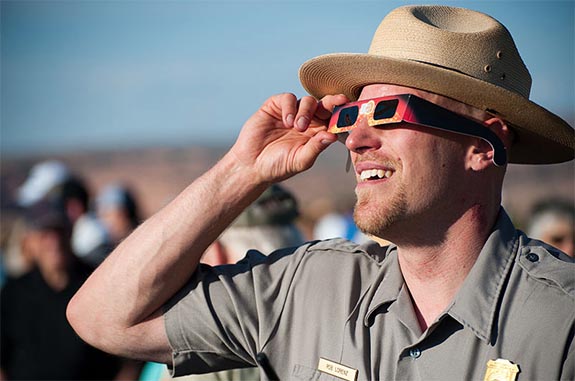
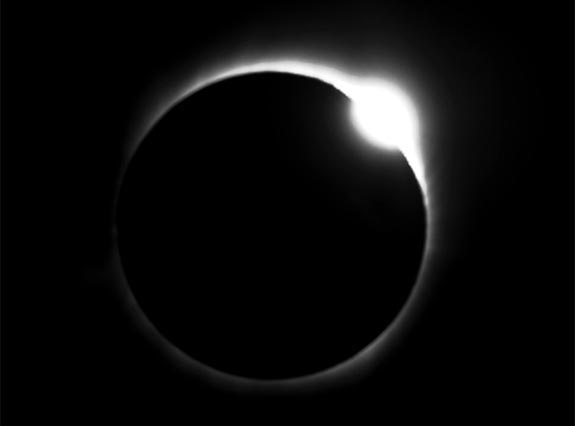
'Diamond Ring Effect' Will Add Excitement to Today's 'Great American Eclipse'

Today, the Great American Eclipse will be visible to nearly everybody in North America, but those of us lucky enough to be viewing from a narrow path that runs from Salem, Ore., to Charleston, S.C., will experience a total solar eclipse and a bonus phenomenon called the “Diamond Ring Effect.”

During a total solar eclipse, the moon aligns itself precisely between the sun and Earth. Sunlight gets blocked out and a 68-mile-wide shadow of the moon (also called its umbra) gets cast upon the Earth, resulting in total darkness for about 2 1/2 minutes. The Diamond Ring Effect occurs in the instant right before the total solar eclipse and in the moment just after.

Francis Baily in 1836 surmised that the Diamond Ring Effect owed its magic to the rugged surface of the moon. As the moon slowly grazes past the sun, tiny beads of sunlight, now called Baily’s Beads, can shine through in some places and not in others. When only one single point of sunlight remains, the burst bears a remarkable resemblance to a diamond, and the halo of the sun still visible behind the moon looks like a ring.

NASA also noted that more than a century earlier, English astronomer Sir Edmond Halley (who discovered Halley’s Comet) also gave a correct explanation of the Diamond Ring Effect during an eclipse of 1715.

The moon's shadow will race across the continental U.S. at speeds ranging from 2,410 mph in western Oregon to 1,502 mph in Charleston. That means that the Diamond Ring Effect should be visible starting in Oregon at about 10:15 a.m. PST and ending in South Carolina at about 2:48 pm EDT. The duration of the 3,000-mile, coast-to-coast celestial show will be about 90 minutes.

Viewers in the path of the total solar eclipse can expect temperatures to plunge by as much as 20 degrees.

Those not living in the direct path of the total solar eclipse will still see a partial eclipse, which resembles a crescent moon, but in this case it's a crescent sun. New York City dwellers, for instance, will see 70% of the sun covered by the moon.

We can not overemphasize the importance of utilizing proper solar glasses or filters when viewing the Great American Eclipse. Solar eclipse eye safety is reviewed at NASA's website here...

Don't miss the Great American Eclipse of 2017. The next total solar eclipse will take place in North America on April 8, 2024.

Credits: Eclipse viewing image by Arches National Park [CC BY 2.0 or Public domain], via Wikimedia Commons. Diamond Ring Effect image by Lutfar Rahman Nirjhar (Own work) [CC BY-SA 3.0], via Wikimedia Commons. Map by NASA.

Friday, August 18, 2017

Music Friday: Marc Scibilia's 'On the Way' Inspires Us to 'Sparkle Just Like Diamonds'

Welcome to Music Friday when we bring you great, new songs with jewelry, gemstones or precious metals in the title or lyrics. Today, singer-songwriter Marc Scibilia celebrates the season of sun, surf and wanderlust in a catchy tune that inspires us to "sparkle just like diamonds."

TV watchers will recognize "On the Way" from the newest Jeep commercial. The 30-second spot, which is called “Summer of Jeep: On The Way," has accumulated 2,300 national airings and has been viewed on YouTube.com nearly two million times since it was posted about 10 weeks ago. It features great-looking millennial Jeep owners enjoying a perfect day at the beach. Shazam the song and you'll learn that Scibilia also released a full length-version.

Scibilia repeats the hook, "Let your summer guide you, on the way, on the way," while encouraging the listener to be fearless when discovering new roads.

In the first line of the song, he introduces precious stones to help make his point. He sings, "Journey where this path may lead / And live as big as giants / Summer sun and feeling free / Sparkle just like diamonds."

Born in Buffalo, N.Y., to a musical family, Scibilia moved to Nashville to become a songwriter just a month after graduating high school. According to his official bio, the young Scibilia got the idea to head south from a sarcastic guidance counselor who was frustrated with Scibilia's reluctance to pursue a "conventional" career path.

“What are you going to do? Go to Nashville and write songs?” she taunted.

To the young musician, this was a great idea.

Scibilia flourished in Nashville and took in all that it had to offer. He experimented with every genre of music, writing songs for other artists and touring as the opening act for James Bay and the Zac Brown Band, among others. In 2010, Scibilia landed a publishing deal with Sony/ATV.

The artist got a big break when his cover of the Woody Guthrie song “This Land Is Your Land,” appeared in Jeep’s “Beautiful Lands” Super Bowl commercial — the most Shazam-ed commercial of Super Bowl 2015.

Once again, Scibilia's "On the Way" has been catapulted by the popularity of a Jeep commercial.

Check out the two videos below. The first is the Jeep commercial and the second is an audio track of the full song. The lyrics are below if you'd like to sing along...

"On the Way"
Written and performed by Marc Scibilia.

Journey where this path may lead
And live as big as giants
Summer sun and feeling free
Sparkle just like diamonds

Golden hearts never afraid
Discover roads brightly shining
Wanderlust runs through our veins
Be fearless, tall as lions

Let your summer guide you
On the way, on the way

Let your summer guide you
On the way, on the way

Let your summer guide you
On the way, on the way

Trust your bones where they take you
Adventure awaits
Here we go it's all brand new
You won't hesitate

Let your summer guide you
On the way, on the way

Let your summer guide you
On the way, on the way

Let your summer guide you
On the way, on the way

Let your summer guide you
On the way, on the way

Let your summer guide you
On the way, on the way

Let your summer guide you
On the way, on the way

Let your summer guide you
On the way, on the way

Let your summer guide you

Credit: Screen capture via YouTube.com.

Wednesday, August 16, 2017

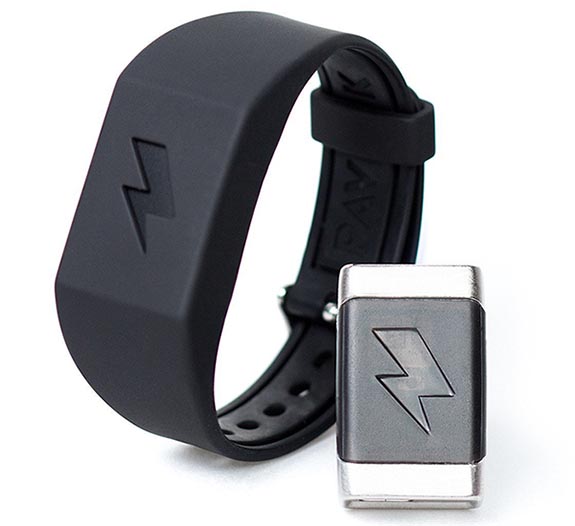
Shocking 'Pavlok' Bracelet Is Designed to Break You of Your Bad Habits

Five years ago, chronic procrastinator Maneesh Sethi hired a woman via Craigslist to slap him in the face any time he strayed off task. The $8-per-hour investment in "Kara The Slapper" quickly paid big dividends, as Sethi quadrupled his productivity AND spawned the concept of Pavlok, a bracelet that can deliver a behavior-altering jolt with the tap of a button.

The idea is based on the 80-year practice of aversion therapy. Each time the user exhibits the undesirable behavior, he or she touches the Pavlok button to self-administer a punishing shock. Over time, the user's brain subconsciously associates the bad behavior with the negative result and the bad behavior is eradicated. The Pavlok website says that the device can be used to break a number of bad habits, including smoking, mindless eating, nail biting and watching too much TV.

A New York Times reviewer noted that the zap could be adjusted from 50 volts (a strong vibration) to 450 volts (like getting stung by a bee with a stinger the size of an ice pick). A police Taser, the writer pointed out, typically delivers about 50,000 volts. The selected intensity of the Pavlok shock can be adjusted with a smartphone app.

Another critic wrote that the Pavlok device was simply a high-tech version of the rubber band, which is sometimes used by patients who are trying to combat anxiety and other disorders. Those patients are instructed to simply put the band around their wrists and deliver a stinging snap to break thoughts related to anxiety, panic and fear.

In 2014, Pavlok got off the ground by generating $284,027 via the crowdfunding site Indiegogo. Today, Pavlok's website boasts more then 40,000 units sold and a slew of video testimonials, including the one from Heather, who credited Pavlok with helping her break a 25-year nail-biting habit, and Carlos, who quit smoking in just five days.

The Pavlok device pairs a silicone, battery-powered shock-inducing bracelet with a Bluetooth-connected mobile app designed for iOS and Android smartphones.

In addition to the self-induced shocks, the device can be set to deliver a stimulus, for instance, if one has been sleeping or resting too long. The device also employs a hand-detection function that can sense if the user might be biting her nails, pulling her hair, or smoking a cigarette. The battery can deliver 150 tiny jolts on a single charge.

What's more, the app includes a five-day guided audio course on how to reverse bad habits.

Pavlok is available in five colors and sells for $179.

Credit: Image via Buy.Pavlok.com

Monday, August 14, 2017

Injured Officer Recruits University of Kentucky Police to Assist With Traffic-Stop Marriage Proposal

A retired law-enforcement officer who was dragged nearly 20 feet and run over while attempting an arrest 13 months ago is now the happiest guy in Lexington, Ky., after his girlfriend said "Yes" to an unusual traffic-stop marriage proposal.

Shepherdsville Police Officer Rocco Besednjak, who was forced to retired due to the seriousness of his injuries, recruited the University of Kentucky Police to assist with his romantic, but mischievous, scheme to surprise Lauren Vincent, who is a nurse manager for the pediatric forensics unit at UK Children’s Hospital.

Because Vincent, 36, works for the University of Kentucky, Besednjak wanted the proposal to tie into the school.

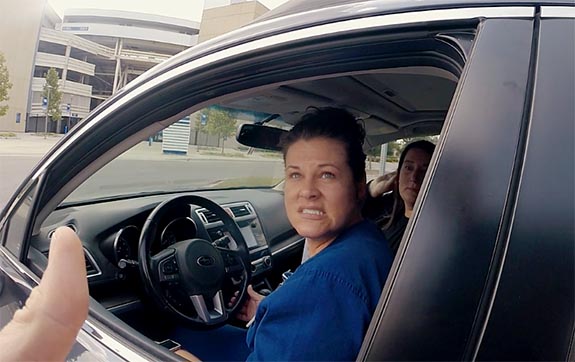
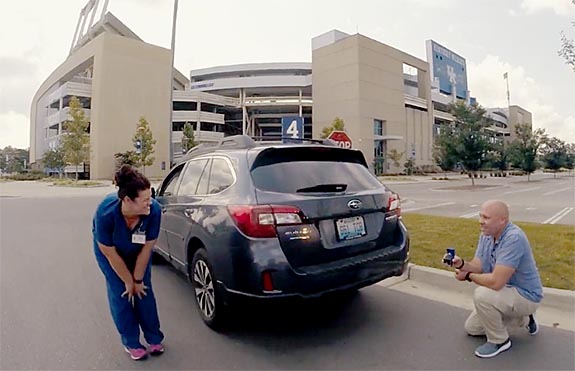
On Thursday, August 10, Vincent and her supervisor, Dr. Christina Howard, who was in on Besednjak's scheme, took a drive to pick up a donation for the hospital. During the trip, which passed in front of UK's Kroger Field, Vincent was pulled over by a University of Kentucky officer.

The officer told Vincent that she had something dragging from the back of the car and that she needed to get out and take a look.

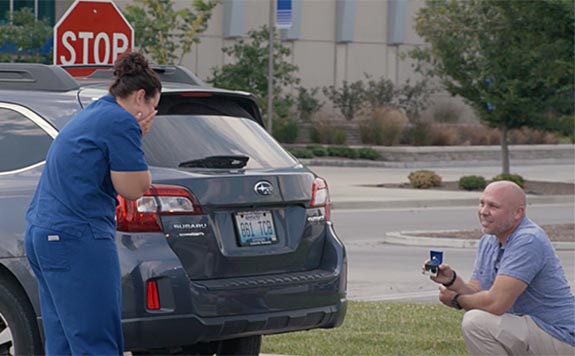
When she circled to the back of the car, Besednjak, 38, who had been hiding in the passenger seat of the officer's car, was already down on one knee with a ring box in his hand.

Vincent was startled for two reasons. Certainly, the marriage proposal during a traffic stop was surprising enough, but the nurse also couldn't believe her boyfriend was kneeling on his damaged leg only one week removed from spinal decompression surgery.

On July 3, 2016, Besednjak nearly lost his life while attempting to arrest a suspect at a gas station. The woman had an outstanding warrant, but instead of surrendering, she rammed Besednjak with her car and dragged him nearly 20 feet. His leg was run over during the tragic incident. The perpetrator received a 40-year sentence in May.

Now in the shadow of Kroger Field, Besednjak was ready with a diamond ring and a proposal for the love of his life.

"You know you make every day happy. You make my life the happiest it could have ever been," he said. "I hope you're not too embarrassed, but I love you a lot and I want you to marry me."

Before she answered, the healthcare professional had to admonish him.

"I love you," she said, "but why are you on your knees?

"So, are you going to marry me?" he interrupted.

"Yes," she screamed, adding, “Why are you on your knee? You’re not supposed to be on your knee. I love you."

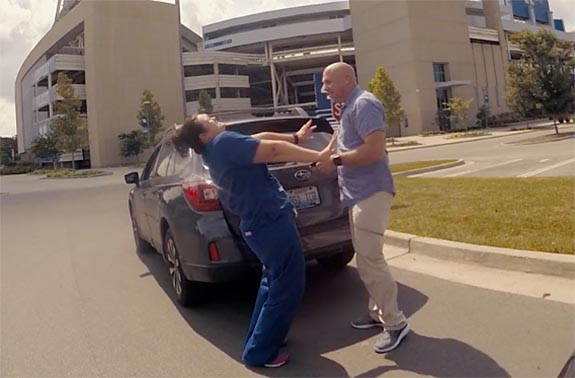
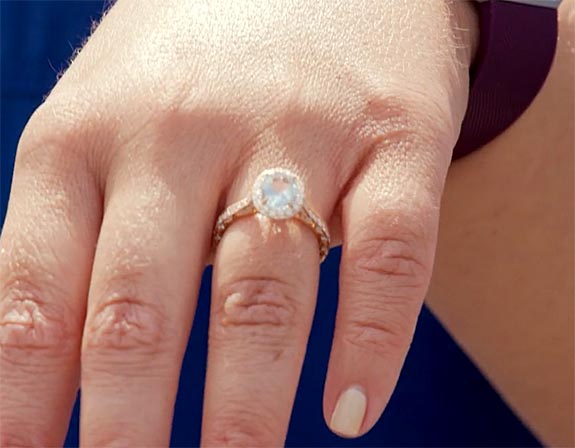
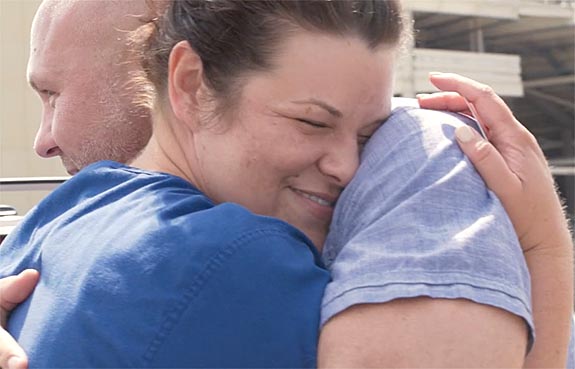
The couple embraced and then Besednjak handed Vincent the halo-style, yellow-gold ring to place on her own finger.

Vincent giggled with excitement, bending backward while viewing her new ring with her arms extended to the front.

Unable to stay in the romantic moment, Vincent returned to the theme of Besednjak needing to take better care of himself.

"I was worried about why you were on your knee when you had surgery last week," she admonished.

"That's what I'm supposed to do," he said.

The proposal was captured from three camera angles — one shot by a videographer, one from the officer's body cam and one from a camera mounted in the ring box. See the video below.

Rocco Besednjak Proposal from Antonio Pantoja on Vimeo.

Credits: Screen captures via Vimeo.com.