Tuesday, November 29, 2016

GIA Museum Acquires 63 'Mineral Marvels' From the Hauser Collection

For more than 60 years, Californian Joel Hauser passionately pursued nature's "mineral marvels" — ornamental specimens of exceptional size and beauty.

The Gemological Institute of America Museum in Carlsbad, Calif., recently acquired a cache of Hauser's finest agates, geodes, minerals and petrified wood through a generous donation by the Hauser family.

giaminerals2

Many of the 63 standouts from the Joel and Barbara Hauser Mineral Collection represent pieces from places with restricted access or that are no longer producing, according to the GIA.

giaminerals3

GIA noted that on one of Hauser's California expeditions, he discovered agate geodes in Riverside County’s Little Chuckwalla Mountains. Today, the area is known as the Hauser Geode Beds.

Hauser, who passed away in 1993, was a skilled lapidary and innovator. Not only did he master the art of contour polishing, but he also designed and modified saws and grinding equipment that could handle the cutting and polishing of almost any specimen, including large pieces of petrified wood.

giaminerals1

“His freeform, undulating polishing style adds interest and texture while removing blemishes, without having to grind away more material than necessary," said Terri Ottaway, GIA’s museum curator. "Joel’s expertise, guided by an artistic eye and perspective, revealed the lovely patterns, markings and colors in the minerals."

giaminerals4

Nearly 50 of Hauser's most celebrated pieces are now on display at the GIA Museum. They will serve as as prime learning tools for students and visitors to GIA about mineral formation and lapidary artistry.

Credits: Azurite (Bisbee, AZ); Variscite (Utah); Laguna Iris Agate (Mexico); Petrified pinecone and wood (Argentina and Utah). All photos by Orasa Weldon; ©GIA.

Monday, November 28, 2016

Alchemy in the Modern Age: Russian Scientists Extract Gold From Coal

Scientists in the far eastern Amur River region of Russia are building a facility that can extract gold from ordinary coal. The announcement brings to mind the alchemists of ancient times, who sought to turn lead into gold.

coalintogold1

While the alchemists never found a way to transform base metals into precious metals, Russian scientists are reporting that after 15 years of research they finally have a commercially viable method for pulling trace amounts of gold from coal.

coalintogold2

Scientists capture minute particles of gold during the burning process. To secure the precious metal, smoke generated during combustion passes through a 100-fold purifying filter. The contaminants are washed out with water and the gold is captured by the filter.

For every ton of coal burned, one-half gram of gold can be recovered. At today's gold price, the gold extracted from one ton of coal would be worth about $19. As the process is perfected, the researchers believe they can get 1 gram of gold from a ton of coal.

coalintogold3

The proof-of-concept experiments will continue this coming year as the Russian Academy of Sciences’ Far East branch will be adding the purifying system to one of the Amur region’s boiler houses. If the tests are successful, the team hopes to receive a grant to develop and implement an industrial-grade device, according to RT.com.

"We plan to use municipal boiler houses to implement our filtering system because they burn about eight to 10 thousand tons in a season, and that’s potentially 10 kilos of gold,” Oleg Ageev, CEO of Complex Innovative Technologies of the Amur Scientific Center, said in a press statement.

The Amur installation, which is near the Chinese border, will get into full gear once the temperatures warm up in the remote far eastern region of Russia. Because the filtering system uses water and part of the process takes place outdoors, it only works when the temperature is above freezing.

Coal is one of the most important sources of energy in Russia. The country produced 323 million tons of coal in 2009 and is estimated to have the second-largest coal reserves in the world at 173 billion tons. The U.S. has the largest coal reserves at 263 billion tons.

Credits: Coal mining photo by Peabody Energy, Inc. (Provided by Peabody Energy) [CC BY-SA 4.0], via Wikimedia Commons. Gold bars by istara [CC0], via Wikimedia Commons. Map by GoogleMaps.com.

Wednesday, November 23, 2016

Grade-School Suitor Proposes to Sweetheart With a Very Real Diamond Ring He Stole From His Mom

A grade-school suitor named Tommy and his sweetheart, Millie, became social media stars this week when the video recounting their playground proposal — and remarkable engagement ring — went viral.

millie1

While the idea of a little boy proposing to his crush is adorable, Tommy's choice of ring is what made him an Internet star. You see, instead of surprising Millie with a candy Ring Pop or Haribo Jelly Ring, young Tommy proposed with a very real engagement ring he stole from his mom.

Millie's dad recounts the story in a 54-second Facebook video that has been viewed 24 million times, and counting.

The video opens with the dad announcing that Millie has been proposed to at school.

"Who proposed to you, Millie?" he coyly asks, as a woman (presumably Millie's mom) laughs uncontrollably in the background.

millie2a

At this point we see Millie for the the first time. The teeny blonde, who looks like she might be in first grade, reveals in a cute British accent that her suitor is classmate Tommy.

"So, Tommy's proposed to Millie and she keeps telling us she's got a ring in her bag," the dad continues.

Millie's dad explains that he and his wife were expecting to see a candy ring. In the UK, kids like to exchange Haribo rings, which are ring-shaped gummy candies.

The dad then asks Millie to get the ring that Tommy used for his proposal. A few seconds later, Millie hands it to her dad and we see that it's not a candy ring at all.

millie3

It's, in fact, a very impressive three-stone engagement ring set in platinum or white gold.

The dad shows the ring to the camera and reports that Tommy has stolen his mother's engagement ring. The woman out of view can't stop laughing.

millie4

"Three enormous diamonds... and [he] proposed to Millie," says the dad.

The video concludes with the dad inviting Tommy to introduce himself to the Facebook viewers.

"Go on then, Tommy," says Millie's dad.

millie5

"Bye, bye," says Tommy as he peeks into the frame with a quick wave and a wry smile.

The video that was posted to TheLADbible Facebook page on Wednesday has already been viewed more than 24 million times. It has been shared 247,000 times on Facebook and the story has been picked up by high-profile websites, such as The Daily Mail and Mashable.

Please check out the video at this link.

Tuesday, November 22, 2016

Imperfect Diamonds Could Hold the Key to the Future of Long-Term, High-Density Data Storage

Imperfect diamonds could hold the key to the future of long-term, high-density data storage, according to a team of physicists from The City College of New York. Researchers claim that a diamond half as long as a grain of rice and thinner than a sheet of paper can hold 100 times more information than a DVD. In the future, a single diamond might have the storage capacity of one million DVDs.

diamonddata1

The team's findings were published recently in the journal Science Advances.

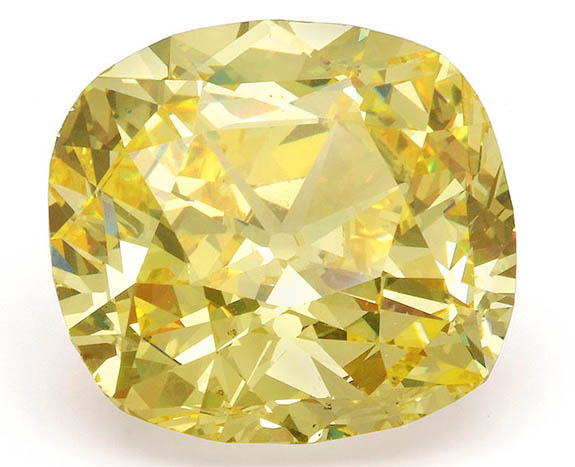
Highly coveted fancy yellow diamonds owe their color to the faint presence of nitrogen atoms in the diamond’s carbon structure. Interestingly, the same chemical imperfections that cause the diamond to be yellow, provide atomic-sized voids for the storage of data. Scientists call these imperfections "nitrogen vacancy centers."

"We are the first group to demonstrate the possibility of using diamond as a platform for the superdense memory storage," lead author Siddharth Dhomkar, a physicist at The City College of New York, told Live Science.

What's more, diamonds hold an advantage over traditional storage media because they are three dimensional and not susceptible to wear and tear. Data stored in a diamond could truly last forever.

“A DVD is like a 2-D puzzle, and this diamond technique is like a 3-D model,” research participant and graduate student Jacob Henshaw told The New York Times. "Unlike the DVD, which has only one surface, a diamond can store data in multiple layers, like a whole stack of DVDs."

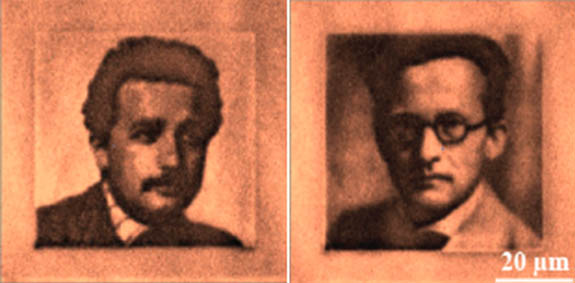
Researchers were able to use lasers to encode data into a diamond's imperfections. They added electrons by shining a green laser and deleted electrons by shining a red laser. The computer reads the presence or absence of electrons much like a traditional computer reads 0s and 1s.

diamonddata2

To illustrate the concept, researchers encoded images of Nobel Prize-winning physicists Albert Einstein and Erwin Schrödinger on a diamond by adding and removing electrons with green and red lasers.

If this breakthrough technology takes off, diamonds coveted for data storage will be very different from the ones seen in jewelers' showcases. For data purposes, the more flaws, the better.

“The bigger the diamond, the more defects, the more places to put information,” Henshaw told The Times.

Credits: Yellow diamond by MJT Symbolic (Own work) CC BY-SA 4.0, via Wikimedia Commons. Laser-encoded diamond by Carlos A. Meriles and Siddharth Dhomkar.

Monday, November 21, 2016

L.I. Woman and Recycling Station Crew Comb Through 6 Tons of Garbage to Rescue Bridal Jewelry

Last Monday, Long Island resident Colleen Dyckman woke up with a sickening feeling in her stomach that caused her heart to race. She couldn't find her diamond engagement and wedding rings and realized that she had accidentally tossed them into the kitchen trash bin while tidying up after the family's dinner the night before.

ringrescue2

The Dyckman's trash had just been picked up that morning and was en route to the Babylon Town dump where it would be incinerated.

Colleen and her husband, Ken, chased down the sanitation truck and told the driver that he likely had the valuable bridal jewelry in his load. The driver called his crew leader, Edward Wiggins, who ordered that he take the truck immediately to a special area at the Town of Babylon's Recycling Center.

ringrescue3

At the Recycling Center, six tons of smelly trash was dumped into an open area, where the Dyckmans proceeded to comb through a field of trash bags and rotting garbage in an attempt to rescue the rings.

ringrescue4

Also assisting in the search were eight Recycling Center employees, including Jeremy Aretakis.

“She was visibly upset," Aretakis told CBS News. "She was ripping through garbage, disgusting stuff."

For the next four hours, the Dyckmans and the Babylon crew worked relentlessly.

“She didn’t stop, so none of us stopped,” Aretakis said.

When Ken Dyckman finally discovered the trash bag his wife threw away the night before, all the searchers were terribly disappointed when no rings emerged.

ringrescue5

But town employee Kim Weathers had a hunch and insisted on double-checking the bag.

Sandwiched between slimy meat scraps and soggy cereal were Coleen Dyckman's rings, which were given to her by Ken nearly 20 years ago. They were worth about $5,000, but carried a priceless sentimental value.

“I was saying to myself, ‘I hope I find these rings,’ so I’m happy I found them, I really am,” Weathers told CBS News.

ringrescue1

Colleen Dyckman was ecstatic. She wept tears of joy and hugged Weathers.

“It was beautiful. It was like out of a movie,” added Aretakis. “One of the coolest things I’ve ever seen in my life.”

Wiggins noted that although his team often gets requests from residents who want to search the trash because they believe they've thrown away something valuable, very rarely will something as small as a ring be recovered.

"We're really glad we were able to help her and get her rings back," Wiggins told ABC News. "To be honest, in the 41 years I've been here, we've only been able to successfully recover lost items three times."

To show their appreciation, the Dyckmans returned the next day at lunchtime with pizza and homemade brownies for the crew.

"I couldn't be more thankful to them," Dyckman said. "They never ever stopped looking."

Credits: Screen captures via YouTube.com/Inside Edition.